


The Frontline Is Better For Ukraine Than You Think. But the Homefront Could Be Falling Apart
Category: Politics
Share
Archive
Like
KYIV –Putin just suffered yet another humiliation in Ukraine.Russia's President made one of the most extraordinary statements of the entire war last week, revealing how far the Kremlin's understanding of the situation has diverged from reality.
He claimed the Russian army had captured the small city of Sviatohirsk, in the Donetsk region, which is not just well under Ukrainian control, but possibly the city furthest from falling in the entire region. In the following days, Ukraine completed a successful counteroffensive in this direction that had reclaimed more than 200 km sq of territory.As AMK Mapping, an OSINT account that if anything leans pessimistic towards Ukraine, put it:
'Putin made a claim that might be the most ridiculous thing to come out of the Russian government so far during this war… Sviatohirsk is nearly 10km from the nearest Russian controlled territory… there is currently no threat to the city from Russian soldiers, infiltrators or even DRGs. In fact, this is an area where Ukraine is actively counterattacking and advancing.'
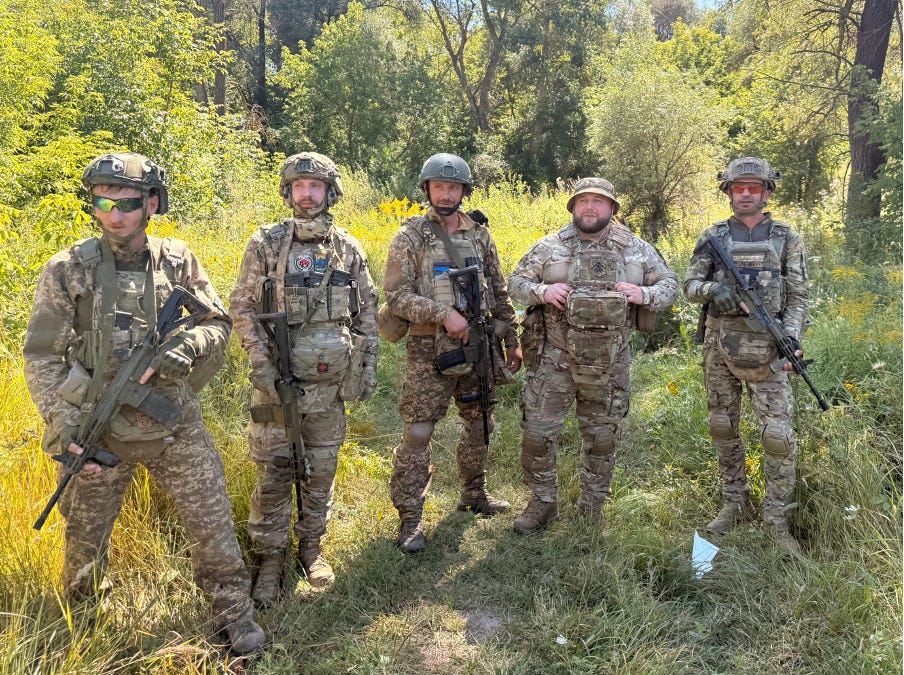
To rub salt in Putin's wound, Andriy Biletskyi, commander of the AFU's Third Army Corps, responsible for Ukraine's defences in the region and a top Russian target, visited the city in open daylight to show just how clear Ukraine's control of the area was.That the Russian military command would feed their President information this misleading and this easily disproved for anyone with internet access, allowing him to publicly embarrass himself and his troops, is a damning indictment of an armed forces unable to deliver accurate information to the top. It was the second time this had happened in recent memory, after President Zelensky himself visited Kupiansk in Kharkiv Oblast late last year shortly after Putin had claimed the city captured by Russian forces.
In fact, the situation on the frontline in 2026 has been better for Ukraine than in any year since 2022. Yet for civil society and the home front the war is more difficult than it has ever been. Since the failure of Ukraine's 2023 summer counteroffensive, we watched Kyiv lose ground in the Donbas to a relentless Russian advance, while behind the lines a united, largely civilian home front held firm. Today it looks as if that balance is flipping.
The Ukrainian army has the initiative on important parts of the front and has held the Russians to a fraction of last year's gains. But for civilians in Kyiv and other cities, the war has never been more dangerous, and there is no near-term prospect of it easing. Most crucially of all, Ukraine's tight political and civilian wartime unity is showing signs of cracking under the pressure of nearly five years of full-scale war.
Thanks for reading Dust and Echoes! Subscribe for free to receive new posts and support my work.
Not only are the Russians nowhere near capturing Sviatohirsk, this is a direction where Ukraine holds the battlefield momentum. Kyiv's forces have run a tightly controlled counteroffensive here that has cut off a sizeable grouping of Russian forces north of the city of Lyman. The operation was conducted with exemplary patience and operational security. The Ukrainians allowed almost no footage of their advances, even for propaganda purposes, which stopped the Russians from reinforcing until it was far too late. The Russian high command is acting on false information from local commanders under pressure to report only successes regardless of the true facts on the ground.
Ukraine has also announced the results of a second counteroffensive further south, in the Oleksandrivka direction, which regained large amounts of territory across the Zaporizhzhia, Dnipropetrovsk and Donetsk oblasts. Ukraine gained significantly more ground here than it did in the failed summer counteroffensive of 2023.
This isn't an exact comparison. In 2023, Ukraine was attacking the well-defended fortifications of the Surovikin Line in Zaporizhzhia. In this latest offensive it was largely taking back territory where the Russians had not consolidated their defences. But unlike 2023, this operation used tactical surprise and strict operational security, and it exploited the February cutoff of Starlink to Russian forces in occupied Ukraine to make hundreds of square kilometres of gains, somewhere between 300 and 745 depending on your source. Ukraine has also made small gains north, near Kupiansk.This is also proof, if any more was needed, that the Ukrainian Army is far from 'collapse'. It retains the ability to conduct difficult, hazardous and efficient counteroffensive operations across the frontline.
The Wall Street Journal reported that one purpose of CIA Director John Ratcliffe's recent visit to Moscow was to deliver a blunt assessment of the failings of Russia's war effort. But Putin would not meet him. Instead, Putin later delivered Trump's more clownish envoys, Jared Kushner and Steve Witkoff, the same wildly inaccurate battlefield assessments he has been pushing publicly. But because Putin's view of the battlefield is so wildly optimistic for the Russian side, he still has no incentive to negotiate seriously for peace in Ukraine.
The Russians have still made progress on the battlefield this year. They have ground their way through much of Kostiantynivka, the first city in Ukraine's 'fortress belt', and made gains in north-east Kharkiv region and near Zaporizhzhia city.
Casualties remain heavily in Ukraine's favour, despite Russia's materiel advantages. CSIS estimates the Russia-to-Ukraine casualty ratio rose to nearly 8:1 in the first half of 2026, with Russian losses finally outstripping recruitment.
So forget the noise about Russia engineering a huge breakthrough in the Donbas and sweeping to the Dnipro, or reinvading from the north to take Kyiv. Neither is the real danger to Ukraine right now.
The gravest danger to Ukraine's cities and home front is well discussed: the systematic lack of air defence, and particularly the months-long shortage of Patriot interceptors.
But the key difference between this and Ukraine's previous shortages is that, at root, this isn't a case of the United States and other allies being unwilling to give Ukraine the tools it needs. It is that the West fundamentally doesn't have them. Russia is producing ballistic missiles faster than Patriot interceptors are being produced in the entire world. And its missiles are aimed squarely at Ukraine, while the US must share interceptors with its Gulf allies because of the war with Iran, and European states have to keep their own air defences topped up. Previous shortages could be blamed on a deficiency of political will. This one is a product of the brutal mathematics of industrial production.
The UN called July 2026 the deadliest month for Ukrainian civilians of the entire war, with 437 killed. The problem isn't limited to ballistic missiles. Russia's upgraded Geran drones, now fitted with jet engines that let them outpace Ukraine's homemade interceptors, are causing havoc across the country. It was one such drone that hit an ammunition depot in the village of Myla, in the Kyiv region, killing 37.
Perhaps Ukraine will eventually find a homegrown answer to Russian ballistic missiles, as it has to so many other problems in this war. But in the short term, Kyiv, Odesa and other cities are almost completely undefended.
The Russians have exploited this mercilessly, with a large-scale campaign against Ukraine's civilian logistics and against shipping in Odesa oblast. They have battered the food, warehouse and port infrastructure through which roughly 90 per cent of Ukraine's seaborne exports flow. Agricultural shipments this season are now projected to fall by more than half, depriving the country of one of its few remaining hard-currency export industries. Another bombing campaign against Ukraine's power grid is expected ahead of winter, plunging cities into freezing cold again.
The forced mobilisation of young men is also far more visible across Kyiv. Whatever its wartime necessity, it is a deeply uncomfortable sight in the capital. TCC teams have set up checkpoints outside nightclubs and train stations, and pulled men out of taxis. In one absurd video circulating on Ukrainian social media, a man lay down behind a TCC vehicle to stop it driving off with his friend. The officers, unable to see him, drove straight over him. I know more and more friends and acquaintances who have been forcibly mobilised into the armed forces, including those previously exempt due to their jobs, connections or health statuses.
The summer of 2026 has also been a chaotic one for Ukraine's internal political and military institutions. On 2 September, officers of the SBU and military intelligence (HUR) opened fire on each other in Kyiv, wounding three HUR officers, over the SBU's detention of a Russian fighting for Ukraine under HUR command. Zelensky called it 'absolutely disgraceful' and dismissed both agencies' deputy heads.
This kind of shootout is more reminiscent of Latin American gang warfare, or Syrian jihadi factional fighting, than of the well-governed democratic state Ukraine desperately wants to present to the world.
This chaos isn't isolated to those agencies. It came after a summer of political turmoil. Zelensky dismissed defence minister Mykhailo Fedorov in July, triggering weeks of protests in Kyiv. He then fired commander-in-chief Oleksandr Syrskyi, bowing to that public pressure. Weeks later, after Fedorov's replacement had already been named, Fedorov became the first major Ukrainian public figure to call for elections since the full-scale invasion.
The call was not well received. It was widely read as the former defence chief trying to capitalise on Zelensky's weakness for his own political benefit. Framing the wartime suspension of elections under martial law as a 'lack of democracy' is a Kremlin talking point. and Ukrainians resent being told they must hold elections by a regime that hasn't had a free or fair one in 26 years.
But Ukraine can't dismiss criticism of the leadership's legitimacy forever.
One reason there has been no serious push for Zelensky to step down is precisely that his government has stayed responsive to public pressure. It reversed plans to gut the independence of the major anti-corruption agencies in 2025 after mass street protests, and Zelensky made his recent large-scale changes to the Armed Forces in response to this summer's demonstrations. The street, rather than the ballot box, has become the forum in which Ukrainians push for the redress of grievances, and given the conditions it has worked remarkably well. But if the war is still grinding on in another four years, and the government ignores public pressure on major decisions, I suspect the mood on elections, both in Kyiv and among its Western partners, could shift fast.
I'm often asked in interviews what the 'mood' in Kyiv is like, and I have to say it is now worse than it has ever been. Only anecdotally, I know more and more people in Kyiv who say they are reaching the limits of their endurance. People who say they will leave, either for somewhere safer in the west or abroad altogether.
Put simply, I haven't seen this level of chaos, fear and exhaustion in Ukraine in any other year of the war.
So this is where Ukraine stands as it heads into the autumn and winter of 2026. Its battlefield position relative to Russia has improved from 2024 and 2025, when it seemed several times that the Russians might achieve a major breakthrough.
But while the armed forces hold relatively firm, the home front has never been under more strain. And eventually, conditions here will reach the front, as troops are starved of ammunition and supplies by a society less able to sustain them.
To be clear, we are still a long way from a Ukrainian or Russian collapse. Ukraine's civil society has already survived extraordinary hardship, and most people will keep shouldering their share of the burden.
There is also no clear roadmap to a diplomatic settlement. Both sides appear set for the climactic battle for Kramatorsk and Sloviansk, which will probably begin early next year. And there is the looming threat of a large-scale Russian mobilisation that could add 500,000 to 600,000 soldiers to the RUAF's exhausted, bedraggled ranks. That would break Putin's long-standing social contract with his population, but it could also strain Ukraine's war effort to breaking point.
Yet I'm coming to believe that the real danger to Ukraine is less a frontline collapse than an indefinite prolongation of the war. If conditions keep worsening, more civilians will slowly leave, while those already abroad settle in and integrate their families permanently. The country may simply deteriorate into something unliveable, with Kyiv and other major cities hollowing out and depopulating the way frontline cities like Mariupol and Bakhmut did before them. This, in its own way, would be the worst kind of Russian victory.
Thanks for reading Dust and Echoes! Subscribe for free to receive new posts and support my work.
A note on cookies
Newshunt uses essential cookies to keep you signed in and to remember your language and country, so the site works the way you expect. With your permission, we'd also like to use analytics cookies to understand how people use Newshunt and improve it over time.
Accepting only affects analytics. To learn more, view our Privacy Policy or Terms & Conditions.
(0)Comments