


Mark Gross: Jazz for Teens – Mark Gross Chats with Cats
Category: Entertainment
Share
Archive
Like
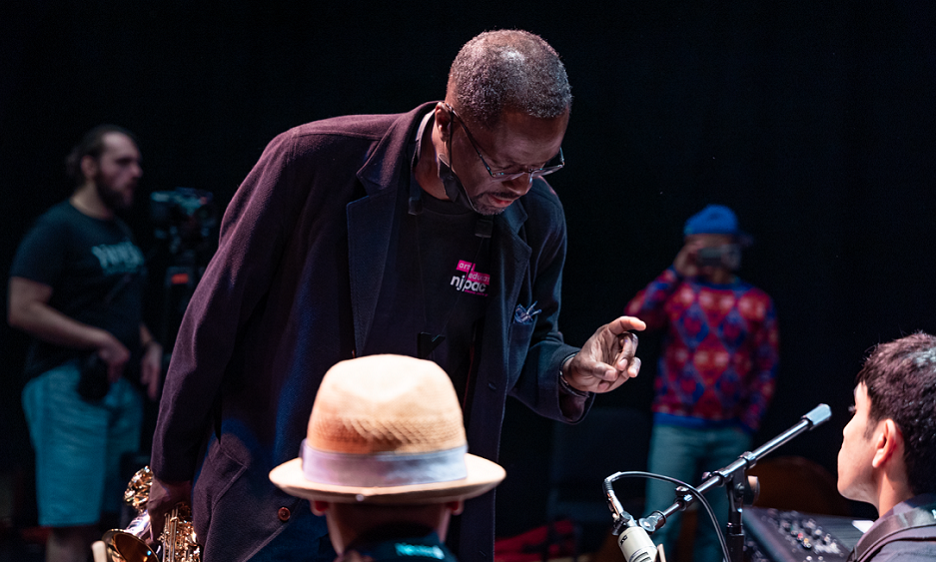
For many young musicians, learning jazz is about much more than learning how to play an instrument. It's about developing confidence, learning to listen, finding your own voice, and discovering how to work with others. Few people understand that better than Mark Gross. As Director of Jazz Instruction at NJPAC, Gross has spent years helping shape the next generation of jazz musicians through programs like TD Jazz for Teens, while also drawing on his own experience as a performer and educator. Jazz for Teens gives young musicians the opportunity to learn from working professionals, perform together, explore the history and traditions of jazz, and begin thinking about what a life in music might look like.
For this edition of Chats with Cats , I spoke with Mark about his role at NJPAC, his approach to jazz education, what he hopes young musicians take away from the program, and what he has learned from teaching the next generation. Mark Gross is an accomplished jazz saxophonist, educator, and bandleader who has spent more than 30 years performing and touring internationally. He has worked with some of the biggest names in jazz, including Dizzy Gillespie , Dave Holland , Mulgrew Miller , Nancy Wilson , James Moody , Jimmy Heath , Nicholas Payton , and the Mingus Big Band. He has appeared on more than 100 recordings, including two Grammy Award-winning albums with the Dave Holland Big Band.
Gross has also brought his music to film, television, and Broadway, appearing in films including Malcolm X and Bolden , as well as HBO's Boardwalk Empire and Broadway productions including After Midnight , Shuffle Along , and Ain't Too Proud . A graduate of Berklee College of Music, Gross has built an equally extensive career as an educator. He currently serves as Director of Jazz Instruction at the New Jersey Performing Arts Center, where he leads programs including Jazz for Teens, while also teaching at Rutgers University and the Prins Claus Conservatoire in the Netherlands.
All About Jazz: You are the Director of Jazz Instruction at NJPAC. What does that entail, and what are you hoping to accomplish through that?
Mark Gross: Absolutely. So the program itself, TD Jazz for Teens, is a program that's been in existence almost since the inception of NJPAC; we're talking like 27 years plus at this point. What it entails is a program for teenagers from the ages of 13 to 18, primarily those in high school. Sometimes we get an advanced junior high schooler in the program, but they get a really comprehensive, deep dive of instruction in the pedagogy of jazz.
There are various levels of theory, with the more advanced theory classes becoming more like theory, composition, and arranging classes. There are small combos that they're all situated in. We have two larger ensembles which bear the name and are dedicated to James Moody: the James Moody Jazz Orchestra. And of course, the Impresario Jazz Festival, Grandmaster, Mr. George Wein , which is the George Wein Scholars. I'll talk more about those in a minute, but they also get masterclasses, where I have not only the faculty conduct them, but on occasion, I'll bring in a guest artist, someone like Stefon Harris or Christian McBride —someone that's not necessarily in the program to come in and talk with the young artists. There's a listening and history class where we do a deep dive into past, present, and future recordings and those artists. We have technique classes where each student of their primary instrument studies with that instructor so they can really get the fundamentals down. And then they have a bunch of performance opportunities throughout the year inside of NJPAC as well as the surrounding greater Newark area.
More specific to the George Wein scholars... So, the George Wein Scholars are for our elite students, where they're held to a higher standard in that they then become the mentors inside of the program. Those are the students who also perform for donors or at a local club in New York or New Jersey. They do a recording each year in a professional recording studio, and then they get to go to the Newport Jazz Festival each year. And during Mr. Wein's lifetime, they were fortunate to have lunch with him at his Manhattan residence, which was great because he would talk to them about what they were doing and what things they were interested in. They would get to perform for him, and he would either make recommendations or just advise them on the culture of jazz and what that means on a bigger scale. So that's kind of what it is. It's a two-semester program. It's a Saturday-based program. So it's all day on each Saturday. In the Fall, it's about ten Saturdays of the year. And then in the spring, it's about fourteen Saturdays, with the final Saturday being their big, final performance. It's a big, big, big day for them. One addition that we've added to the program is an arm called Business of Jazz, where we bring in professionals to talk about the business side of music. So we'll bring in folks from ASCAP or BMI to talk about publishing and copyright. We'll bring in managerial people to come in and talk about what that entails—what a manager looks for in an artist and vice versa, what an artist should look for in a manager. We've had people come in and talk about website design and the use of social media and how it can be impactful in their careers. So it's a really big and comprehensive program.
AAJ: Sounds like an amazing opportunity. How do you recruit students? Do they audition? Do you go and find them?
MG: Yeah, it's a bit of all of that. I try to attend the IAJE and JEN conferences, so we get the word out on those kinds of platforms. I also know a lot of the band directors and educators in the board of education system, particularly around the Newark area. So I try to get in the schools and talk to the students. The teachers allow me some time to come in, work with the students, and talk to them about the program. Some of the students who are currently, or who have been in the program, tell their buddies about it. And then, NJPAC itself tries to get the word out through social media as well. So we try to hit it on all fronts. I mean, it's almost like an old-school method of street flyers, word of mouth, and then using social media to get the word out. But we're always looking to recruit because, once a student graduates out of the program, we try to maintain a certain number of young artists in the program. So it's a constant recruitment effort.
AAJ: Yeah, I would imagine. I'm sure that you have students at various levels of experience and proficiency. How do you create an environment where they can all function together in one ensemble?
MG: Yeah, you know, that's always the challenge because part of our model in all of our programs, especially in the TD Jazz for Teens programs, is that we don't want to turn any student away for any reason, whether it be for level of proficiency, financial matters, or whatever the case may be. So we get the young artists in there; some are in programs at their schools, have had private lessons, and are involved in other programs similar to ours. Then there are some who are coming in for the first time and are new to jazz. And the beauty is that, because of the way that the program is structured, we intentionally devise the curriculum, as well as every aspect of it, to make every person that comes into the program feel comfortable with where they are. So we have beginner-level bands. We have beginner-level theory classes. The technique classes are divided so that the teaching artists have opportunities to work 45 minutes with a beginner-level artist and an intermediate, more advanced-level person. The program is intentionally designed so that wherever you are, you can come in at a comfort level and still be able to grow exponentially once you're in the program. Part of my intention, in terms of the curriculum, was to build it in such a way as to have a pipeline once they leave us. Most of them do go on to pursue jazz, or other music, or some aspect of music. So we partner with Rutgers Newark over there with Stefon Harris. We partner with William Paterson, and with Berklee College of Music, and the Manhattan School of Music, and all of these schools because these are where our students are going. And, sometimes, particularly with Berklee being my alma mater, we send students to their summer camp each year where they have opportunities to spend five weeks and grow. Then, if they want to audition for the college, they can do that on site there and have a leg up in that process, if you will. So yeah, anybody can come into the program, find their place, and grow. I should mention that the program is gonna start in October. Registration is currently open, and the program will start the first weekend of October.
AAJ: Do they get grades or do they get any kind of credit at their regular school?
MG: In terms of grading, it's all internal in that there are assessments done throughout the year-three, if you will. Obviously, there's no audition to get in the program, but there is an audition for placement. So we assess where they are at that point. Then at the end of the fall semester, there's a whole team that will reevaluate. We ask things like: what have they learned and benefited from? Where can we, as the NJPAC team, make adjustments if that needs to be the case. And then the final analysis, at the end of spring, what was the full impact of the year on them? So although there's no grade, we assess where they are just to make sure what we're doing is beneficial not only to them, but to where the program needs to be going. For me, I keep my ear to the beat, or to the street, or whatever you want, in terms of where the industry is going. What colleges are looking for in an incoming freshman, and making sure I'm preparing the Jazz for Teens students to be competitive in that way. So it's an assessment, not only for these young artists, but for me as well, making sure we're staying competitive to give them opportunities to be able to attend these schools.
AAJ: Do you find that most of these students want to pursue music professionally?
MG: Oh yeah. Our alumni roster is pretty, pretty amazing. I would say at least 75% of them go on to pursue music in colleges, universities, and conservatories, and at this point, a lot of them are my colleagues, if you will. They're professionals out here, with one of our most notable being Tyshawn Sorey , not only a great educator, but a great musician. He plays vibraphones, plays drums, he arranges, he writes... He's won the Pulitzer Prize, as well as the MacArthur Grant. And we've got others, not of that notable "awardy" type of thing, but in terms of their proficiency and what they're doing out here on the scene, are doing really remarkable things.
AAJ: Yeah. Tell me more about some of the success stories.
MG: Yeah, what I love about it is that they are willing to come back and work with our students in addition to their careers. One of our teachers, who was a student of mine back in the early 2000s when I was the saxophone teacher, is Alex Wintz , a great guitarist who performs regularly with Etienne Charles . He's got several recordings of his own. He's a great guitarist. We've got Jalin Shiver , a great alto player, who plays quite often with Savion Glover, Wynard Harper, and small groups of his own. Then we've got some who are doing Broadway shows and things like that; a great saxophonist, Brandon Wright . He's doing MJ, the Michael Jackson show. And so forth. So we've got quite a number of students like that. Some, as I mentioned with Tyshawn, have won those big, glossy awards. But I don't necessarily define success by the awarding of things. I think those are the cherry on top of the cake. But they're successful in that they're making a living doing the craft, and doing it well.
AAJ: Tell me what you've learned about teaching teenagers over the years.
MG: (laughs])Teaching teenagers is interesting because they're coming into the program, especially in a program like what we have, with all kinds of scenarios, whether it be socio-economic situations or proficiency level, as I mentioned before. Or even an interest in jazz. We call it Jazz for Teens, but some of them want to be engineers, or they want to write, or they want to do Broadway and things of that nature. What I offer to them is a lens or a perspective inside the bigger picture. And what I've learned is that, although I'm talking to them about my love and interest and things I deem important—knowing about Duke Ellington , Charlie Parker , and Miles Davis , and the grandmasters, as well as the contemporaries like Christian McBride , Stefon Harris, and Kamasi Washington —they may be more interested in the influence of jazz in some other genre of music. What I've learned, and what I try to impart to them, is having a thorough understanding of the music and of the culture, and how that fits into the mold of where they are and what truly resonates for them.
And I tell them, Charlie Parker and them played the way they did because they were influenced by what was going on in the '30s and '40s. That was their time. I will tell the teens, "This is your time. So you should be influenced by what Beyoncé is doing. You should be influenced by what Kamasi Washington is doing. You should be influenced by listening to the recordings of John Coltrane and Miles Davis. You should be influenced by listening to Sarah Vaughan , in addition to listening to Samara Joy . You should be finding commonalities and taking those things that you like, and figuring out how that can become a part of where you are to keep the needle moving forward."
AAJ: As you move into the future, is there something you're trying to change or add to the program, or do you think you have it dialed in pretty well at this point?
MG: Oh yeah, totally dialed in, but I never want to stay complacent because the industry is always changing, especially now with AI becoming such a big part of everyday life. In fact, I attended a conference back in April, and one of the panel discussions was about the influence of AI, and everyone's take on how it's going to influence where the music is going.
AAJ: Yeah, It's inescapable.
MG: It's inescapable. And so, to your question, I have to figure out ways that it can be utilized as a resource and not discount it. Because I may be old-school with the mindset of pen-to-paper writing, you know, you still got to know those things, but this AI thing is not going anywhere. In fact, it's just going to continue to grow. And how can young artists in their teenage years start to understand what that is and not let that become the sum of it all for them, because they probably, more than folks of my age, are using AI. And I don't want them to become reliant on that and not understand the core tenets of music and things that they need to know away from a resource like AI, but to use it as a resource for what they should know. I mean, you could just put in a couple of prompts, hit a button, and then boom, you got a 3-minute song that sounds pretty good.
AAJ: Do you want to tell me more about what else you're personally up to, besides Jazz for Teens?
MG: Yep, so, on the professional side, I've been a performer for 40-plus years at this point. The most recent project that I'm working on, and I will release toward the end of November, is a project called The Gospel, According to Mark . It has my core quintet: trumpet, alto, and rhythm section, amplified with a gospel choir and an eight-piece string ensemble; I have poets on it. I have a rapper on it. It's talking about the biblical story of Christ as told by Mark, but as an instrumental depiction, although there's spoken word on some tracks,
So some of the influences in this project are, I would listen to, like, if you can imagine the opening scene to, you know, Cecil B. DeMille's The Ten Commandments. I wanted all of that kind of fanfare-esque, brassy kind of stuff. But at the same time, it feels like it's a Cannonball Adderley Quintet thing—Cannon and Nat. It feels like maybe Kirk Franklin might have done something on one of these tracks. There's some rapping on it. Wow. I mean, how dare I say it, but you know, maybe Jay-Z did something on it.
So, it's a culmination of all of those things intertwined in one story. It's probably my... not probably, it is definitely my most ambitious project. So that's what I'm mostly gearing toward putting out.
AAJ: Are you currently in the process of working on it?
MG: It's all done. I'm in the process now of just mixing and mastering. So in the next month, I will be posting an official release date and putting together some concerts for it.
AAJ: As an aside, I saw that you recently played at Pizza Express in London.
MG: I did. That was the last recording I did. When I played there, the house engineer, who was great, said he had recorded the show. I thought, like, most venues, they record it; they send it to you. Okay, thank you; maybe I'll listen and use it for something. My bass called me and said, "Man, did you listen to that recording?" I said, no, he was like, "You need to listen to it." So I did, and it was so clean. I was like, wow. I asked the proprietors at the club if they would allow me to release it as a CD, and they agreed. So that's how that came about.
AAJ: Is there anything that I missed that you want to talk about?
MG: Well, in addition to that recording, Live at Pizza Express , the one I did before that, Plus Strings , were both done on a record label that I started about seven years ago called MGQ Records. So the most recent one will also be released on that label. Other than that, I'm just out here, you know, trying to keep jazz alive, man,
AAJ: We all are, man (laughs).
MG: Absolutely (laughs).
A note on cookies
Newshunt uses essential cookies to keep you signed in and to remember your language and country, so the site works the way you expect. With your permission, we'd also like to use analytics cookies to understand how people use Newshunt and improve it over time.
Accepting only affects analytics. To learn more, view our Privacy Policy or Terms & Conditions.
(0)Comments