


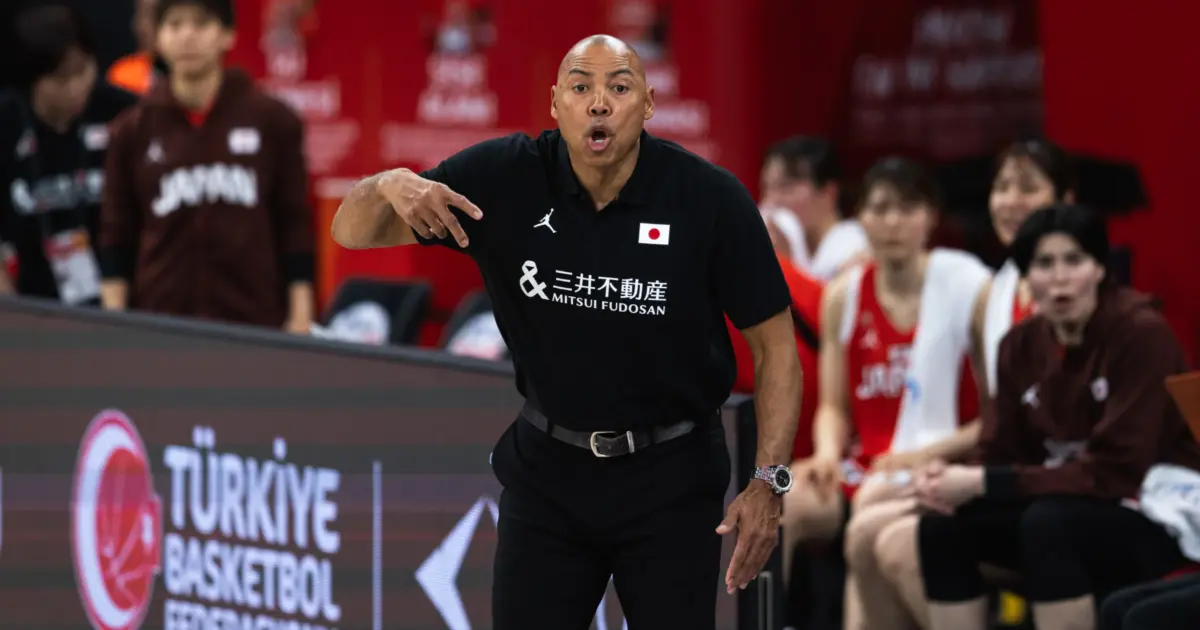
The Corey Gaines philosophy: not a single timeout in three games!
Category: Sports
Share
Archive
Like
During these days of the FIBA Women's Basketball World Cup in Berlin, one of the teams attracting the most attention from fans has been Japan. A small team in terms of size, Japan relies heavily on the three-point shot as an essential weapon. The numbers speak for themselves: the Japanese have attempted 92 three-pointers in the group stage, the second-highest total in the tournament, behind only France, who have taken 101. In fact, in their opening game, a 102-97 win over Mali, Japan knocked down 20 three-pointers: the highest single-game total in the history of the Women's World Cup.
Yet the outside shooting is not the only reason Japan have stood out. The Japanese, who advanced to the knockout stage in third place in Group A after beating Mali and subsequently losing to Germany (74-58) and Spain (59-79), have done something even more unusual. Despite how close the game against Mali was, and despite things clearly not going their way against the two European opponents, Japan have not called a single timeout so far in the tournament.
No adverse run, blown lead or opponent gaining the upper hand has altered the philosophy of Corey Gaines, Japan's head coach. In the face of adversity, the former NBA player's response is not to stop the game, but to let his players keep playing.
As Gaines himself has explained, the American starts from an idea that is as simple as it is unusual: calling a timeout can signal concern to the opponent while also giving them a chance to catch their breath. 'A timeout means two things,' Gaines explained after the game against Mali. 'The first is telling the other team that I'm worried, and the second is that I'm giving them a chance to rest, too.' His intention is precisely the opposite: to maintain the pressure, the pace and the uncertainty.
But there is more behind the decision than a tactical choice. Gaines sees practice as the real time to prepare the answers that will later be needed in games. His argument is straightforward: if he needs to explain something during a game that the team has not previously worked on, then the problem is his. He does not believe in emergency solutions or in a 'magic pill' that can suddenly appear during a stoppage in play.
The result is a radical commitment to player autonomy. The players must read the game, identify problems and find solutions on the court. The coaching staff remains involved, offering instructions from the bench, but without constantly taking control of every situation. Gaines wants his players to trust the game plan and, above all, their own ability to execute it. It is certainly a striking approach in the modern game.
Even in the most tense moments, Gaines has remained faithful to his principles. Against Mali, Japan fell 10 points behind and received a 15-0 run. Still, there was no timeout. Japan eventually came back to win, setting a three-point record in the process, and Gaines emerged from the game even more convinced in his approach. Against Germany and Spain, he again never used his right to stop the game, whether to give his players a breather or to make tactical or emotional adjustments.
'As long as they believe in this, I believe in it, too,' he says.
Ultimately, it is a philosophy built on trust: trust in practice, trust in the game plan and trust in the players. Gaines does not refuse to call timeouts out of dogma. He does so because he believes that stopping the game can undermine wh0at he is trying to build in practice: a team capable of thinking, reacting and competing without needing someone to tell them when to do so.
A note on cookies
Newshunt uses essential cookies to keep you signed in and to remember your language and country, so the site works the way you expect. With your permission, we'd also like to use analytics cookies to understand how people use Newshunt and improve it over time.
Accepting only affects analytics. To learn more, view our Privacy Policy or Terms & Conditions.
(0)Comments