


4 Great Superheroes That Still Need a Movie (And They're Not From Marvel or DC)
Category: Entertainment
Share
Archive
Like
While Marvel and DC superheroes tend to dominate public conceptions of the genre, they are far from its only inhabitants. Rival comic studios such as Image Comics and Dark Horse Comics have been producing superhero comics for decades, while TV and film studios like Hanna Barbera, Warner Bros, and Amazon MGM Studios have been bringing them— either via adaptation from other properties or as entirely original characters— to the small screen. Superheroes from outside Marvel and DC are not absent from the big screen either, with even figures who offer more unconventional takes on the genre, such as The Crow and Spawn, having gotten their own feature films.
Videos by ComicBook.com
However, not all superheroes have been so lucky as to make it to theaters, and this is especially true for those outside of the well-funded and well-known Marvel and DC brands. This list showcases some of these lesser-known heroes who, whether due to concept, plot, aesthetic appeal, interesting use of the genre, current relevance, or all of the above, are long overdue for a big-screen adaptation.
4) Rocket Girl
Dayoung Johansson, the titular hero of Image Comics' 2013 series Rocket Girl, is a Teen Cop from a neon-lit cyberpunk-dystopian future — one where things have gotten so bad that the police force is made up of entirely of teenagers— who is sent back in time to an equally, if less robotically, neon-dripping depiction of the year 1986 in an attempt to find proof that the all-controlling megacorporation Quintum Mechanics has messed with the timeline. Spoiler alert, they have, and her own arrival in the 1980s may just be helping them do it.
Dayoung is no superhero in her own technologically-advanced time, but in 1986 New York, her jetpack, helmet, and bodysuit earn her the moniker of Rocket Girl as she speeds around the city searching for evidence. To say any further would be major spoilers, but suffice to say the plot goes truly unexpected places, showcases a remarkably consistent and functional 'what you do in the past effects the future' world-building system, and even gets in some tearjerker moments by the end. A teenage cop in a rocket suit going back to the 80s to reveal an evil megacorporation-turned-government's crimes against history? Count us in for a movie.
3) Space Ghost
While Space Ghost first appeared as a straight-laced galactic guardian in a generic space adventure cartoon of the same name from Hanna-Barbera in 1966, he is best remembered (and meme-ified) for the 1994 Cartoon Network faux-talk-show Space Ghost: Coast To Coast (which was later spun off into the 1995-98 Cartoon Planet series). Space Ghost: Coast To Coast is far from a conventional superhero show, or even a conventional TV show in general— in place of original animation, the show was created by collaging together frames from the original 1966 cartoon, dubbed over with original, and completely nonsensical, voice acting.
The plot (if you can call it that) of Space Ghost: Coast To Coast and Cartoon Planet involved the masked spaceman holding two recurring villains from the 1960s show, Zorak and Moltar, hostage as his co-hosts on a talk show that reaches across the galaxy. Cartoon Planet featured characters such as Popeye, Looney Tunes, and The Flintstones, while Space Ghost Coast To Coast took a trip to the real world world with live-action guest appearances from celebrities such as Denzel Washington, Hulk Hogan and Weird Al Yankovic. The questions brought up on Space Ghost's talk shows are nonsensical, as are the answers given. The humor is random and grating, the scenarios encountered are ridiculous. Pacing, sanity, common sense, and quality are nonexistent. It's hilarious, and the only logical conclusion is that Space Ghost and his talk show are long overdue for a feature-film adaptation. Would it be a film with a superhero? Yes. Would it be a superhero film? Well…
2) Grendel
Image courtesy of Dark Horse
No, not the enigmatic creature from the Early Medieval epic poem Beowulf, though his big-screen break has been all but radio-silent since May of 2024. The comic series, which has run through multiple publishers but is best associated with Dark Horse Comics, first follows Grendel as the alter ego of author Hunter Rose (himself the alter ego of a disgraced gifted child named Eddie), then later as an identity taken on by a long series of troubled individuals over several centuries. The moniker eventually becomes synonymous with the Devil Himself, a reputation that allows the then-holder of the Grendel legacy to overthrow a religious dictatorship and eventually conquer all of earth, thus shifting the genre of the remainder of the series to political thriller (shameless Terminator knockoffs, Batman crossovers and space adventures aside).
All the while, it is increasingly unclear whether Grendel is truly just a secret identity with a centuries-long legacy of violence, or if it is some sort of malevolent spirit that influences, if not outright possesses, those who take on the name. While there were initially plans for an 8-episode Netflix adaptation directed by Andrew Dabb with Abubakr Ali as Hunter Rose, it was scrapped by the distributor in September 2022. The loss of a screen adaptation of Grendel dealt a massive blow to the world of comic-book adaptations, as Grendel's sharp, graceful, monochrome-forward aesthetics, iconic costume designs and intense combat-focused plots are apt for artful adaptation to the screen.
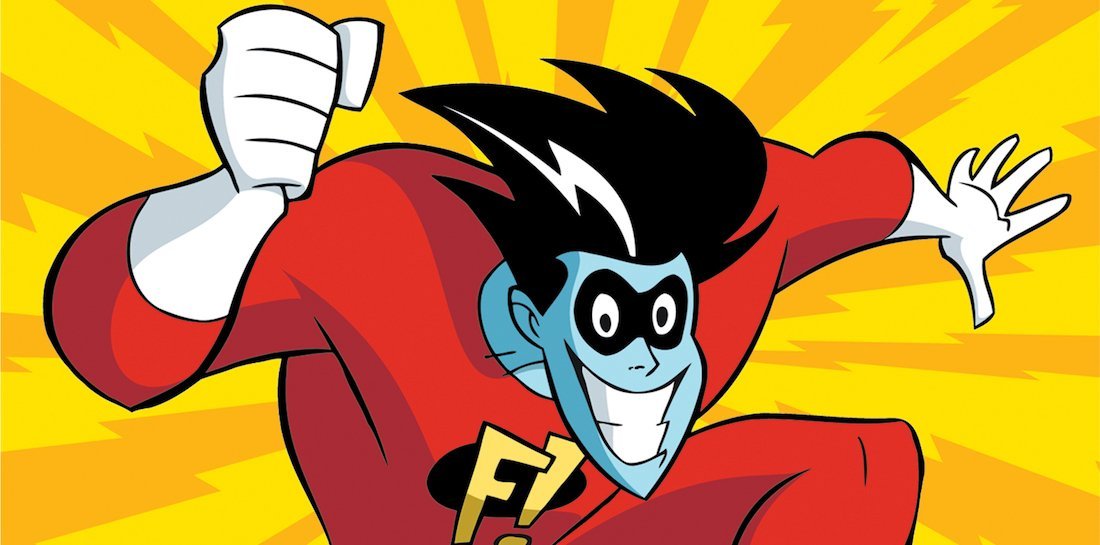
1) Freakazoid
Just over five years after the first public servers were put into operation, the internet got its own superhero. Dexter Douglas, a teenage nerd obsessed with surfing the newly-created web on his heap of blocky 90s tech, is accidentally sucked into cyberspace. Exposed to the sheer, constant information overwhelm that is the internet (in the year 1995), Dexter becomes Freakazoid, a blue-skinned, spiky-haired, utterly bonkers insane superhero. Freakazoid's powers include zapping around on a bolt of lighting (when he remembers he can, anyway— he prefers to run around with his hands above his head shouting 'whoosh! whoosh!', because, well, he's Freakazoid), questionable super strength and durability, and feats of impossible cartoon logic.
His most important power, however, is his ability to annoy his enemies (and doubtless some audiences) into a frothing rage. As part of the same Warner Brothers television programming block to introduce the Animaniacs (who themselves recently got a small-screen reboot), some offbeat and high-speed humor could be expected from the blue hero, but Freakazoid easily out-annoys any other character on the channel with his incessant incomprehensible yammering, yowling, pop-culture references, physical comedy, and overall bizarre and random behavior. The idea of a lonely internet surfer becoming a unhinged superheroic avatar of chaos, hyperactivity and cultural references through sheer force of information overload is, arguably, the most fitting possible superhero story to bring back in 2026— and that's not even starting on Freakazoid's tendency for casual political satire and poking fun at network censorship and other messier parts of behind-the-scenes cartoon production. As the theme song itself says, 'Hopes to make a movie deal, Freaka-me, Freaka-you!'
A note on cookies
Newshunt uses essential cookies to keep you signed in and to remember your language and country, so the site works the way you expect. With your permission, we'd also like to use analytics cookies to understand how people use Newshunt and improve it over time.
Accepting only affects analytics. To learn more, view our Privacy Policy or Terms & Conditions.
(0)Comments