


New IT consul highlights technology's role in Laredo services
Category: SciTech
Share
Archive
Like
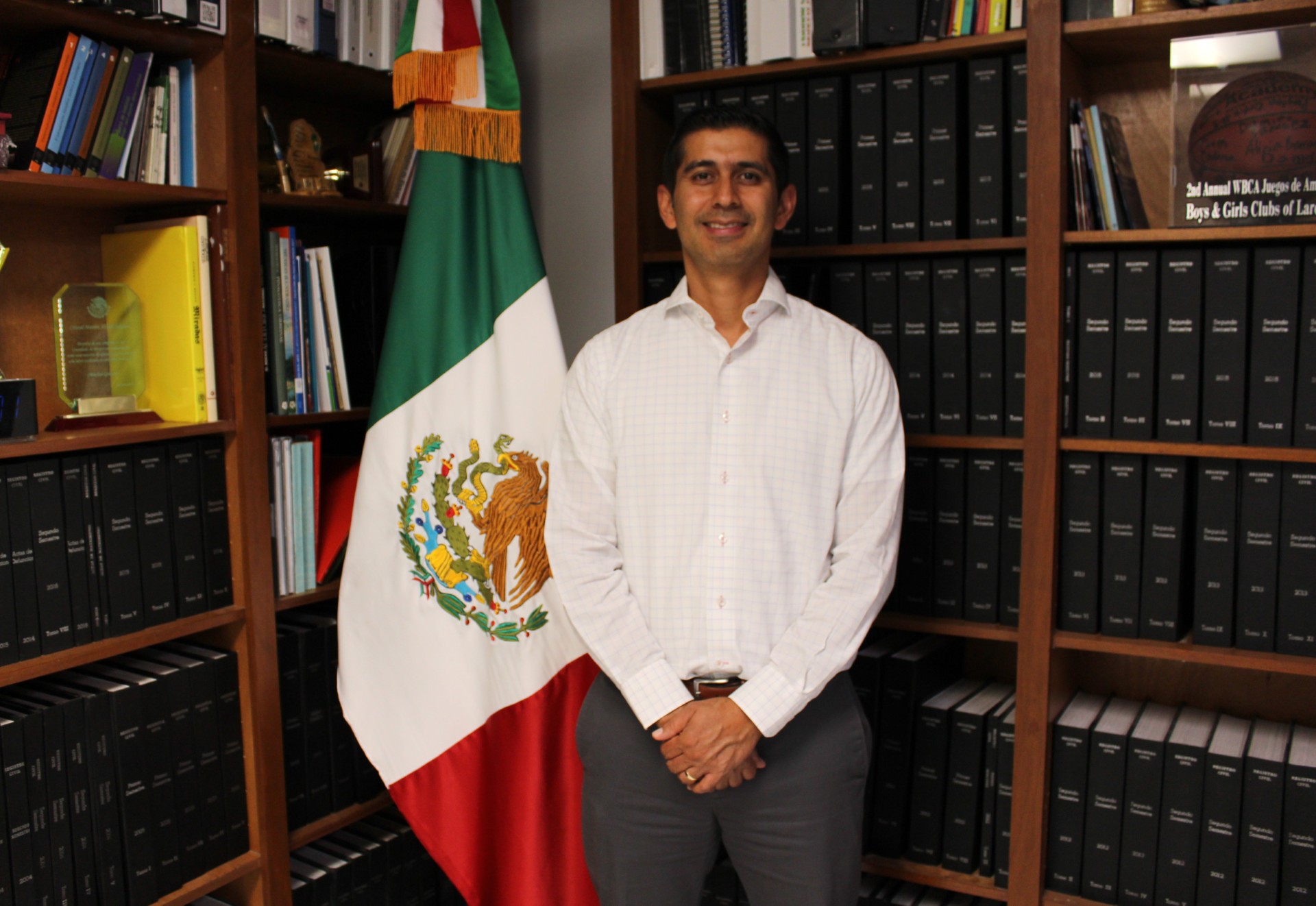
The Consulate General of Mexico in Laredo recently welcomed Salvador Rivera Camacho as its new IT consul.
Rivera Camacho, a native of Escuinapa, Sinaloa, Mexico, holds a degree in computer systems engineering and a master's degree in information technology administration from Tecnológico de Monterrey's Guadalajara campus.
Rivera Camacho has served as an IT officer at the Consulates General of Mexico in Raleigh, Chicago and Los Angeles, as well as at the Mexican Embassy in Honduras.
Rivera Camacho said his primary responsibility in Laredo is to keep the Consulate General's information technology and telecommunications infrastructure operating efficiently.
'The goal is to provide the services our Mexican community needs as efficiently as possible,' Rivera Camacho said. 'Likewise, I am responsible for providing technical support to users, preventive and corrective maintenance of equipment and managing contracts for services and the leasing of IT equipment.'
Rivera Camacho said that as a regional IT officer, he also provides assistance and technical support remotely to the Mexican consulates in Del Rio, McAllen, Brownsville and Eagle Pass, traveling to those locations when necessary.
Rivera Camacho added that, like his fellow consuls, he assists with coordinating the Documentation Department when needed and participates in Jornadas Sabatinas, during which the consulate provides document services by appointment on select Saturdays.
Rivera Camacho highlighted the role technology plays in the Consulate General's overall operations.
'Today, without IT tools, we would not be able to issue documents to our fellow Mexican citizens,' he said. 'It would be nearly impossible to issue passports, consular identification cards, birth certificates and powers of attorney, among other documents. As in most companies and institutions, nearly all processes rely on information technology, which also helps maintain high security standards.'
Rivera Camacho said incorporating technology into consular procedures and those of other government agencies has helped simplify processes.
'As part of the simplification and digitalization of procedures implemented by Mexico's Agency for Digital Transformation and Telecommunications, information technology has helped make consular procedures faster and simpler,' he said. 'Not long ago, obtaining a passport could take several hours. Today, across the consular network, an applicant can have a new passport in hand in an average of one hour.'
Rivera Camacho said the speed of the process distinguishes Mexican consulates from many other offices around the world.
Despite advances in technology, Rivera Camacho said the sensitive nature of the information handled by consulates limits what can be automated through artificial intelligence and makes human involvement essential.
'On the one hand, it is extremely important to keep the software we use to process users' information and issue consular documents properly updated to maintain both quality and security standards,' he said. 'On the other hand, the digitalization of consular processes presents a challenge for our community because, despite technological advances, we must consider how our fellow Mexican citizens interact with these technologies. I am referring to the digital divide, as a large part of the migrant community faces technical difficulties navigating digital tools.'
Rivera Camacho said the digital divide must be considered when developing IT applications to make them as accessible and user-friendly as possible.
Rivera Camacho said efforts to simplify and digitalize consular procedures continue as technology creates new opportunities to improve how services are provided.
'We have made considerable progress in the way we process and issue consular documents,' he said. 'We can now access civil registry birth certificates in real time, allowing us to quickly complete the requirements for processing passports and consular identification cards. This type of immediate access to information and digital documents is part of a major technology initiative being promoted by the Mexican government.'
'I believe the time has not yet come to automate all the services offered at consulates,' he said. 'A consular procedure is very personal. A face-to-face interview is very important in determining whether to authorize and issue a document, such as a birth certificate or passport. These tasks must be performed in person because human interaction is essential, as is the collection of biometric data.'
However, Rivera Camacho said appointment scheduling is one process that could be automated using artificial intelligence, whether through text messages, WhatsApp or telephone calls.
Rivera Camacho said a properly programmed AI agent could assist with appointment scheduling, but human supervision would remain necessary because of the personal nature of consular services.
Rivera Camacho said consulates maintain high security standards when handling documents used in consular procedures.
'Passport, consular identification card and voter identification card procedures are digital,' he said. 'This means that we at the Consulate General scan the documents people present to us and then send them digitally in encrypted form to our central servers in Mexico City.'
Rivera Camacho advised Mexican citizens to avoid using third-party appointment services unaffiliated with the Consulate General to help protect their personal information.
'We remind the community that there are third-party agents unaffiliated with the Consulate General who charge high fees to schedule appointments, which are free of charge,' he said. 'These agents have access to the personal information of our fellow Mexican citizens because they need it to schedule an appointment. Therefore, we recommend that people avoid these types of unofficial services because they could put themselves at risk of identity theft and fraud.'
Rivera Camacho said appointments for consular services are free and can be scheduled through the MiConsulado portal at citas.sre.gob.mx, by calling +1 (424) 309-0009 or through WhatsApp.
A note on cookies
Newshunt uses essential cookies to keep you signed in and to remember your language and country, so the site works the way you expect. With your permission, we'd also like to use analytics cookies to understand how people use Newshunt and improve it over time.
Accepting only affects analytics. To learn more, view our Privacy Policy or Terms & Conditions.
(0)Comments