


Thore Graepel Leaves DeepMind: AlphaGo Co-Creator Bets Structured Search Over LLM Scaling
Category: SciTech
Share
Archive
Like
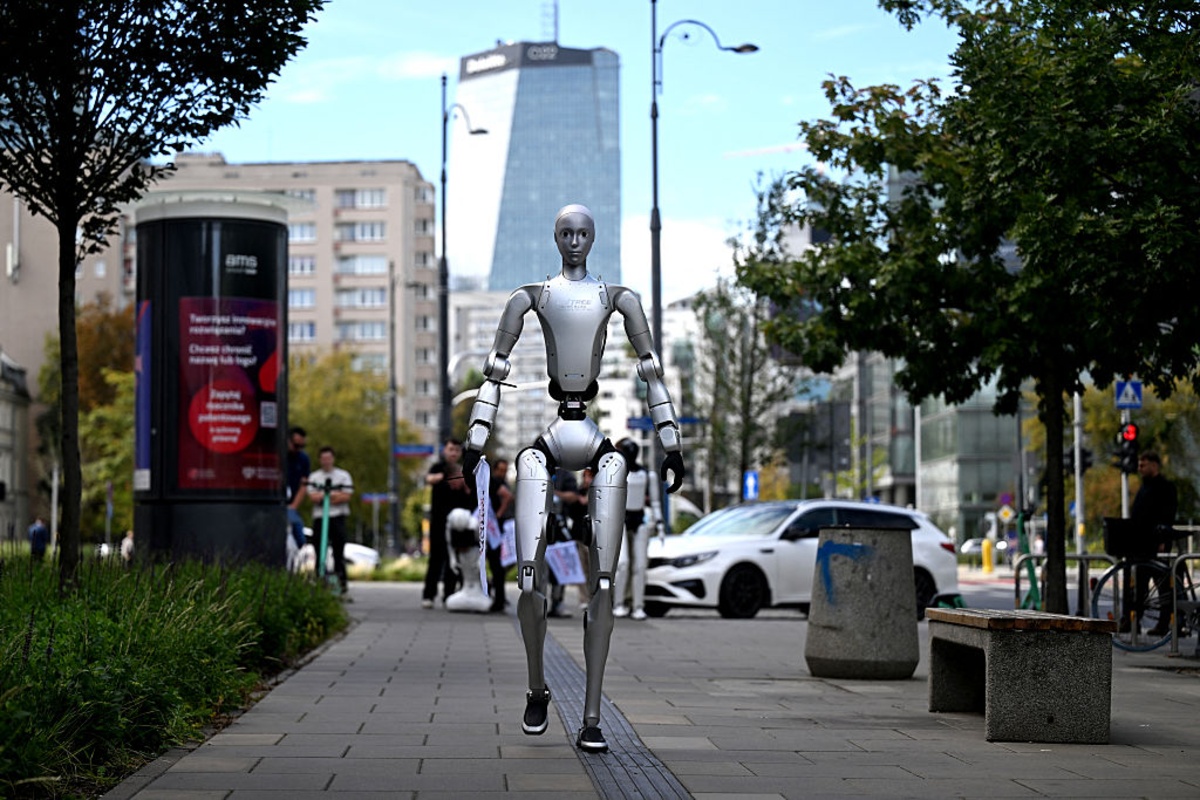
Sergei GAPON/AFP via Getty Images
Thore Graepel — physicist, machine learning pioneer, and one of the scientists whose names appear on the 2016 Nature paper that introduced AlphaGo — has left Google DeepMind to found a new AI startup, betting that the structured search and planning techniques he co-invented a decade ago can generalize from a Go board to the physical world. His departure, reported Sunday by Sifted, adds one more senior name to the most concentrated single-lab talent exodus the AI industry has ever recorded — and his specific technical thesis makes it one of the most consequential.
"We need to go back to the architecture and fundamentally redesign it so that it does proper reasoning," Graepel told Sifted. His
Why This Bet Is a Decade in the Making
Graepel spent his career building machines that reason under uncertainty. At Microsoft Research Cambridge from 2003 to 2015, he co-created TrueSkill, the player-ranking engine that has driven matchmaking on Xbox Live since 2005, and AdPredictor, the Bayesian click-through prediction model behind Bing's advertising system. Both systems rest on factor graphs and message-passing inference — a discipline of translating uncertain inputs into calibrated probabilistic outputs at scale.
He joined DeepMind in 2015 and was among the team — alongside David Silver, Aja Huang, and Demis Hassabis — that published the
Between his two stints at DeepMind, Graepel served as Senior Vice President and Global Head of Computational Sciences, Machine Learning and AI at Altos Labs, the cellular-rejuvenation biotech company backed by Jeff Bezos and others, where he
The Architecture Behind Today's AI Reasoning Revolution
To understand what Graepel is building, it helps to understand what AlphaGo actually was — because it turns out to be the intellectual ancestor of the AI industry's current most-discussed capability.
AlphaGo did not work the way large language models like GPT or Gemini do. An LLM generates each token in a single forward pass — it does not search; it predicts. AlphaGo instead combined three learned components with an explicit search procedure. A policy network, trained first on 30 million expert human Go games and then refined through self-play, proposed which moves to consider next. A value network, trained through extensive self-play, estimated the probability of winning from any given board position. And Monte Carlo Tree Search — MCTS — used both networks to build an asymmetric decision tree at inference time, running thousands of simulated lookaheads and allocating more exploration to the branches the policy network judged most promising. The result was a system that did not just pattern-match to the most likely next move; it reasoned ahead, pruned the space of possibilities, and chose the move a well-calibrated analysis recommended. A
This three-part architecture — a policy that suggests, a value that judges, a search tree that looks ahead — is precisely the blueprint that OpenAI's o1 and Google's Gemini Thinking variants now approximate through chain-of-thought reasoning at inference time. The crucial difference: o1 implements its lookahead implicitly, through trained reinforcement learning that encourages extended chains of tokens before a final answer. AlphaGo-style MCTS implements the same principle explicitly, as a structural component of the system, with a separate environment model governing which futures are reachable.
Graepel co-invented the original proof of concept. He is now betting that the explicit version — principled structured search, with a learned world model, rather than implicit chained token prediction — is what it will take to make AI systems that can operate reliably in physical environments where the state space is continuous, dynamic, and unforgiving. A robot dropping a package, a surgical instrument approaching tissue, a drone navigating a cluttered interior: these problems do not have a token stream to continue. They have state spaces to reason through.
How Does AlphaGo's Architecture Actually Work?
AlphaGo's original architecture required knowing the rules of Go in advance — the search tree was built over legal Go positions. Its direct successor AlphaGo Zero (2017) stripped out human game data entirely, learning purely through self-play starting from random moves, achieving superhuman performance in days. AlphaZero (2017) generalized that approach to chess and shogi simultaneously, mastering chess in nine hours from a blank slate with no human game knowledge — it was given only the rules. MuZero (2019) went further still: it
MuZero is the architectural ancestor Graepel's new venture most resembles conceptually. If an AI system can learn its own model of how states transition — how the world changes in response to an action — it no longer needs a human-coded rulebook. It can build that rulebook from experience. Applied to robotics, this would mean a system that models its own physical environment, runs structured lookahead over possible action sequences, and selects the action its value function judges most likely to succeed. That is a fundamentally different engineering approach from the fine-tuned language models that currently power most robotics AI, which rely on imitation learning from human demonstrations and struggle with novel physical configurations.
The technical challenge is significant: MCTS in game-playing can run millions of rollouts because each rollout is computationally cheap and the environment model (the board rules) is exact. Real-world physical environments have continuous state spaces, imperfect sensors, and irreversible consequences. Building a learned world model accurate enough to support reliable lookahead in those conditions is the hard problem Graepel's new venture is tackling. A
Why Are Researchers Leaving Google DeepMind?
Graepel's departure is the latest chapter in a year-long pattern that has stripped DeepMind of an extraordinary concentration of founding talent. In January 2026, David Silver — the lead architect of AlphaGo and Graepel's closest collaborator on the original paper —
The numbers underlying the pattern are stark. Analysis from Zeki Data, a UK-based AI talent intelligence firm, showed that
Interviews with current and former DeepMind researchers, reported by Fortune, identified several factors: rival labs poaching with cash-heavy offers and pre-IPO equity, mounting frustration with DeepMind's increasing focus on commercializing Gemini at the expense of open-ended research, and tightened publication rules that former researchers described as alienating. One departure — that of Noam Shazeer — was reportedly triggered by the specific reallocation of his team's computing resources to DeepMind's London pretraining cluster.
Hassabis, asked about the departures at the Cannes Lions Festival in June 2026, dismissed the narrative: "We have by far the biggest and broadest research bench of any of the labs out there. We win our fair share of the top talent," he told Semafor, characterizing the job market as the "most ferociously competitive" the tech industry had ever seen.
DeepMind is not on the verge of collapse — it retains extraordinary resources, proprietary TPU access, and Gemini is approaching a billion monthly users. What has changed is the opportunity cost. Venture capital is flowing into AI startups at unprecedented rates: Dealroom data cited in recent reporting shows VC has invested $18.8 billion in AI startups founded since early 2025. A scientist with Graepel's track record — AlphaGo, AlphaZero, TrueSkill, Altos Labs — can raise capital on the strength of a thesis alone.
What Comes Next
Graepel has not yet disclosed investors, team members, or a formal company name. His website describes the project as bringing together his work on probabilistic reasoning, multi-agent learning, and AlphaGo-style planning — disciplines that converge around the central challenge of making machines act reliably in environments that are uncertain, dynamic, and high-stakes. A
For an industry that has spent three years focused on the fluency of language models, an AlphaGo architect who says the field needs to "go back to the architecture" may be betting that the next leap looks more like Go than GPT — and that the architecture that proved it once can prove it again, in a world that does not conveniently follow rules written on a 19x19 grid.
For European AI observers, Graepel's founding in the UK adds another landmark to a growing cluster: Ineffable Intelligence (Silver), H (Holistic, former DeepMind researchers), and now Graepel's unnamed venture — each building frontier AI outside the American and Chinese labs that have historically owned the compute advantage.
Frequently Asked Questions
Why are so many senior DeepMind researchers leaving in 2026?
Multiple factors converged. Rival labs including Anthropic and OpenAI made aggressive offers combining high salaries and pre-IPO equity that Google's compensation structure struggled to match. Internally, several researchers described frustration with DeepMind's increasing focus on commercializing Gemini rather than pursuing the kind of long-horizon scientific exploration that originally made the lab attractive. One departure was triggered specifically by the reallocation of a research team's computing resources to a different project. The broader context is an extraordinary VC environment: startups founded by DeepMind alumni are raising at valuations — and speed — that would have been impossible a few years ago. Zeki Data analysis shows
What is the difference between AlphaGo-style reasoning and how current AI models like GPT or Gemini work?
Large language models generate responses token by token, each in a single forward pass through the neural network. They do not maintain an explicit search procedure; they predict the most likely next word given what came before. AlphaGo-style reasoning is structurally different: it uses an explicit search tree built at inference time, guided by two learned networks — one that proposes which futures to explore (the policy network) and one that estimates which futures are most promising (the value network). The search runs thousands of simulated lookaheads before choosing an action. This is more computationally expensive but more principled for problems with known or learnable structure. OpenAI's o1 and Google's Gemini Thinking approximate this principle through trained chain-of-thought reasoning, but do so implicitly rather than through an explicit search tree.
What specifically made AlphaGo's Move 37 in Game 2 against Lee Sedol so significant?
Move 37 was a shoulder hit on the fifth line that every human commentator initially called a mistake. AlphaGo's policy network had estimated a 1-in-10,000 chance that any human player would make that move — but its search system identified it as the highest-valued option nonetheless. The move was eventually recognized as a stroke of strategic creativity that shifted the game's balance in AlphaGo's favor. Its significance is that it was not imitation of human play — it was something the search procedure discovered by evaluating futures humans had not explored. This capacity to identify genuinely novel solutions in high-dimensional spaces is precisely the capability Graepel's new venture is attempting to extend beyond board games. More background on AlphaGo's key moments is available at
What risks does Graepel's technical bet face in moving from board games to robotics?
The primary engineering challenge is the world model. In board games, the environment is exact and discrete — MCTS can run millions of rollouts because each rollout is cheap and the future states are perfectly modeled by the rules. Physical robotics environments are continuous, partially observable, and involve irreversible consequences. Building a learned world model accurate enough to support reliable multi-step lookahead in those conditions — without catastrophic degradation over long planning horizons — is an unsolved research problem. MuZero demonstrated that a system can learn its own dynamics model, but it was tested in environments (Atari, board games) far simpler than the open-ended physical world. Extending it is the hard problem, and it is the problem Graepel's team will have to solve. The
A note on cookies
Newshunt uses essential cookies to keep you signed in and to remember your language and country, so the site works the way you expect. With your permission, we'd also like to use analytics cookies to understand how people use Newshunt and improve it over time.
Accepting only affects analytics. To learn more, view our Privacy Policy or Terms & Conditions.
(0)Comments