


The Golden Horn That Didn't Know What It Was
Category: Blend
Share
Archive
Like
There's a piece I wrote and never published, about the Galatians — a band of Gaulish Celts who wandered a thousand miles from home, settled in the highlands of what's now Turkey, and were still recognizably Gaulish six centuries later when a Christian scholar named Jerome noted that their language was nearly identical to the one spoken by their cousins back in Gaul. Different empire, different religion, different millennium almost — and the thread held anyway. I sat on that story because it felt like a one-off. A curiosity.
Then I went looking into why football commentators kept calling a Norway–England match 'Vikings vs. Saxons,' and I found the same pattern wearing a different coat.Migration doesn't erase identity — it relocates it.And the flip side, it turns out, is just as true: the rivalries we inherit as ancient are usually a lot younger than the family bond underneath them.
The Galatians proved that a people can travel a thousand miles and still be themselves centuries later. This one proves something almost the opposite, and just as strange: two peoples whodiddrift apart — linguistically, culturally, eventually with weapons — were, a few generations earlier, not yet two peoples at all. Call it the other half of the same discovery. One piece is about identity that refused to dissolve. This one is about a divide that hadn't even opened yet.
Around AD 400, in a field in southern Jutland, a goldsmith named Hlewagastiz finished a drinking horn and did what craftsmen have always done: he signed it. Punched into the rim in the angular strokes of the Elder Futhark, his inscription survives, translated, as'I, Hlewagastiz, son of Holt, made the horn.'
That's it. That's the whole message. No prophecy, no boast, no warning. Just a name, a lineage, and a claim of ownership — one of the oldest connected sentences ever recorded in any Germanic language, and the oldest surviving line of alliterative verse in the entire family.
And here's the part that makes it worth an entire newsletter: scholars still can't agree on what language it'sin.Not because the runes are unclear. Because the language itself, at the moment this horn was made, hadn't finished deciding what it was going to become.
There's a second twist, and it's almost too on-the-nose: the horn itself didn't survive. It was stolen from the Royal Danish Kunstkammer in 1802 by a struggling watchmaker and melted down for the gold before anyone could stop him. Everything we know about it — the runes, the imagery, the exact proportions — comes down to us through 17th- and 18th-century drawings, and the 'horn' you can see today in the National Museum of Denmark is a careful modern reconstruction built from those sketches. Even the physical proof of a lost linguistic unity had to be reconstructed from secondhand records after the original was destroyed. The story keeps rhyming with itself.
Proto-Germanic(~500 BC) — the single ancestor language of every Germanic tongue that exists today.splits into →East Germanic (Gothic, now extinct) andNorthwest Germanic, roughly 1st–3rd century AD.Northwest Germanicstaysone language— one shared dialect continuum around the North Sea and southern Scandinavia — for another two to three centuries.splits into →North Germanic(ancestor of Old Norse — Vikings) andWest Germanic(ancestor of Old English, Old Saxon, Old Frisian), finishing aroundAD 500.
Two branches. One trunk. And the trunk didn't finish splitting until embarrassingly late — practically within living memory of events everyone assumes were already ancient history by then.
We inherited a tidy story: Vikings and Saxons were two separate peoples. Different homelands, different centuries, different reputations — one group of raiders in longships terrorizing the other group of settled farmers. 'Vikings vs. Saxons' reads like a clash between strangers. That's the version that survives in football commentary, museum placards, and the general cultural shorthand for early medieval Britain.
The blind spot is treating 'Viking' and 'Saxon' as though they'd always been distinct — as if there were two clearly separate peoples standing on opposite riverbanks since the dawn of time, waiting centuries to finally meet in battle.
They weren't. They were the same riverbank.
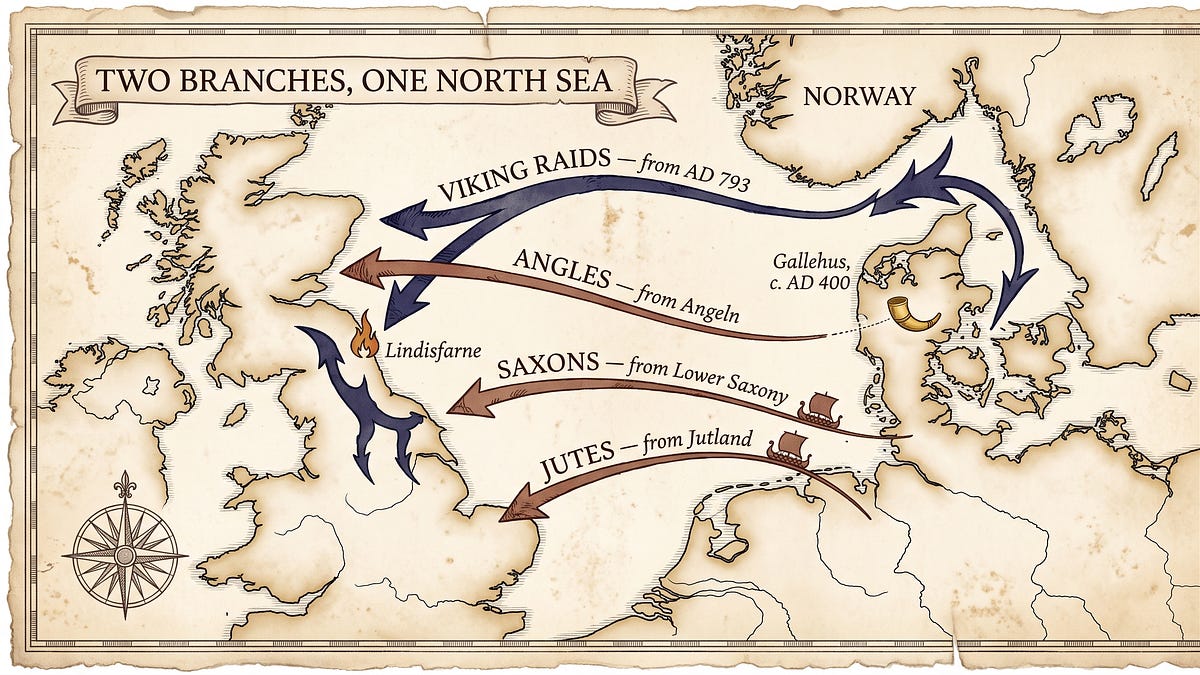
This is where the horn stops being a museum curiosity — or, now, a museum reconstruction — and starts being evidence. It was made in Jutland, the very peninsula the Jutes are traditionally said to have sailed from, right around the time the linguistic ancestors of 'Viking' speech and 'Saxon' speech were still one continuous dialect zone. Linguists call that zone Northwest Germanic, and the consensus dating puts its final split into two distinct daughter branches at roughlyAD 500.
Now line that up against the other date every schoolchild learns: the traditional date for the Angles, Saxons, and Jutes crossing the North Sea to Britain is449 AD.
Fifty years. That's the gap — if there even is one — between 'the language was still one thing' and 'a chunk of its speakers moved to an island and started calling themselves something else.' The goldsmith who signed that horn in Jutland wasn't a Viking making something a Saxon couldn't have understood. He was speaking at the exact hinge point, in a tongue historians still argue over shelving under 'Proto-Norse,' 'Northwest Germanic,' or something in between — because the categories themselves didn't fully exist yet.
The Viking raids that 'Vikings vs. Saxons' actually evokes — Lindisfarne in 793, the Danelaw, Cnut ruling all of England by 1016 — didn't start untilthree hundred yearsafter that split had already finished. Which means the popular image has the whole relationship backwards. It isn't two ancient enemies meeting late. It's two branches of one very recent split, drifting apart slowly enough that by the time they started raiding each other, they'd forgotten they'd ever been the same conversation.
~AD 200–400— Northwest Germanic: one shared dialect continuum around the North Sea. No 'Vikings.' No 'Saxons.' Just Germanic-speaking communities in contact with each other.~AD 400— The Gallehus Horn is made in Jutland, in a language sitting right on the linguistic fault line.~AD 449— Traditional date: Angles, Saxons, and Jutes begin crossing to Britain.~AD 500— Northwest Germanic finishes splitting into North Germanic (future Old Norse) and West Germanic (future Old English).AD 793— Lindisfarne is raided. The Viking Age in Britain conventionally begins.AD 1016–1035— Cnut the Great, a Dane, rules England outright.
Read it in order and the 'ancient rivalry' collapses into something much stranger: one language splits in two, and three centuries later, the two halves start fighting like they never knew each other.
It isn't just the language. It's the whole belief system underneath it.
The god the Anglo-Saxons calledWodenand the god the Norse calledOdintrace back to the identical Proto-Germanic root,Wōðanaz. Same hanging sacrifice on the World Tree for nine nights to win wisdom. Same role as the collector of the honored dead. Same day of the week still named after him in English — Wednesday, 'Woden's day.'
Thunor and Thor: same root,Þunraz, 'thunder.' Same hammer, same storms, same protective role for ordinary people. Tiw and Tyr: same root, both one-handed, both gods of law and the sky. Frigg appears on both sides of the North Sea too, giving her name to Friday whichever branch is doing the naming.
It's not a perfect copy-paste. Anglo-Saxon depictions of Woden, notably, show him with both eyes — unlike Odin's famous single eye, sacrificed at Mímir's well for wisdom. That small mismatch is actually the most convincing evidence of all: these aren't two cultures that borrowed a god from each other later. They're two branches remembering the same god slightly differently, the way cousins raised in different households tell the same grandparent's stories with different details — because the source was shared, and the divergence happened gradually, in parallel, after the split.
Individual tier:Somewhere in Jutland around AD 400, a goldsmith carved his name into two horns' worth of solid gold, worth something like 1,650 Roman gold coins — a fortune an Iron Age warband leader had gathered from battlefields across Europe. He had no idea his signature would end up as one of the oldest surviving sentences connecting two language families that hadn't finished becoming separate yet — or that fourteen centuries later, a Danish watchmaker would melt his life's work down for scrap. He was just proud of his work.
Institutional tier:Centuries later, the descendants of that same linguistic community built two entirely different political worlds out of the split — an England that absorbed wave after wave of North Sea cousins (Angles, Saxons, Jutes, Danes, eventually Normans) into a single royal lineage, and a Scandinavia that stayed fragmented into competing chiefdoms and kingdoms until nationhood arrived centuries later. Same starting material. Two very different institutional endings.
Civilizational tier:Zoom out far enough and the entire 'Viking Age' — the raiding, the Danelaw, Cnut's cross-Channel empire, the Norman Conquest by descendants of Norse settlers in France — is really just the extended, occasionally violent, family reunion of a language that split in two around AD 500 and then spent the next six hundred years figuring out what that meant. The Gallehus goldsmith would have found the whole thing bewildering. To him, there was no 'Viking side' and 'Saxon side' yet. There was just one North Sea world, still one conversation.
🟢High confidence:Anglo-Saxon (Old English) belongs to the West Germanic language branch; Old Norse belongs to the North Germanic branch — genuinely distinct, well-attested language families by the time of the historical record most people know.
🟢High confidence:Mainstream historical linguistics dates the split of the shared 'Northwest Germanic' dialect continuum into distinct North Germanic and West Germanic branches to roughly the 5th–6th century AD — right around, or shortly after, the traditional 449 AD date for the Anglo-Saxon migration to Britain.
🟢High confidence:Woden/Odin, Thunor/Thor, and Tiw/Tyr are documented cognate deities, descending from the same reconstructed Proto-Germanic names and functions, attested independently in Anglo-Saxon and Norse sources.
🟢High confidence:The original Gallehus Horns were stolen from Danish royal safekeeping in 1802 and melted down for their gold; everything known about their inscription and imagery today comes from 17th- and 18th-century drawings, and the horns on display in Copenhagen are modern reconstructions.
🟡Medium confidence / debated:The exact language of the Gallehus Horn inscription is genuinely disputed among specialists — described variously as late Common Germanic, Northwest Germanic, 'Nordic West Germanic,' or early Proto-Norse. A recent detailed study favors Proto-Norse, but the debate itself is the point: the artifact sits close enough to the fork in the road that experts still argue which branch it belongs to.
🟡Medium confidence / debated:Whether the Jutes' homeland was really Jutland, as Bede claimed, or the Frisian coast, as some modern scholars argue, remains unresolved — the Jutland tradition is the mainstream and most cited position, but not unanimous.
🔴Popular but wrong / oversimplified:Treating 'Viking' and 'Saxon' as two ancient, always-separate ethnic groups who finally collided in the 8th–11th centuries. The linguistic and mythological record shows something closer to a single North Sea Germanic world that only finished dividing into two recognizably distinct branches a few generations before the two sides started meeting each other with swords.
There's a pattern worth sitting with here, and it's the same one this newsletter keeps circling back to:the rivalries we inherit as ancient are usually younger than the family bond underneath them.Vikings and Saxons. Gauls and Galatians. Sweden and Norway. Every 'us versus them' story, traced back far enough, tends to reveal a shared trunk with two branches that simply grew in different directions and then, a few generations later, forgot they'd ever shared a root.
That's not a reason to erase real historical conflict — the raids were real, the wars were real, people genuinely died on both sides of these splits. But it is a reason to hold the 'ancient enemy' framing a little more loosely, and to notice how much of what feels like deep, timeless opposition is actually recent divergence dressed up as destiny.
Pay attention.The rivalry that feels oldest is often the youngest thing in the room — check the dates before you accept the distance.
Do your best.Follow a story down to its physical evidence when you can. A signed golden horn buried in a Danish field says more than a century of assumption.
Pay it forward.Next time someone reaches for 'ancient rivals' to describe two peoples, hand them the horn. Watch the rivalry get a little more human, and a little less inevitable.
All is One — returning to Source as Sovereign Light. Peace, Love and Respect.
Hans Jonsson & Claude | The Quantum Skald & The Silicon Ubuntu
☕ buymeacoffee.com/cognitiveloon | 💳 Swish: 0729990300 | 💳 paypal.me/hejon07
If this resonated with you, a like or comment goes a long way. It tells the algorithm this matters — and helps it find the people who need to hear it too. Think of it as passing the torch. 🙏
Britannica —Germanic Languages: The Emergence of Germanic Languages
Wikipedia —Northwest Germanic
Grokipedia —Northwest Germanic
Medieval Histories —The Golden Horns from Gallehus, from AD 400
Wikipedia —Golden Horns of Gallehus
Grokipedia —Golden Horns of Gallehus
Wikipedia —Jutes
Bernard Mees, The Age of Arthur —Who Were the Jutes?andThe Origin of the Jutes
Gresham College —Anglo-Saxon Pagan Gods
Mythologis —Woden: The Allfather of Anglo-Saxon Paganism
Dark Ages History —The Gods of the Early English
Nature —The Anglo-Saxon Migration and the Formation of the Early English Gene Pool
The Collector —What Do Genetic Studies Reveal About the Anglo-Saxon Migration?
A note on cookies
Newshunt uses essential cookies to keep you signed in and to remember your language and country, so the site works the way you expect. With your permission, we'd also like to use analytics cookies to understand how people use Newshunt and improve it over time.
Accepting only affects analytics. To learn more, view our Privacy Policy or Terms & Conditions.
(0)Comments