


This family of four put 1,000 km on a cargo e-bike instead of buying a second car
Category: Business
Share
Archive
Like
I've been working in the electric bike industry for nearly two decades, and publicly reviewing e-bikes for around half of that. I used to say I've touched hundreds of e-bikes, but now that I've lost count, I wouldn't be surprised to find I need to add a digit to that. With so many saddles that I have to sit on, I get to ride a lot of e-bikes for a few weeks, but I rarely get to spend months on any one bike. So when I finished my one-month review of the Xtracycle Hopper electric cargo bike and had a unique opportunity for a longer-term project, I jumped on it.
My best friend and his wife have a couple of kids and are a bike-friendly family, so I made him an offer: take this bike and ride it as much as you guys can. Now, having just hit 1,000 km (620 miles) on the thing, he's back to share his experiences with me. And by extension, with you all.
At this point, the bike is so ingrained in their lives that my buddy and his wife probably have a much stronger claim to the Hopper than I do. More importantly, they've been using it exactly the way a compact electric cargo bike like this is intended to be used: as real transportation, day in and day out, over the long term.
As a four-person household with kids aged four and two, they share a single car. The Xtracycle Hopper has effectively become the family's second vehicle.
And 1,000 km (620 miles) later, it's hard to imagine a better demonstration of why electric cargo bikes make so much sense. There's nothing like living close enough to the sea that it makes sense to always carry a beach umbrella!
The Hopper gets used virtually every day, with the most regular duty being the morning daycare run. One parent hops on, one or both kids climb aboard, and off they go.
But it's not just a daycare shuttle.
Evening and weekend rides frequently turn into family outings, especially trips down to the beach. One parent takes the Hopper with both kids on the back while the other rides another bike. That's two bikes, four people, and four smiles.
Ask most parents about loading two small children into a car for a trip and you probably won't hear them describe it as the highlight of anyone's day. There are car seats, traffic, parking, and all of the other little annoyances involved in moving a family around.
On the Hopper, the kids actually look forward to it. Riding on the back of the bike has become an activity in itself.
When I join them for rides, I can see it in the kids' faces – they're just having a blast because the trip isn't just transition time, but rather part of the experience. Instead of transportation being the annoying thing that happens between leaving home and arriving somewhere fun, the transportation itself has become part of the fun. It's time the kids spend outside with their parents, looking around, breathing in fresh air, talking, and enjoying the ride.
That might sound a little sentimental for an e-bike review, but after 1,000 km, it feels just as important to me as most of the numbers on the spec sheet. Or perhaps even more important.
(In case you're wondering though, here's a spec sheet refresher: the bike's got a 750W motor, 48V 15Ah battery with 720Wh of capacity, can hit 28 mph or 45 km/h on pedal assist, or has the option of throttle operation limited to 20 mph or 32 km/h.)
Of course, you need the right bike for that kind of heavy-duty use.
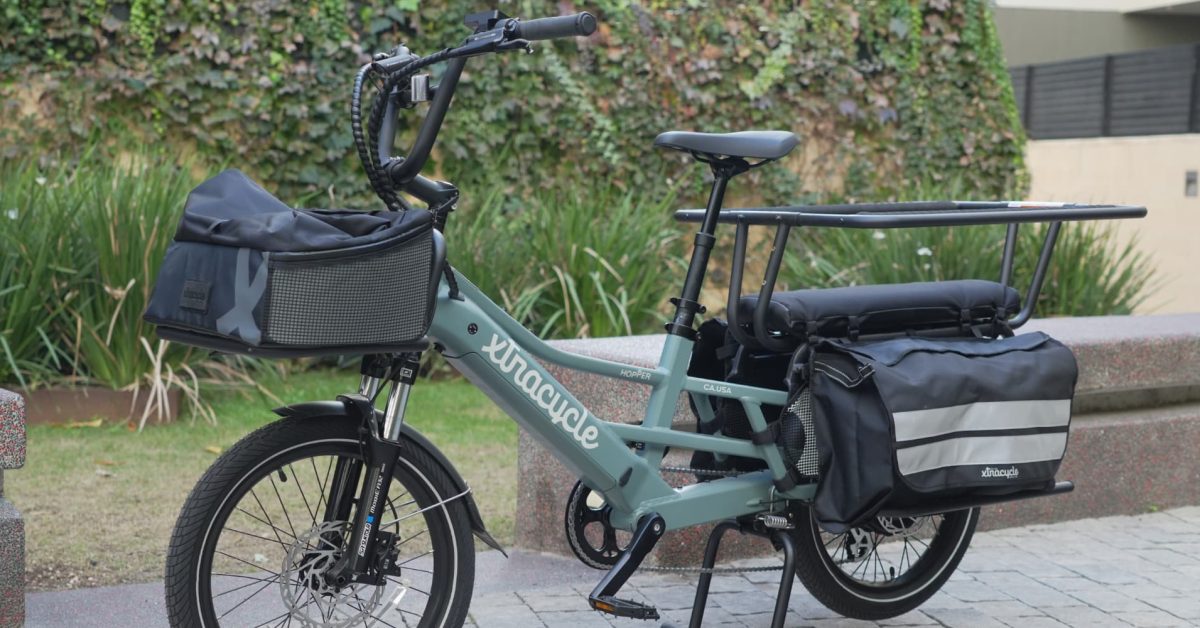
The Hopper is Xtracycle's somewhat more compact cargo e-bike, and its relatively small footprint is a major part of its appeal compared to their longer bikes that can easily carry four people. Despite having room for two small passengers on the rear deck, it isn't much longer than a conventional bicycle. The 20-inch wheels also help keep the center of gravity low, which becomes especially important when you've got a pair of wiggling kids behind you.
The bike is rated for up to 500 lb (227 kg) of total weight, while the rear rack itself is rated for 242 lb (110 kg). It comes with Xtracycle's Hooptie passenger rails, footrests, and a front PorterRack (though my buddy eventually removed it in favor of keeping a bag in the rear behind the older child to make it easier to wiggle around the bicycle room of their building), meaning much of the family-hauling hardware is already there right out of the box.
There are fancier cargo bikes out there, including expensive mid-drive models with nicer features, but this setup has proven plenty capable for daily family transportation. And importantly, the torque sensor gives the bike a much more natural response than the cheap cadence-sensor systems found on many budget cargo e-bikes. That being said, I definitely see my friend relying on that throttle a lot of the time. I can't really blame him, though, since having a couple of kids to deal with probably means the throttle is a welcome relief on occasion when you just don't feel like pedaling.
As far as the rest of the neat components, hydraulic disc brakes, a suspension fork, integrated lights, full fenders, and even a suspension dropper post round out a package that feels designed around daily utility rather than simply hitting an attractive price on a spec sheet. So while it's not the fanciest cargo e-bike out there, it's got great components and comes with just about all the accessories you'd need for normal cargo hauling and family fun, right on the first day.
Not much has gone wrong.
In fact, the mechanical reliability might be one of the more boring parts of this review – which is exactly what you want from a family vehicle. One of the reasons you pay more for a nicer quality bike is so that it lasts longer. There are lots of pretty good $1,500 cargo e-bikes out there, but the Xtracycle Hopper is a great cargo e-bike. At $2,499, it costs a bit more, but it comes from a dedicated cargo bike company that knows how to build these things, uses higher-end components and materials, and is built to last.
In fact, the only noteworthy issue they've experienced was a broken spring on the dual-leg kickstand. Xtracycle quickly sent out a replacement under warranty, and that was basically the end of the drama.
Ironically though, that little failure resulted in a pretty revealing moment during this long-term test.
While they were waiting for the replacement spring to arrive, the family took their car to the beach that weekend instead.
My friend later told me how striking it was to go back to doing the trip by car. Suddenly, they were waiting in city traffic, then sitting in a long line of cars to enter the parking lot, hunting for a space, paying for parking, and dealing with all of the little inconveniences they had largely forgotten about.
To put it another way, they had forgotten how much it sucked to have to take the kids somewhere in the car, especially somewhere that was supposed to be a fun and relaxing destination.
Living with a cargo bike also reveals advantages that aren't immediately obvious during a short review.
The dual-leg kickstand (broken spring notwithstanding) is particularly important when loading kids. I found it useful for my grocery runs when loading up the panniers during my period of time living with the bike, but my friend found that being able to stabilize the bike and then get the children situated on the rear deck makes the whole process much easier than balancing a heavily loaded bike on a conventional side stand. And kids apparently move a lot more than sacks of potatoes, or at least I'm told.
The smaller wheels and relatively low rear deck also help considerably. You certainly feel the weight of two children back there, but it doesn't feel like they're perched precariously high above the ground.
And because both parents use the bike, the adjustable cockpit and dropper seatpost are genuinely useful rather than merely nice additions. A family bike often isn't your bike. It's whoever-needs-it-right-now's bike. And just as a car's seat and steering wheel are quickly adjustable to fit different drivers, a bike with quickly adjustable handlebars and seat makes a big difference. The dropper post is a great way to change the seat height on the fly, even while riding, and lets you drop the seat low to flat foot it at stops. The activation lever is under the saddle itself, which is slightly more economical than the handlebar-mounted levers I prefer, but also has the added benefit of letting other people think you're going in for a little self-congratulatory tickle down there.
There are also the little things you start appreciating after hundreds of trips: integrated lights that are always there, fenders when the roads are wet, the passenger rails that give kids a natural place to hold onto, and a front rack that doesn't interfere with steering because it's mounted to the frame rather than turning with the handlebars.
None of those features are individually revolutionary. But together, they make the bike easy enough to use that grabbing it for another trip doesn't require much thought.
I've argued for years that many two-car families could probably replace their second car with an electric bike, but my friend's experience with the Hopper is almost a perfect case study.
They still have a car – they're not about to sell it and go car-free. There are obviously trips where it makes more sense to take their car, and nobody is pretending an electric cargo bike can perform every task that a car can.
But a huge number of family trips aren't road trips or giant grocery hauls. They're a few kilometers to daycare. They're a quick errand. They're meeting someone nearby. They're going to the park or heading down to the beach.
For those trips, the Hopper isn't merely an acceptable substitute for the car. Quite often, it's better .
There's no gasoline. There's virtually no parking problem. Running costs are negligible. It's easier to get through crowded urban areas. And instead of the kids being strapped into the back of a metal box, the ride becomes part of the outing. Everyone just has a nicer time.
At $2,499, the Xtracycle Hopper isn't a cheap bicycle. But compared to buying, registering, insuring, fueling, parking, and maintaining a second car, the economics start looking very different. And the long-term test on a bike like this confirms that there's more to a bike than how well it works in the first few weeks. The quality of the build determines whether you'll spend months on a bike, or years.
But even after more than 1,000 km, perhaps the most impressive thing isn't that the bike has held up well. It has.
It's that those kilometers represent hundreds of trips that otherwise could have happened in a car – and hundreds of times this family instead chose the option they actually enjoyed more.
When a four-year-old and a two-year-old are excited to climb aboard for the daycare run, you've done more than build a useful cargo bike. You've managed to make transportation into family time. And in today's fast-paced world, family time is at a premium.
That's a feature you're never going to find on a spec sheet. So keep having fun on that bike, buddy. I hope your story can inspire others.
FTC: We use income earning auto affiliate links. More.
A note on cookies
Newshunt uses essential cookies to keep you signed in and to remember your language and country, so the site works the way you expect. With your permission, we'd also like to use analytics cookies to understand how people use Newshunt and improve it over time.
Accepting only affects analytics. To learn more, view our Privacy Policy or Terms & Conditions.
(0)Comments