


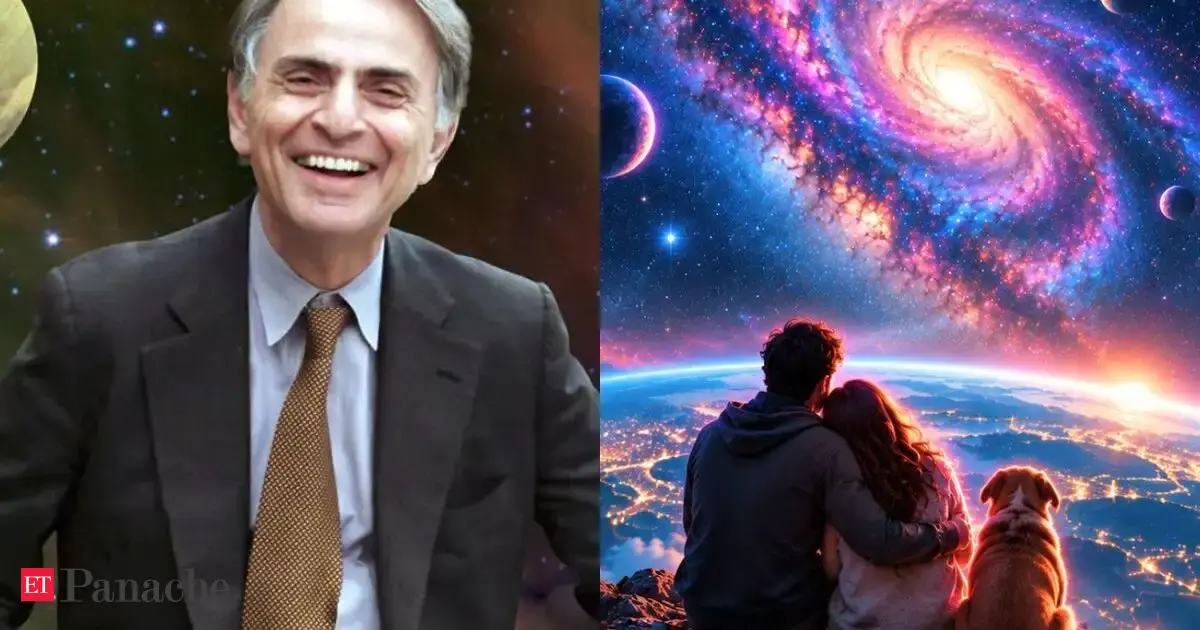
Quote of the day by Carl Sagan: 'For small creatures such as humans the universe is bearable only through love' - A powerful life lesson on why love can make life's biggest challenges easier to face by the American astronomer & astrophysicist
Category: SciTech
Share
Archive
Like
Have you ever looked at the night sky and felt both amazed and strangely small? The universe is filled with billions of stars, distant galaxies and questions that humans may never fully answer. For Carl Sagan, that sense of wonder did not make human life meaningless. Instead, it made love and human connection even more important. His famous words, 'For small creatures such as we the vastness is bearable only through love,' offer a simple but powerful reflection on how people can find comfort and meaning despite the enormous scale of the cosmos.
Carl Sagan quote
: 'For small creatures such as we the vastness is bearable only through love'
The quote comes from Sagan's 1985 science-fiction novel Contact. It appears near the end of the book as the protagonist reflects on the meaning of the universe and humanity's place within it. The line has since become one of Sagan's best-known reflections on love, existence and the human experience.
Although Sagan was best known as an astronomer and science communicator, his writing often connected scientific ideas with larger questions about human life. This quote captures that approach by placing the immense scale of the universe alongside something deeply personal: the human ability to love.
What Carl Sagan meant by the quote of the day
The word 'vastness' in the quote can be understood as more than the physical size of the universe. It can also represent the uncertainty, loneliness and mystery that come with being human.
People know that their individual lives are brief when compared with cosmic time. The universe is far older and larger than anything a single person can experience. That realization can sometimes make everyday struggles feel insignificant.
Sagan's message, however, is not that human beings should feel powerless because they are small. Instead, the quote suggests that relationships give life meaning even when we cannot understand everything around us.
Love creates a sense of belonging. It connects individuals to families, friends, partners and communities. In that sense, something as personal as caring for another person can make the overwhelming scale of existence easier to face.
Why love becomes important when life feels overwhelming
There are moments when people can feel small because of circumstances they cannot control. Questions about the future, loss, loneliness, uncertainty and the limits of human knowledge can all create a sense of helplessness.
Sagan's words offer another way to look at that feeling. We may not be able to control the size of the universe or answer every question about existence, but we can build meaningful relationships within the small part of it that we occupy.
Love does not remove uncertainty. It does something different: it gives people a reason to care despite uncertainty.
A conversation with someone we trust, time spent with family or simply knowing that another person cares can make difficult experiences feel less isolating. The quote therefore turns the enormous scale of the cosmos into a reminder of the value of human connection.
Life lessons from Carl Sagan's quote
Find meaning in human connection:
The universe may be unimaginably large, but meaningful relationships give everyday life emotional value. Caring for others can create a sense of belonging that cannot be measured by scientific scale.
Do not fear being small:
Being one person among billions does not make an individual life worthless. Sagan's thought suggests that significance can come from how we experience life and connect with others rather than from our size or status.
Accept that some questions may remain unanswered:
Human beings cannot know everything about the universe. Instead of allowing uncertainty to create fear, people can accept what they do not know while continuing to explore, learn and remain curious.
Choose connection over isolation:
When life feels overwhelming, withdrawing from others can make that feeling stronger. Building genuine relationships can provide emotional support and remind people that they are part of something larger than themselves.
Appreciate the wonder of existence:
Sagan spent much of his career helping ordinary people understand the universe. His quote suggests that scientific wonder and human emotion do not have to exist separately. Looking at the cosmos can make us appreciate the rare and meaningful experience of being alive.
Why this Carl Sagan quote still matters today
Sagan's words remain relevant because modern life can often make people feel both connected and isolated at the same time. Technology allows people to communicate across continents, yet loneliness and emotional disconnection remain familiar experiences.
The quote offers a reminder that having access to more information does not necessarily answer the deeper questions people have about their lives. Understanding the universe is one kind of achievement, but finding people with whom we can share that life is another.
That idea also fits Sagan's wider legacy. He spent decades helping people understand science and encouraging curiosity about the cosmos. NASA notes that he advised the agency from the 1950s and contributed to missions including Mariner, Viking, Voyager and Galileo. He also helped popularise science through books and the television series Cosmos.
Carl Sagan's life and his fascination with the universe
Carl Sagan was born in Brooklyn, New York, on November 9, 1934. His fascination with astronomy began when he realised that the stars visible in the night sky were distant suns. He later studied physics, astronomy and astrophysics at the University of Chicago and built a career around planetary science and the search for life beyond Earth.
Sagan became a professor at Cornell University in 1968 and directed its Laboratory for Planetary Studies. His scientific work covered planetary atmospheres, the possibility of extraterrestrial life and the conditions that might support life beyond Earth. He also worked with NASA on several planetary missions.
His influence went well beyond academic research. Through books, television and public appearances, Sagan became one of the best-known science communicators of his generation. His television series Cosmos reached hundreds of millions of viewers around the world, helping introduce astronomy and scientific thinking to a huge audience.
A note on cookies
Newshunt uses essential cookies to keep you signed in and to remember your language and country, so the site works the way you expect. With your permission, we'd also like to use analytics cookies to understand how people use Newshunt and improve it over time.
Accepting only affects analytics. To learn more, view our Privacy Policy or Terms & Conditions.
(0)Comments