


Hubble Spots ‘Superbubble' in Large Magellanic Cloud
Category: SciTech
Share
Archive
Like
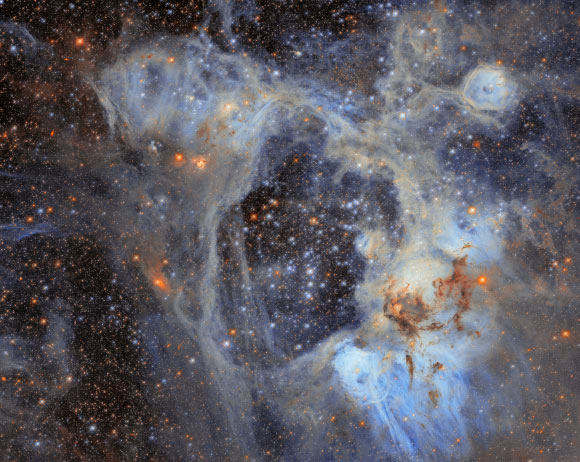
A new images from the NASA/ESA Hubble Space Telescope reveals LHA 120-N44, a striking nebula located roughly 160,000 light-years away in the Large Magellanic Cloud, a satellite galaxy of the Milky Way.
LHA 120-N44 (or N44 for short) resides approximately 160,000 light-years away in the constellation of Dorado.
'N44 is dominated by two features: a vast central void and a shell of dense, dusty gas,' Hubble astronomers said in a statement.
'The central void is a 'superbubble' spanning roughly 210 by 140 light-years across.'
'The glittering stars at the center of the void are responsible for its creation; through their powerful stellar winds and explosive supernovae, these stars expelled much of the gas from which they were born.'
'When the stars of N44's central star cluster swept away this gas, the expelled gas formed a shell around the superbubble.'
New stars are forming in this compressed gas shell, making N44 an interesting target for researchers studying the process of star formation.
The astronomers used Hubble to catalog nearly half a million stars in the region, including roughly 30,000 still in their infancy, before they've begun fusing hydrogen.
'Each feature within the broader N44 star-forming complex was catalogued by astronomer Karl Henize in the 1950s,' they said.
'One feature is a smaller bubble, catalogued as N44F, that is located near the upper-right corner of this image.'
'N44F is an interstellar bubble blown by the intense stellar winds of a single hot and massive star.'
'As this previously released Hubble close-up shows, the star's furious winds and radiation have sculpted the surrounding bubble and created pillars of dusty gas.'
A note on cookies
Newshunt uses essential cookies to keep you signed in and to remember your language and country, so the site works the way you expect. With your permission, we'd also like to use analytics cookies to understand how people use Newshunt and improve it over time.
Accepting only affects analytics. To learn more, view our Privacy Policy or Terms & Conditions.
(0)Comments