


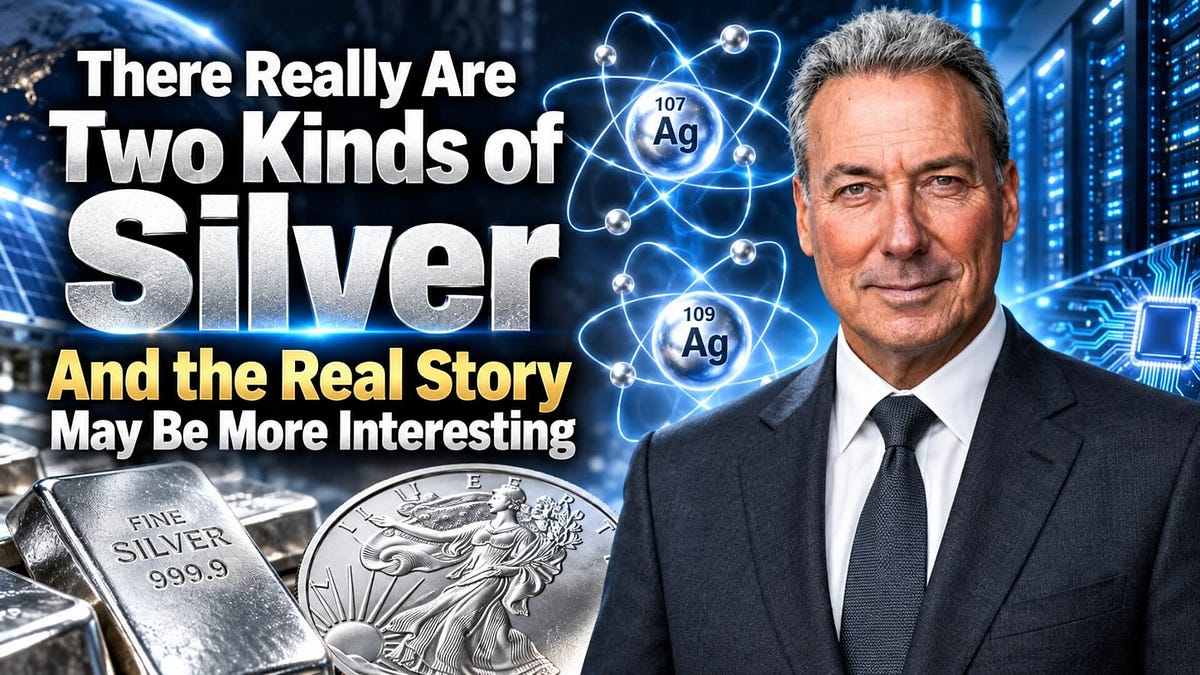
There Really Are Two Kinds of Silver: And the Real Story May Be More Interesting
Category: SciTech
Share
Archive
Like
Every so often, a claim about silver comes along that sounds so unusual that it deserves a closer look.
Recently, attention has been drawn to the idea that there are two forms of naturally occurring silver-107 and 109 and that one of them may possess unusual properties. Silver is a much more unusual element than most people realize, and its physical properties put it at the intersection of several technologies that could shape the next decade.
The Two Silvers in Your Silver
Natural silver consists of two stable isotopes.
According to the National Institute of Standards and Technology (NIST), approximately51.84% of naturally occurring silver is Silver-107 (¹⁰⁷Ag), while approximately48.16% is Silver-109 (¹⁰⁹Ag).
Both contain 47 protons, the defining characteristic of silver. The difference is in the nucleus. Silver-107 contains 60 neutrons, while Silver-109 contains 62. Both isotopes are stable, and both have a nuclear spin of 1/2, although their nuclear magnetic moments differ. These aren't theoretical constructs.
The U.S. Department of Energy's National Isotope Development Center makes highly enriched silver isotopes available for scientific purposes: Silver-107 enriched above 98% and Silver-109 enriched above 97%.
So, when you hold a one-ounce Silver Eagle, you aren't holding atoms that are all identical. Roughly speaking, slightly more than half the silver atoms are Ag-107 and slightly less than half are Ag-109. That is fascinating science.
Does Silver-107 have some unique properties? I spoke with Clif High some time ago about the possibilities. Recently, Clif brought up the idea with CryptoRich. Shortly after, some inquiries came in asking if there really are two types of silver.
The existence of Silver-107 and Silver-109 is established science. Their different atomic masses and nuclear characteristics are measurable. Claims about specific properties are not yet established but keep an open mind.
For investors, however, the known properties are impressive enough. Anything beyond could only enhance the status of silver.
The Most Electrically Important Metal on Earth
Silver has the highest electrical conductivity and thermal conductivity of any metal, along with extremely high optical reflectivity. Those characteristics explain why silver keeps appearing wherever electrical efficiency and reliability matter.
Silver is used in electrical contacts, electronics, power systems, automobiles, solar cells, catalysts, and numerous specialized industrial applications. That becomes increasingly important as the world becomes more electrified. For most of human history, silver's monetary characteristics dominated its story.
During the next stage of technological development, its electrical characteristics may become equally important.
AI Is Becoming a Silver Story
Artificial intelligence sounds like software. But AI ultimately exists in the physical world. It requires enormous data centers filled with servers, processors, switches, power-management systems, cooling equipment, and electrical connections. Those facilities require enormous quantities of electricity—and an expanding electrical infrastructure to deliver it.
Silver appears throughout the electronics and electrical ecosystem because conductivity matters. The Silver Institute reports that AI-related technologies and data centers are among the areas expected to support silver consumption in the years ahead.
The same applies to the power grid expansion needed to support them. The AI revolution, therefore, isn't merely about semiconductor chips. It is also aboutelectrons. And when moving electrons efficiently matters, silver has a seat at the table.
Automobiles Are Becoming Electronic Devices
Another major transformation is taking place in transportation. Modern vehicles contain increasingly sophisticated electronics whether the vehicle is gasoline-powered, hybrid, or fully electric. Sensors, control modules, infotainment systems, safety systems, power electronics, and electrical connections all create potential uses for silver. Electrification increases that intensity.
The Silver Institute identifies automotive applications and EV infrastructure as structural growth areas for silver demand through the end of the decade. That makes the automotive silver story larger than simply predicting how many EVs will be sold. The broader trend is thatcars are becoming computers on wheels.
Solar: A Huge Market, But There's an Important Catch
Solar energy has been one of silver's greatest industrial growth stories. Silver paste is used in photovoltaic cells to collect and conduct electricity generated by sunlight. Between 2020 and 2024, silver demand from photovoltaics more than doubled.
But investors need to understand what is happening now. Solar manufacturers have strong economic incentives to use less silver because silver represents a material cost. Manufacturers have therefore reduced the amount of silver required per cell; this is known as 'thrifting' and, in some cases, pursuing substitution.
That trend became significant enough that photovoltaic silver demand declined in 2025 even as other technology-related silver applications continued to grow. The 2026 World Silver Survey expects further pressure from PV thrifting and substitution.
This is precisely why I resist simplistic projections that take today's silver consumption per solar panel and multiply it by tomorrow's expected solar installations. Technology adapts to price. Copper substitution is already being manufactured into solar panels. Yet, there is another side to the equation.
Global solar installations can continue increasing even while manufacturers use less silver per panel. The question becomes whether growth in total installations eventually overwhelms reductions in silver intensity. That is one of the important silver-demand variables we will be watching.
The Electrical Grid May Be the Sleeper
Perhaps one of the least glamorous—but most important—silver stories is the electrical grid itself. AI data centers, electric vehicles, renewable generation, battery systems and an increasingly digital economy all require electricity. Electricity requires generation. Generation requires transmission. Transmission requires switching, control and distribution equipment.
The Silver Institute reports that power-grid investment has already been contributing to structural silver demand. That suggests we should stop looking at AI, EVs, solar, and grid modernization as separate silver stories. They are interconnected pieces of a larger trend:
The world is attempting to electrify more of the economy.Silver is one of the materials enabling that transformation.
Industrial Demand Has Already Changed the Market
This isn't merely a forecast. Industrial silver demand reached a record680.5 million ounces in 2024, marking the fourth consecutive annual record.
Demand eased to657.4 million ounces in 2025, primarily because solar thrifting and other industrial changes outweighed growth in areas including AI infrastructure, automobiles, and grid investment. For 2026, Metals Focus forecasts industrial demand of approximately639.6 million ounces. Those numbers deserve some perspective.
Industrial demand alone is now consuming hundreds of millions of ounces of silver annually. And unlike investment bars sitting in a vault, much industrial silver is dispersed across enormous numbers of products. Some will eventually be recycled, but recovering tiny quantities of silver from millions of electronic components is very different from melting a 1,000-ounce commercial bar.
Investment Demand
This is where silver becomes unlike most commodities. Copper is overwhelmingly an industrial metal. Gold is a monetary and investment metal. Silver sits between the two worlds.
When economic activity accelerates, industrial demand can benefit silver. When distrust of currencies, debt markets, or financial institutions rises, investment demand can benefit silver.
That dual identity has always been central to the silver thesis. According to the Silver Institute, the market is expected to record itssixth consecutive annual supply deficit in 2026, while physical investment is forecast to rise substantially.
A market deficit does not automatically mean prices must rise immediately. Above-ground inventories, recycling, investor selling, and substitution all matter. But persistent deficits deserve attention.
The Next Few Years
So where might silver demand come from over the next several years?
The areas I will be watching most closely areAI and data-center infrastructure, electrical-grid expansion, automotive electronics and electrification, photovoltaics, advanced electronics, aerospace applications, and silver-based industrial catalysts.
Some will grow faster than others. Some applications will use less silver per unit as engineers respond to higher prices. New technologies may emerge that we aren't adequately accounting for today.
That is how commodity markets work. The strongest case for silver doesn't require assuming that every new technology will consume enormous quantities of metal. It simply requires recognizing something much more fundamental: We are building a more electrical world, and silver is the world's best electrical conductor.
Two Silvers—and One Remarkable Metal
So yes, there really are two naturally occurring stable isotopes of silver.
Silver-107.
Silver-109.
That isn't speculation. It is atomic physics. Whether one isotope possesses properties involving human consciousness remains an entirely different question.
Silver already possesses an extraordinary combination of characteristics: unmatched electrical conductivity among metals, exceptional thermal conductivity, high reflectivity, useful catalytic properties, and thousands of years of monetary history.
Few elements sit at the intersection of the ancient world of money and the emerging world of artificial intelligence, electrification, advanced technology, and perhaps a new field.
Silver does. For thousands of years, humanity valued silver because it was money. The intriguing question for the next decade is whether we will increasingly value it becausemodern civilization can't do everything it wants to do without it.
David Morgan is the publisher of The Morgan Report and has followed the precious-metals and mining markets for more than four decades. See: https://www.themorganreport.com/
Thanks for reading The Morgan Report! Subscribe for free to receive new posts and support my work.
A note on cookies
Newshunt uses essential cookies to keep you signed in and to remember your language and country, so the site works the way you expect. With your permission, we'd also like to use analytics cookies to understand how people use Newshunt and improve it over time.
Accepting only affects analytics. To learn more, view our Privacy Policy or Terms & Conditions.
(0)Comments