


LUMS Scientists Identify Promising Plant Compounds
Category: SciTech
Share
Archive
Like
Researchers from the Lahore University of Management Sciences (LUMS) have contributed to an international scientific study that identified two synthetic compounds capable of improving plants' tolerance to drought by modulating potassium (K⁺) channel activity.
Dr Khurram Bashir, Associate Professor at LUMS, and PhD researcher Farhan Aziz were among the co-authors of the study, which brought together scientists from Pakistan, Japan, Italy, Germany and Spain. The findings have been published in the peer-reviewed journal Nature Communications.
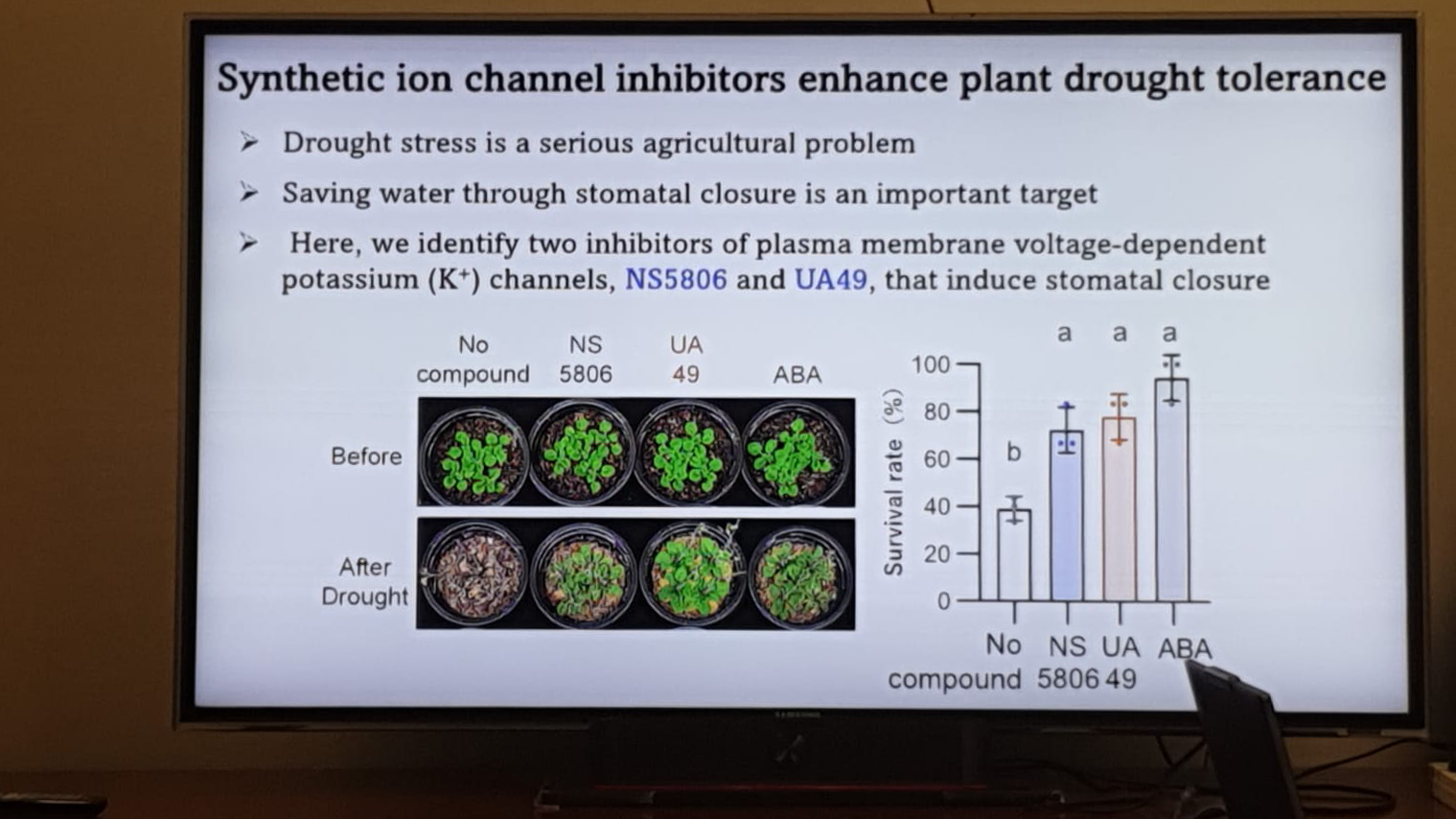
The research identified the small molecule NS5806 and its derivative, UA49, as compounds that promote stomatal closure while inhibiting stomatal opening. Stomata are microscopic pores on plant leaves that regulate gas exchange and water loss. Their movement plays a critical role in helping plants respond to water stress.
Under drought conditions, plants naturally produce the hormone abscisic acid (ABA), which helps conserve water by triggering stomatal closure. However, externally applying ABA can have unwanted effects, including delayed seed germination and reduced root growth, limiting its potential agricultural applications.
Laboratory experiments showed that NS5806 and UA49 enhanced drought tolerance without producing the ABA-associated effects observed with external hormone application. The findings indicate that the compounds may activate a signalling pathway distinct from the conventional ABA pathway.
The study also uncovered a previously unrecognised connection between potassium channel activity and calcium (Ca²⁺) signalling in guard cells, the specialised cells responsible for controlling stomatal movement. According to the researchers, this finding provides new insight into how K⁺ channels participate in intracellular signal transduction when plants experience environmental stress.
By inducing stomatal closure and limiting stomatal opening, the two compounds can help plants reduce water loss during drought conditions. The researchers also believe NS5806 and UA49 could serve as useful chemical tools for investigating the molecular mechanisms underlying stomatal regulation and plant adaptation to water scarcity.
The findings could have wider significance for agriculture in countries facing increasing pressure on water resources. In Pakistan, crop production remains heavily dependent on irrigation, while rising temperatures, changing rainfall patterns and growing water stress are increasing the vulnerability of agricultural systems to climate variability.
A better understanding of the cellular mechanisms that regulate plant water loss could contribute to longer-term efforts to develop crops that are more resilient to drought and other environmental stresses. However, the current research does not establish NS5806 or UA49 as agricultural treatments for Pakistani crops.
The researchers describe the compounds as promising candidates for future drought-tolerance research, but additional studies will be needed to determine their effectiveness in commercially important crops and assess their performance under field conditions.
The international collaboration also highlights the growing importance of cross-border research in plant stress biology. With researchers from five countries working together, the study provides new molecular-level insights that could eventually contribute to strategies for helping plants withstand water scarcity and climate-related stresses.
A note on cookies
Newshunt uses essential cookies to keep you signed in and to remember your language and country, so the site works the way you expect. With your permission, we'd also like to use analytics cookies to understand how people use Newshunt and improve it over time.
Accepting only affects analytics. To learn more, view our Privacy Policy or Terms & Conditions.
(0)Comments