


Nagpur Retains 10th Spot In Clean-Air Survey, Score Slips Marginally To 183.8
Category: Health
Share
Archive
Like
Nagpur: Despite a marginal dip in marks, Nagpur retained 10th position in the national clean-air ranking for the second consecutive year, scoring 183.8 in the fifth Swachh Vayu Sarvekshan 2026.
The city has steadily improved its standing in the survey — from 18th, with 166 marks, in 2023, to 15th, with 169.6 marks, in 2024, and 10th, with 185 marks, last year, when it first entered the top 10. Within Maharashtra, Nagpur secured third position.
The awards were announced by the Ministry of Environment, Forest and Climate Change (MoEF&CC) on September 7, coinciding with Swachh Vayu Diwas.
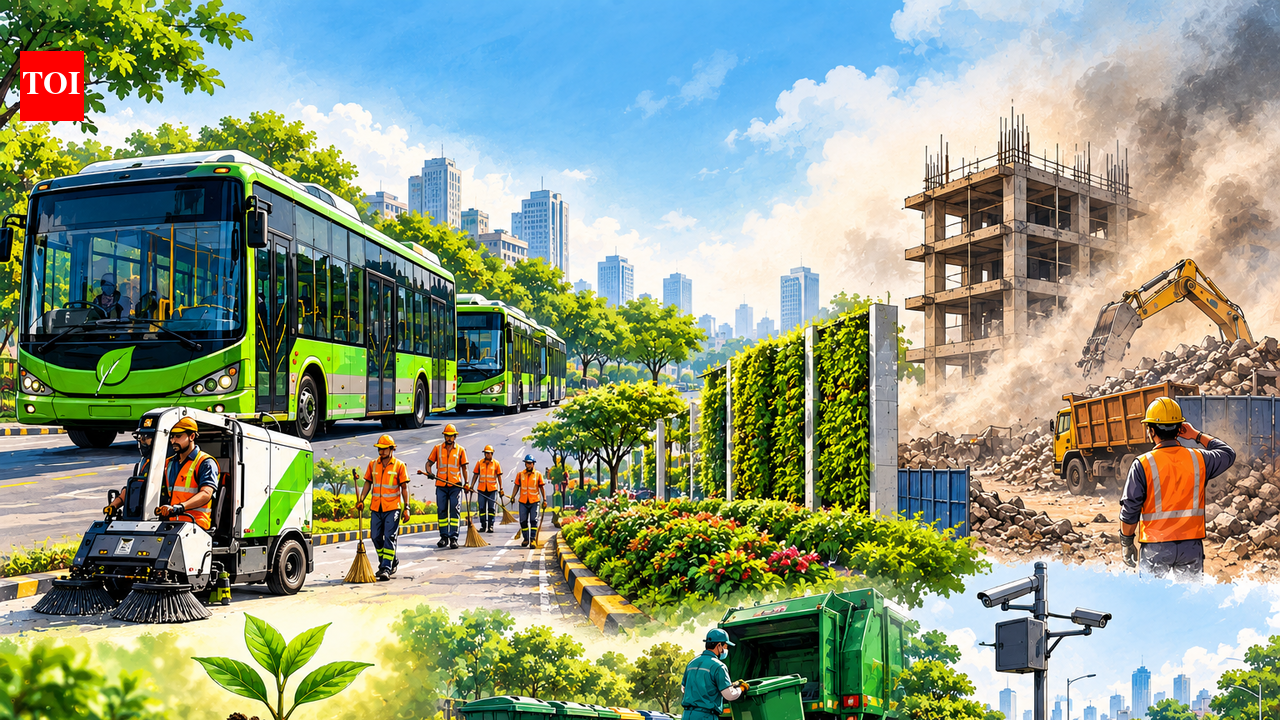
A major contributor to Nagpur's performance has been the shift to electric public transport.
Of Nagpur Municipal Corporation's (NMC) fleet of more than 700 buses, only 195 run on diesel, with the rest electric — a transition that has helped curb vehicular emissions, a key component of the clean-air action plan.
Road-dust management has also played a role. NMC's solid waste management department has deployed mechanised sweepers, supported by more than 5,000 sanitary workers who manually sweep roads across the city's nearly 4,500-km network.
Legacy-waste processing, improved solid waste management, and expanded green cover through road dividers and vertical gardens have further boosted the city's score. The Intelligent Traffic Management System (ITMS), aimed at reducing vehicle idling and associated emissions, is another key component of the plan.
Mayor Neeta Thakre and municipal commissioner Vipin Itankar have been overseeing implementation of the clean-air action plan under the National Clean Air Programme (NCAP).
Construction and demolition activity, however, remains a weak link. Nagpur's ranking could have been higher with stricter enforcement against developers and builders undertaking such activity, since dust generated by demolition, excavation and transportation of construction material adds significantly to particulate pollution — making compliance monitoring at such sites crucial.
NMC's environmental department, headed by superintending engineer Shweta Banerjee, monitors construction-related pollution.
TOI tried to contact Banerjee for her response on Nagpur's performance and enforcement against construction-related pollution, but she did not respond.
Centre for Sustainable Development founder-director and environmentalist Leena Buddhe attributed Nagpur's gains to the paving of unpaved stretches, mechanised sweeping, legacy-waste processing and compressed biogas (CBG) initiatives.
She also highlighted CFSD's NCAP-funded awareness programmes, which reached around two lakh households and were conducted across NMC schools, colleges, slums and communities.
Around 3,000 sanitation workers across all 10 NMC zones were sensitised to the health impacts of biomass burning.
According to Buddhe, these initiatives have improved awareness among students and residents, and helped reduce incidents of garbage and biomass burning.
The survey assesses measures taken by various agencies to tackle identified sources of air pollution, with departments such as the Nagpur Municipal Corporation (NMC) and Maharashtra Industrial Development Corporation (MIDC) submitting action-taken reports in a prescribed format.
WHAT HELPED NAGPUR
Majority of city buses converted to electric
Mechanised road sweeping introduced
5,000-plus sanitary workers deployed
Around 4,500-km road network covered by sweeping operations
Legacy waste processing and CBG initiatives
Green cover through road dividers and vertical gardens
ITMS aimed at reducing vehicle idling
Awareness campaigns covering around two lakh households
Sensitisation of nearly 3,000 sanitation workers
YEAR-WISESCORECARD
Year—National rank — Score
2023—18—166
2024—15—169.6
2025—10—185
2026—10—183.8
You Can Also Check:
Gold Rate in Nagpur
|
Silver Rate in Nagpur
|
Bank Holidays in Nagpur
|
Public Holidays in Nagpur
|
Petrol Price in Nagpur
|
Diesel Price in Nagpur
|
CNG Price in Nagpur
|
LPG Price in Nagpur
Stay updated with the latest Nagpur news. Download the TOI App.
A note on cookies
Newshunt uses essential cookies to keep you signed in and to remember your language and country, so the site works the way you expect. With your permission, we'd also like to use analytics cookies to understand how people use Newshunt and improve it over time.
Accepting only affects analytics. To learn more, view our Privacy Policy or Terms & Conditions.
(0)Comments