


Warning of new flood threat as barrier lakes swell and rescue teams struggle to cope with glacier collapse in Nepal
Category: Tourism
Share
Archive
Like
Nepal and China have both warned of fresh risks of flooding in the Himalayas as two lakes that have developed on either side of their border threaten to burst in a region still grappling with this week's catastrophic flood.
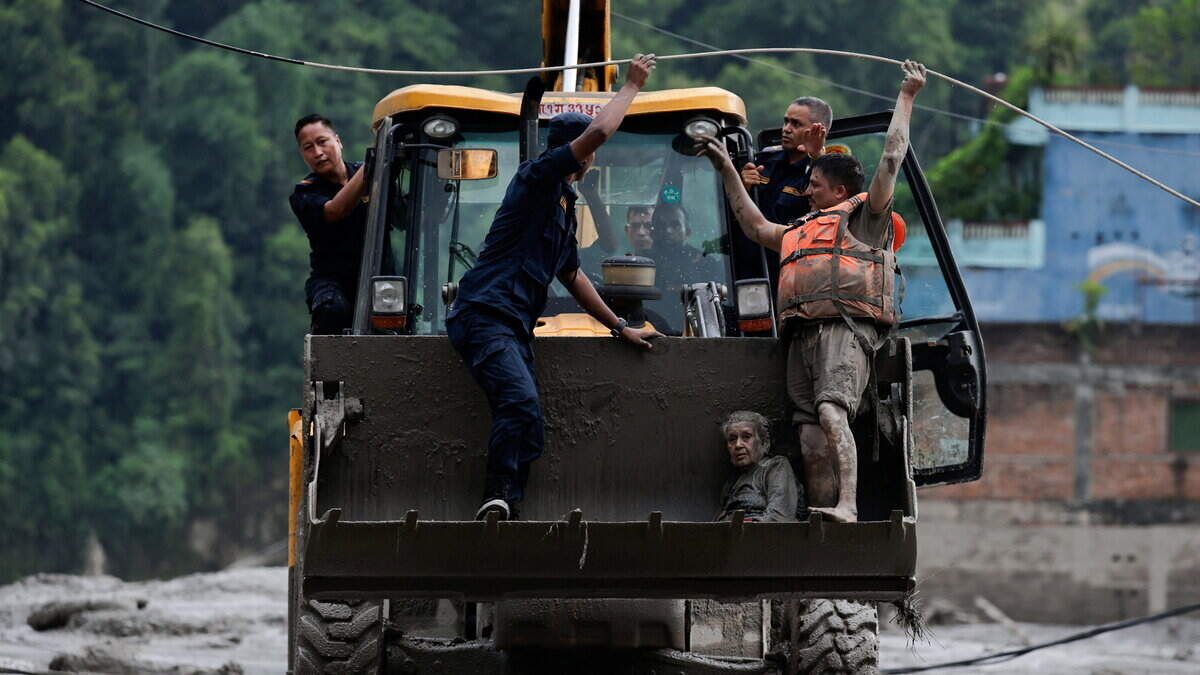
Search and rescue operations are still under way in the debris-strewn valleys and hillsides, with nearly 1,000 people still missing after Wednesday's flood struck the border regions of Nepal and China's Tibet, killing at least 362 people.
Both countries have blamed the flood on a glacier collapse that pushed rock, ice, mud and debris into river systems in the mountains.
Nepal's disaster authority issued a notice on Thursday warning that a lake formed by debris blocking a river at the flood site is rising and at risk of bursting.
Read more Explainer: What triggered Nepal flash floods? Glacier collapse so powerful it registered as an earthquake
The authority urged residents and rescuers along the lower banks of the river to move to safe areas.
China warned that three million cubic metres of water – the equivalent of about 1,200 Olympic swimming pools – are expected to flow into an already dammed lake on its side of the border over the next three days, creating a high risk of a breach, with peak flow expected around September 1.
The formation of a barrier lake was captured in aerial footage by a Chinese rescue team on Thursday, state broadcaster CGTN reported.
The footage showed masses of brown water accumulating in a basin with no visible outlet. The water had already submerged bushes and trees and appeared to push against a barrier of debris and stones.
Rainfall forecast over the coming week will exacerbate the threat, Chinese state media said, citing the Chinese water resources ministry.
'The volume of water is continuing to increase, and so is the risk,' Zhu Jinfeng, a researcher at the water resources ministry's hydrology department, told state broadcaster CCTV.
Heeding the warning, some rescue workers in Nepal began moving towards higher ground on Thursday.
Among them was Pawan Koirala, who began moving away from the river bed along with his team of 13 after the warning was issued.
'We are here for rescue and don't want to be near the danger zone,' he said.
Authorities in Nepal used helicopters to search for survivors and drop emergency supplies to thousands cut off in towns and valleys in the wake of Wednesday's disaster, which swept down a route thronged by trekkers and pilgrims that links Kathmandu with Lhasa in Tibet.
Dozens of bodies were swept down into the plains from where they were being recovered.
Nepal's Home Minister Sudhan Gurung said the focus remained on finding survivors as rescue teams located 100 missing Indian visitors, mostly pilgrims, and 25 Chinese workers in the worst-hit region around Trishuli.
Nearly 550 foreigners were still unaccounted for, while Nepali authorities were yet to determine the number of locals missing.
The Red Cross said that entire villages had been destroyed and impassable roads and bridges had left communities cut off. The full scale of the disaster remains unclear, it added.
The tally of missing in Tibet's Gyirong County was 558, Chinese state broadcaster CCTV said on Thursday, including 260 foreign nationals. China said the death toll stayed at three.
Residents look at the devastation left by flash flooding in Nepal's Nuwakot district © AP
The missing foreigners in Nepal belonged to more than two dozen countries, including 288 from India, 63 from the US, 51 from Malaysia, 34 from Australia, 33 from Britain and 25 from Canada. Two Irish people are also feared missing.
China is in close communication with Nepal on search and rescue efforts, with nearly 100 Chinese nationals in the affected area across the border in Nepal, the Chinese foreign ministry said.
China's Premier Li Qiang, arrived at the disaster-stricken site in Gyirong on Thursday afternoon, state-run Xinhua news agency said.
The visit suggested Beijing was treating the disaster as a matter of the highest national priority.
The Gyirong border port has a key role linking the country to South Asia, with logistics parks, yards, and car parks built there in the past decade.
Verified videos showed crushing masses of water and debris sweeping away dozens of people at a border crossing in Gyirong, with homes, roads and power projects washed away in Nepal as the flows travelled downstream.
Chinese government geologist Guo Zhaocheng said the ice-avalanche debris flow that caused the mudslide travelled at about 50 metres per second, leaving people little time to react, and extended for more than 20km.
Mr Guo said a high-altitude ice avalanche triggered the debris flow, which picked up glacial moraine as it moved down a channel before becoming a mudslide that struck port facilities and areas on both sides of the China-Nepal border.
Ganesh Aryal, the administrator of Chitwan district, said authorities had recovered 103 bodies from the river system in his district, which is about 100km away in the plains from Trishuli.
There are no human-made things, no human settlement left. Everything is just flat
Sangar Pandey
Tourism operator
With local hospitals unable to accommodate all the bodies, district authorities were setting up tents and making arrangements for families to claim their dead relatives, he said.
Nepal's Prime Minister Balendra Shah left by road to assess the flood situation in one of the worst-affected districts of Nuwakot, his office said on social media.
The disaster is a major challenge for Mr Shah's five-month-old government, but officials said the country had systems and officials who have experience in handling such tragedies, including the 2015 earthquake that killed nearly 9,000 people.
Early reports from Nepali officials suggested an earthquake in the area could have caused the lower part of a glacier to collapse and trigger the floods.
The US Geological Survey said an earthquake with magnitude initially reported as 4.4 was in fact seismic energy generated by the collapse of glacial rock and ice, followed by debris flow.
Beijing officially identified the cause of the disaster, with the Xinhua news agency reporting: 'Cause of the Gyirong mudslide in Tibet identified: A high-altitude glacier collapse in Nepal.'
Chinese authorities have also identified risks from a still-dammed lake in Gyirong, upstream from the mudslide and flood-stricken Tibet-Nepal border crossing that could complicate rescue efforts, particularly as rains are forecast, CCTV said.
On Thursday morning, the dammed lake was estimated at two million cubic metres in volume and was already overflowing, state media said.
Many of this week's victims were pilgrims headed to Kailash Mansarovar, a high-altitude site in Tibet revered by Hindus and Buddhists, among others.
Mount Kailash, which Hindus believe to be the home of Lord Shiva and which lies on the banks of Lake Mansarovar, is also held sacred by many.
'There are no human-made things, no human settlement left. Everything is just flat,' Sagar Pandey, chief executive of a Himalayan tourism operator, said after flying over the zone in a helicopter.
Read more Magnitude 5 earthquake hits Tibet as more than 359 people killed by flash floods in Nepal; two Irish nationals among missing
'So anyone in the hotel, the restaurant, or the car, I believe that everybody is gone.'
Vasanthi Muniandy, whose sister Vennila was part of a Hindu pilgrimage group from Malaysia, said she had last heard from her after she had crossed into Tibet from Nepal.
'I am totally broken. My sister is very important to me,' Ms Muniandy said. 'I really want her to come back. I don't have anyone but her.'
A note on cookies
Newshunt uses essential cookies to keep you signed in and to remember your language and country, so the site works the way you expect. With your permission, we'd also like to use analytics cookies to understand how people use Newshunt and improve it over time.
Accepting only affects analytics. To learn more, view our Privacy Policy or Terms & Conditions.
(0)Comments