


Does Art Need Meaning?
Category: Blend
Share
Archive
Like
🟡Think of these notes as small provocations, not answers. You are free to accept them, reject them, misunderstand them, or forget them completely. If one question stays with you, good. If none do, that is also fine. Just keep making.
'In place of a hermeneutics we need an erotics of art.'Susan Sontag,Against Interpretation
Sontag argues that traditionalhermeneutics(the theory and practice of interpretation) reduces art to a hidden "content" or message to be decoded.
She believes that over-analyzing a work of art strips away its power, making it tame, manageable, and conformist.
We are often trained to explain our work.
What is it about?What does it represent?What is the concept?
Sometimes we become so good at explaining the work that the explanation becomes more convincing than the work itself.
But perhaps art does not always begin with understanding.
Sometimes we make because something disturbs us, attracts us, repeats itself, or simply refuses to leave. We follow it without fully knowing where it is going.
So what if the artist does not fully understand their own work?
Maybe that is not a weakness.
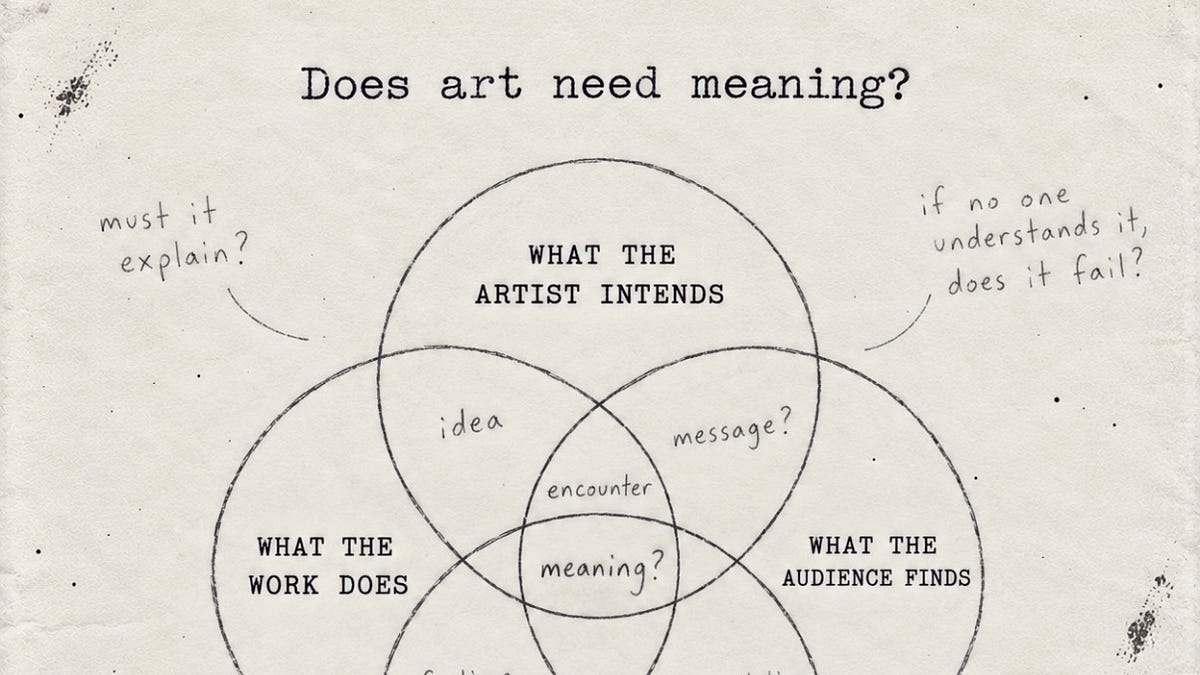
Marcel Duchamp once argued that the artist does not complete the creative act alone. The spectator also brings the work into the world through interpretation. Meaning, then, may not belong completely to the artist.
It can happen somewhere betweenintention and encounter.
This makes me wonder whether we are sometimes too desperate to make art 'mean something.'
We attach theories.We construct narratives.We search for important words.
But meaning that is added too quickly can become decoration.
Sol LeWitt famously wrote: 'The idea becomes a machine that makes the art.'
But an idea is not automatically meaning.
An artwork can begin with an idea and still need to discover why it matters.
Perhaps the more difficult question is not:
What does my artwork mean?
But:
Why does this work need to exist?
And perhaps an even more uncomfortable one:
Are you making meaning, or decorating an idea?
'Meaning changes when the viewer changes.'
-Dr.Kamal Sabran
A note on cookies
Newshunt uses essential cookies to keep you signed in and to remember your language and country, so the site works the way you expect. With your permission, we'd also like to use analytics cookies to understand how people use Newshunt and improve it over time.
Accepting only affects analytics. To learn more, view our Privacy Policy or Terms & Conditions.
(0)Comments