


In the early Holocene, West Siberian peatlands started storing carbon. Today, 11,700 years later, the lowland holds 70 billion tonnes, but thawing puts the store at risk
Category: SciTech
Share
Archive
Like
The
West Siberian Lowland
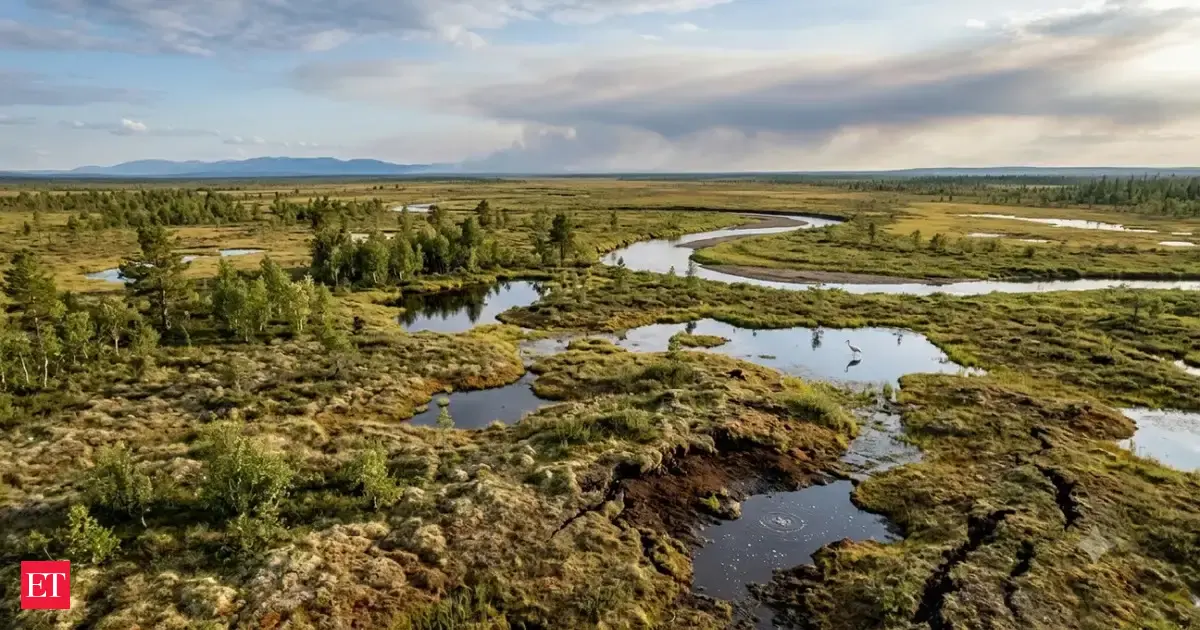
has been a long-term carbon dioxide sink and global methane source since the early Holocene, which began around 11,700 years ago. The region is estimated to contain about 70 billion metric tonnes of carbon.
Stretching across around 3 million square kilometres of central Russia, the West Siberian Lowland extends from the northern Arctic tundra to the edges of the Kazakhstan steppe. The Ural Mountains lie to the west and the Yenisey River valley to the east, while the lowland accounts for about 16% of Russia's territory.
The region contains what is generally considered the
world's largest peatland
, although estimates of its size vary. Research estimates range from 592,440 to 900,000 square kilometres, while Guinness World Records puts the area at 787,000 square kilometres, as per a Discover Wildlife report.
A vast carbon store dating back to the early Holocene
The West Siberian Lowland has functioned as a long-term carbon dioxide sink since the early Holocene and is also a global methane source.
Its peatlands hold an estimated 70 petagrams of carbon, equivalent to 70 billion metric tonnes. But the conditions that have helped preserve this enormous store are changing.
Thawing permafrost
puts the store at risk
Permafrost lies beneath the snow-covered landscape, but it is thawing across the region.
As the permafrost thaws, the carbon store could release its contents into the atmosphere. This could contribute to a positive feedback loop in which rising greenhouse gas levels increase global temperatures, leading to further permafrost thawing.
Heatwaves and wildfires also make the region more susceptible to releasing its stored carbon.
The
world's largest high-latitude wetland
The West Siberian Lowland is also the world's largest high-latitude wetland.
Apart from some low hills and ridges, the plain is mainly flat and featureless. Its wetlands and taiga support a wide range of wildlife.
Brown bears, grey wolves, Eurasian lynx and wolverines are among the predators found across the region. Smaller mammals include steppe polecats, Siberian weasels and Siberian flying squirrels.
The watery environment supports many insects and provides feeding opportunities for birds including yellow-breasted buntings, Siberian cranes and white-headed ducks. Migrating greater-spotted eagles also use the lowlands during the breeding season.
The wider West Siberia region is home to amphibians including the Siberian salamander, moor frog and Siberian wood frog. However, amphibian fauna is relatively poor because of the harsh climatic conditions.
A note on cookies
Newshunt uses essential cookies to keep you signed in and to remember your language and country, so the site works the way you expect. With your permission, we'd also like to use analytics cookies to understand how people use Newshunt and improve it over time.
Accepting only affects analytics. To learn more, view our Privacy Policy or Terms & Conditions.
(0)Comments