


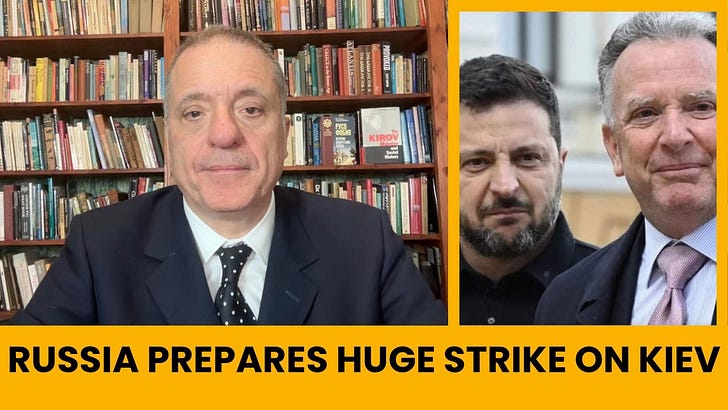
The Post-Mission Fallout: The Bizarre Witkoff-Kushner-Zelensky Press Conference Collapse The Expiration of the Capital Truce - Russia Readies Huge Kiev Strike
Category: Politics
Share
Archive
Like
The diplomatic shuttle undertaken by U.S. presidential envoys Steve Witkoff and Jared Kushner concluded its final leg in Kyiv without a negotiated breakthrough, setting the stage for an immediate kinetic resumption across the theater.
Following their Kremlin audience with Vladimir Putin, the American delegation traveled via rail from Warsaw to Kyiv, where scheduled substantive negotiations were largely eclipsed by a volatile and fragmented press conference.
Ukrainian President Volodymyr Zelensky rejected the disengagement parameters presented by the envoys, refusing territorial concessions in the Donbas and dismissing the disengagement baseline.
Simultaneously, Zelensky appeared to validate widespread reporting regarding the functional intent of the visit, commenting that Witkoff and Kushner had'performed even better than Patriot systems'in granting the capital a 72-hour pause in strikes and flippantly urging them to'come more often so our people have the opportunity to live a little longer.'
The localized capital pause expired at midnight, immediately preceding preparations for a multi-axis Russian strategic aviation strike.
Long-Range Aviation deployed Tu-95MS and Tu-160 bombers to forward staging airfields atEngels-2andOlenya, while frontline defenses buckled across multiple sectors:
Russian assault forces under Colonel General Andrey Ivanayev advanced into the village ofDobropillya,
Mechanics of encirclement closed aroundOleksiievo-DruzhkivkaandOrekhov,
The Russian Ministry of Defense confirmed that1,700 Ukrainian personnel remain encircledin the northeastern Kharkiv border pocket.
These developments coincide with political disruption in Western Europe: in the German state election inSaxony-Anhalt, theAlternative for Germany (AfD) surged to 43.8% of the vote, while Chancellor Friedrich Merz's Christian Democratic Union (CDU) dropped to 17.3%, escalating domestic political pressure in Berlin.
The contrast between the structured consultations in Moscow and the chaotic reception on Bankova Street laid bare the failure of Washington's shuttle diplomacy:
The Rejection of Reciprocity:Despite public statements from Steve Witkoff emphasizing that an enduring settlement requires territorial and strategic compromises, Zelensky dismissed the proposal to withdraw forces from the remaining contested sectors of Donetsk Oblast.
The 2027 Projections:In private briefings and public remarks, Bankova Street framed the current operational crisis as temporary, insisting that the military balance will shift decisively bymid-2027. This calculation assumes that anticipated surges in U.S. industrial output of Patriot PAC-3 MSE interceptors, combined with nascent domestic surface-to-air missile projects, will re-establish air defense coverage over major industrial and logistics nodes.
The Structural Reality:Defense manufacturing realities contradict this assessment. The global production capacity of PAC-3 interceptors remains constrained by sub-tier supplier bottlenecks, with backlogs stretching into the late 2020s.
With the expiration of the localized 72-hour capital flight pause, Russian command networks have positioned strategic strike aviation for a theater-wide infrastructure campaign:
Strategic Bomber Deployment:Following the redeployment of regiments from the Far East, satellite telemetry confirmed the concentration ofTu-95MSturboprop bombers andTu-160supersonic missile carriers atOlenya(Murmansk Oblast) andEngels-2(Saratov Oblast). Ground crews completed the uploading of Kh-101 air-launched cruise missiles, preparing high-volume salvos targeting high-voltage electrical autotransformers and rail electrification networks.
The Demise of Open-Skies Conventions:The vulnerability of strategic aviation bases demonstrated during previous Ukrainian asymmetric drone raids (such as the historic 'Spider's Web' operation) led to a comprehensive construction campaign of hardened aircraft revetments and concrete blast pens across western Russian military airfields. This construction ended decades of informal superpower agreements that kept strategic delivery platforms visible in the open for satellite verification.
The Interdiction of Western Logistics:Simultaneously, overnight precision strikes continued against western logistics hubs. Drone strikes damaged freight distribution complexes inDniproandKhmelnytskyi, while maritime denial in the Black Sea was enforced via Banderol missile strikes on merchant shipping attempting unauthorized entry into the Dniester and Danube estuaries.
The Perm Interception Wave:Russian air defense units repelled a concentrated overnight strike package involving up to306 Ukrainian long-range drones, with the primary wave directed against the industrial refining complex inPerm. Multi-layered Pantsir-S1, S-400, and automated electronic warfare assets intercepted the drones, preventing critical damage to fuel production units.
Along the line of contact, Russian motorized and airborne formations maintained operational tempo across key Donbas and southern axes:
The Dobropillya Encirclement:Video documentation corroborated reports from Russian military analyst Andrei Marochko showing Russian assault forces advancing through thecenter of the village of Dobropillya. With Russian positions established inHannivkato the northeast, the advance closes physical fire control over the T-0514 highway, leaving the Ukrainian garrison inside the town of Dobropillya isolated.
The Oleksiievo-Druzhkivka Salient:Northeast of Druzhkivka, Russian units expanded control over60% of Oleksiievo-Druzhkivkafollowing the capture of Klynove, cutting the primary paved supply route connecting local defensive positions to Kramatorsk.
The Kharkiv Cauldron:In northeastern Kharkiv Oblast, the Russian Ministry of Defense confirmed that the operational pocket east of Vovchansk has contracted, enclosing an estimated1,700 Ukrainian personnel across 27 settlements. Deprived of tactical withdrawal orders, the pocket faces systematic reduction under FAB glide-bomb bombardment.
The Svyatohirsk Anomaly:Conflicting assessments emerged along the northern flank of Sloviansk. While the Kremlin formally claimed the capture ofSvyatohirskon September 1, Ukrainian command released verified video showing senior officers inside the municipal core. Analysts assess that while Russian vanguards established forward firing positions near the historic Holy Dormition Lavra, continuous counterattacks and heavy artillery fire from the high ground west of the Seversky Donets River have turned the town into a contested grey zone.
The diplomatic failure in Eastern Europe coincided with political shifts inside Germany, the primary European financial underwriter of the Ukrainian war effort:
The Rejection of the Leipzig Frame:The Merz government's attempt to weaponize the Leipzig Airport drone incident—framing the discovery of an unexploded UAV near an An-124 airframe as an imminent Russian hybrid attack—failed to resonate with the eastern German electorate.
Economic Reality over Rhetoric:Voters in Saxony-Anhalt delivered a rebuke centered on industrial contraction, surging domestic energy costs following the cutoff of cheap Russian pipeline gas, and open-ended financial underwriting of Kyiv.
The Federal Leadership Crisis:The scale of the CDU's collapse has ignited open dissent within the Union faction, with regional leaders questioning whether Friedrich Merz's aggressive foreign policy and unstinting support for Ukraine are making the party unelectable ahead of federal contests.
The collapse of the Kushner-Witkoff diplomatic effort underscores the widening divergence between political narratives and physical reality.
Bankova Street's refusal to negotiate concessions reflects an assumption that the Western alliance will continue to underwrite the conflict indefinitely, betting on speculative industrial expansions in 2027.
Yet on the ground, the margin of survival is rapidly shrinking.
With1,700 troops trapped in Kharkiv,Ivanayev's pincers closing the Dobropillya and Druzhkivka cauldrons,strategic bombers forward-staged at Engels-2for a nationwide strike on the energy grid, andpolitical stability unraveling in Berlin, the conflict has reached an inflection point:the military outcome in Eastern Europe will be decided by the collapse of frontline logistics and the destruction of the domestic power grid, rendering performative diplomatic maneuvers entirely obsolete.
A note on cookies
Newshunt uses essential cookies to keep you signed in and to remember your language and country, so the site works the way you expect. With your permission, we'd also like to use analytics cookies to understand how people use Newshunt and improve it over time.
Accepting only affects analytics. To learn more, view our Privacy Policy or Terms & Conditions.
(0)Comments