


Can You Trace an AI Decision Back to the Data That Created It?
Category: SciTech
Share
Archive
Like
A walk backward through data, context, and reasoning — and why most enterprise AI systems can't survive the trip.
I've spent over a decade building enterprise data and analytics platforms — the kind that sit underneath dashboards, reports, and, increasingly, AI-driven recommendations at large organizations. A few years ago, on a healthcare analytics program, I watched a readmission-risk model quietly flag a batch of patients as low-risk who had no business being scored that way.
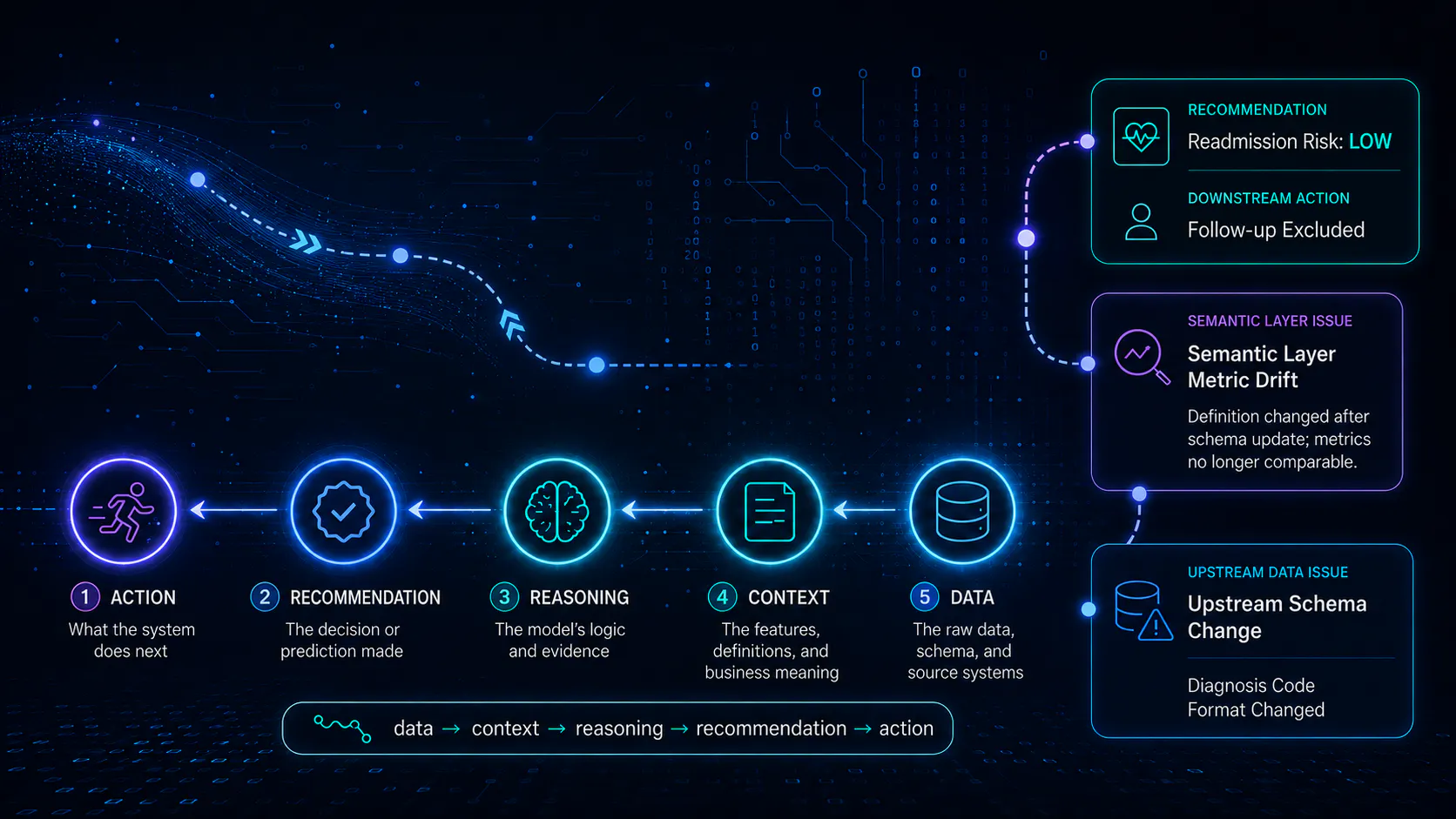
The answer wasn't in the model. It was buried four layers back, in a semantic layer metric that had silently drifted after an upstream schema change nobody flagged. And finding it meant walking backward through a chain most enterprise teams never bother to map: data → context → reasoning → recommendation → action.
This is the story of that walk, and why I think every team shipping AI-driven decisions — especially ones built on top of enterprise analytics platforms — needs to be able to make it.
The question nobody asks until it's too late
When a model spits out a recommendation, the natural question is "is it right?" That's the wrong first question. The right one is "where did this come from?"
Most teams can answer that for maybe one link in the chain. They can show you the training data. Or they can show you the final output. What almost nobody can do on demand is walk the full path — this specific data point, combined with this specific context, produced this specific line of reasoning, which produced this specific recommendation, which triggered this specific action.
That gap is invisible right up until someone asks you to explain a decision under pressure. A regulator. A customer. Your own VP after a bad outcome. Then it's the only thing that matters.
What "tracing" actually means
I want to be precise here because "explainability" has become a word that means everything and nothing. I'm not talking about SHAP values or attention maps — those tell you what the model weighted, not what actually happened in your system.
Tracing means being able to answer, for one specific decision, all five of these:
Most incident postmortems I've sat through get maybe two of these five. Usually reasoning and recommendation, because that's what's easiest to log — it's just the model call. Data and context get inferred after the fact, which means they get misremembered after the fact. Action almost never gets tied back at all.
The readmission flag, walked backward
Here's what that walk actually looked like once we stopped guessing and started instrumenting the platform itself, not just the model.
None of these five layers was individually broken. The model was doing exactly what it was trained to do. The pipeline hadn't crashed. The semantic layer wasn't throwing errors. But stacked together, they produced a decision nobody would have signed off on if they'd seen the whole chain at once — and in a healthcare context, "low-risk" isn't a label you want to get wrong quietly.
That's the part that stuck with me: failures like this rarely live in one layer. They live in the seams between layers, where nobody owns the handoff.
Why this is harder than it sounds
If tracing sounds simple in theory, here's why it isn't in practice.
What actually helped
I'm not going to pretend we solved this cleanly. But a few things moved us from "we can't trace anything" to "we can trace most things in under an hour," which is a real improvement.
We started fingerprinting decisions, not just logging them. Every recommendation now carries a composite ID referencing the exact data snapshot, semantic layer definition version, feature version, and model version involved — not just a timestamp, an actual pointer to reconstructable state.
We stopped treating the semantic layer as a black box. Metric and feature definitions in the semantic layer now carry their own version history and lineage back to source tables, so a drift like the join issue above shows up as a traceable change, not an unexplained shift in a number.
We separated "recommendation" from "action" in our logs, explicitly. If a clinician, analyst, or downstream system deviates from the model's suggestion, that deviation is logged as its own event, not silently merged into "what happened."
We made the chain queryable by non-engineers. This mattered more than I expected. A clinical reviewer or compliance analyst shouldn't need a data engineer to reconstruct a decision. If tracing only works when the right person is in the room, it doesn't really work.
The uncomfortable part
Here's what I keep coming back to. Being able to trace a decision doesn't make the decision better. It just makes it accountable. And accountability is uncomfortable, because it means you can no longer wave at "the model" as an explanation. You have to say: this data was stale, this context signal was overweighted, this handoff had no owner.
That's a harder conversation than "the AI decided." But it's the only conversation that actually fixes anything, and it's the one your regulators, your customers, and eventually your own team are going to demand — whether or not you're ready to have it.
If you can't answer, right now, how a specific decision your system made last week traces back to the data behind it, start there. Pick one recommendation your platform produced this month, and see how far back you can actually walk it. That single exercise will tell you more about your AI readiness than any model benchmark will.
A note on cookies
Newshunt uses essential cookies to keep you signed in and to remember your language and country, so the site works the way you expect. With your permission, we'd also like to use analytics cookies to understand how people use Newshunt and improve it over time.
Accepting only affects analytics. To learn more, view our Privacy Policy or Terms & Conditions.
(0)Comments