


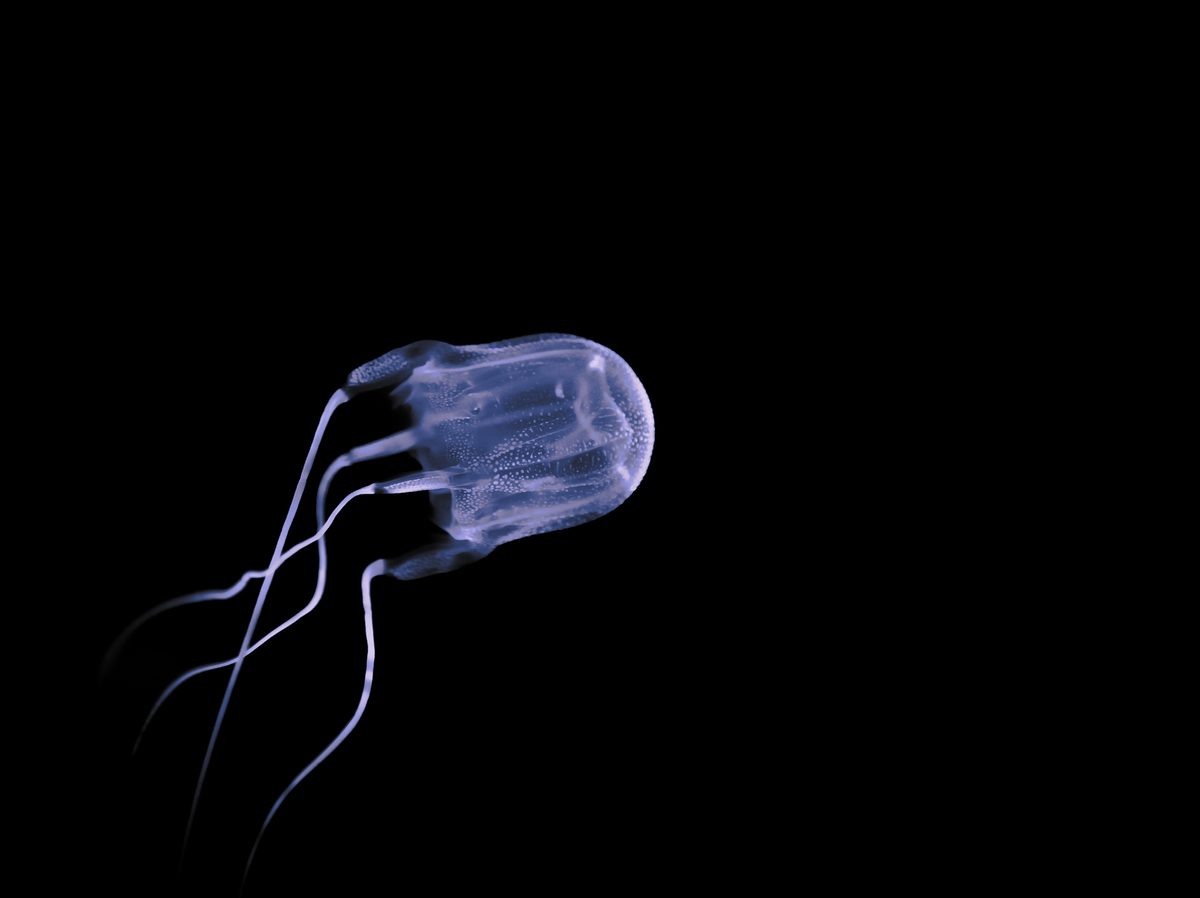
This predator uses its 24 eyes to help with transferring sperm packets during courtship. It could be lurking in the shallows near you
Category: SciTech
Share
Archive
Like
Most jellyfish are passive feeders, this means that species such as moon jellyfish don't need proper eyes, and instead possess simple, light-sensitive 'eye-spots' or 'ocelli' that detect light and dark to help them orientate themselves and find food. But the box jellyfish, which has 24 eyes, is an exception.
Unlike open-ocean jellies, box jellyfish hunt actively in shallow, obstacle-strewn waters such as mangrove swamps. Their eyes are arranged in four clusters, called rhopalia, that hang from the corners of their cuboid bodies. Each of these rhopalia contains six eyes of four different types. Some are simple light detectors but others are sophisticated.
Some of their upper eyes have retinas, corneas and lenses that allow them to look through the water's surface. Researchers believe these can pick out the silhouettes of overhanging mangrove trees, to help the jellyfish stay near their feeding grounds.
Other eyes with lenses look out for obstacles, while their simpler eyes are thought to measure light levels and estimate depth. Their vision is also thought to help with transferring sperm packets during courtship.
A note on cookies
Newshunt uses essential cookies to keep you signed in and to remember your language and country, so the site works the way you expect. With your permission, we'd also like to use analytics cookies to understand how people use Newshunt and improve it over time.
Accepting only affects analytics. To learn more, view our Privacy Policy or Terms & Conditions.
(0)Comments