


Divide and conquer: Defeating the AfD needs a fresh strategy
Category: Politics
Share
Archive
Like
Affairs
September 8, 2026
3 Min Read
If Germany wants to dodge a powerful, far-right government, it might need to let the AfD dig its own grave.
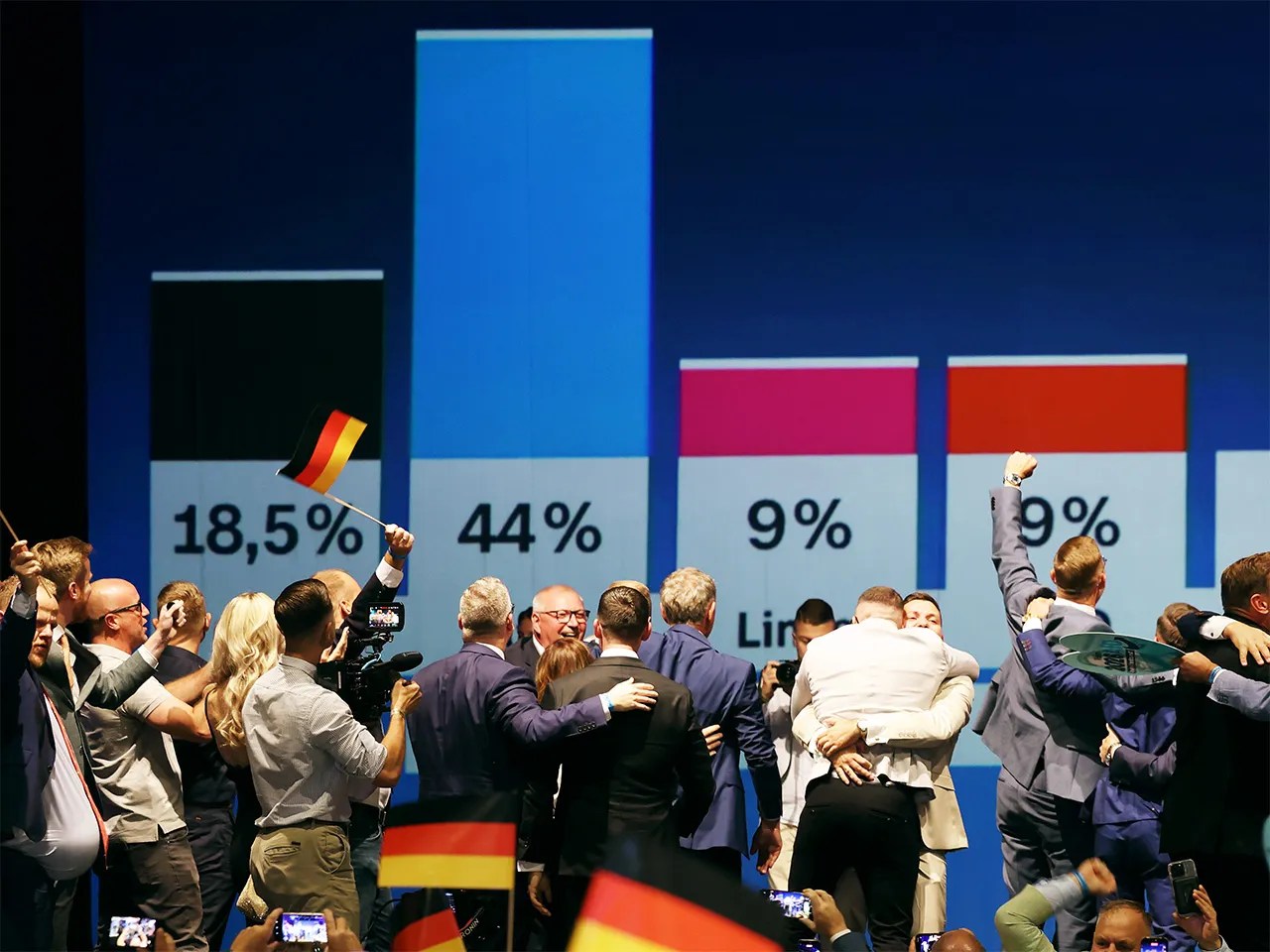
One thing is clear: Germany's firewall – the refusal of moderate parties to work with the far-right Alternative for Germany (AfD) under any circumstances – has failed. After emerging as the largest party in this weekend's elections with almost 44 per cent of the vote, the AfD gets first dibs this week on putting together a state government in Saxony-Anhalt. To prevent it from taking power there, quite literally every other party in the state – from the centre-right Christian Democratic Union (CDU) to the far left – would have to form a coalition. But I'd argue that the best solution would be for Chancellor Friedrich Merz and his CDU to jump into the fray and join a coalition with the AfD while they still can.
Many historians and those on the left will retort that Adolf Hitler rose to power with the same concept. But despite the country's history of liberal democrats allowing budding autocrats into government, hear me out: can the centre realistically hold the AfD out of a future government at this point? Waiting until they gain an absolute majority is far more dangerous.
Germany's current right-left coalition between the Christian Democrats and the Social Democrats has failed to govern effectively. Along with Merz's inability to implement reforms, two ideologically opposed parties – even those on relatively central ground – tend not to mesh well (try picturing Mitt Romney and Barack Obama in a cabinet together).
Voters tend to want bold plans and ideas, which is impossible when you're forced to compromise with your ideological opposite. Merz came to power promising to take the wind out of the AfD's sails, which was never going to happen while governing with a party that forced him to tack to the centre instead. Many voters have had no choice but to head to the fringes and, thanks to the firewall that protects it from having to govern effectively in a coalition, the AfD has been able to maintain its anti-establishment narrative for more than a decade now.
A coalition with the Christian Democrats would present a stark contrast to voters and test the AfD's actual governing chops, tempering the far-right party's instincts and distinguishing its own approach and policies more clearly. The left could then rebuild in opposition and present a viable alternative when the next election comes around.
An example of this strategy isn't hard to find. Twice in the past three decades, the far-right Freedom Party (FPÖ) in Austria was brought into government under the watchful eyes of the centre-right People's Party. The country was excoriated for breaking a perceived political firewall and both coalitions ended in scandal for the FPÖ, whose popularity then plummeted as a result.
The trick – at least from moderates' perspective – is to work with the extremes when the centre still controls the levers of power. It's a strategy that only works before the far-right becomes powerful enough to govern on its own, which in today's Germany is not a question of 'if' but 'when'. For now, other parties can still control the 'how'. Perhaps Germany should try the Austrian method and let the foxes into the henhouse.
A note on cookies
Newshunt uses essential cookies to keep you signed in and to remember your language and country, so the site works the way you expect. With your permission, we'd also like to use analytics cookies to understand how people use Newshunt and improve it over time.
Accepting only affects analytics. To learn more, view our Privacy Policy or Terms & Conditions.
(0)Comments