


U.S. utilities and grid operators are urging households to prepare for tighter electricity supplies, possible rolling blackouts during extreme weather, and new risks from large loads like data centers
Category: Business
Share
Archive
Like
Kind of Ironic that we lost power over the holiday and had a great dry run.
Hope everyone had a great Labor Day weekend. As we had company, a storm rolled in on us, and only 900 people in our county were without power.
As you have heard me say, it is better to prepare and walk through a crisis calmly, and your survival rate goes up. Just went through the normal procedures, pulled 3 of the buildings off the grid, and was about to sit down and watch a movie with the family when I realized there were some missing items in my backup plans.
Our guest bedroom spot was not covered in the wiring plans, and it will be fixed very easily; I already have the Jackery unit picked out. I have not spent much, as I installed one set of buildings from a Frankenstein-type system, thinking I could put my own together cheaper, but I was wrong. I really learned how to install solar by doing it all as a project, and it worked, but I highly recommend using professionals or buying a Jackery System, coupled with gasoline, natural gas, or propane systems. Generac systems are fantastic because they plug straight into natural gas or large propane tanks, but they could still go out. You don't have to spend a lot for a great system anymore.
A true hybrid mix for your house is ideal. Look at the amount of power needed to run a refrigerator, a freezer, heat, and cooking. Also plan on several weeks of water.
We all need to prepare for longer, more frequent blackouts as demand has steadily increased over the last several years.
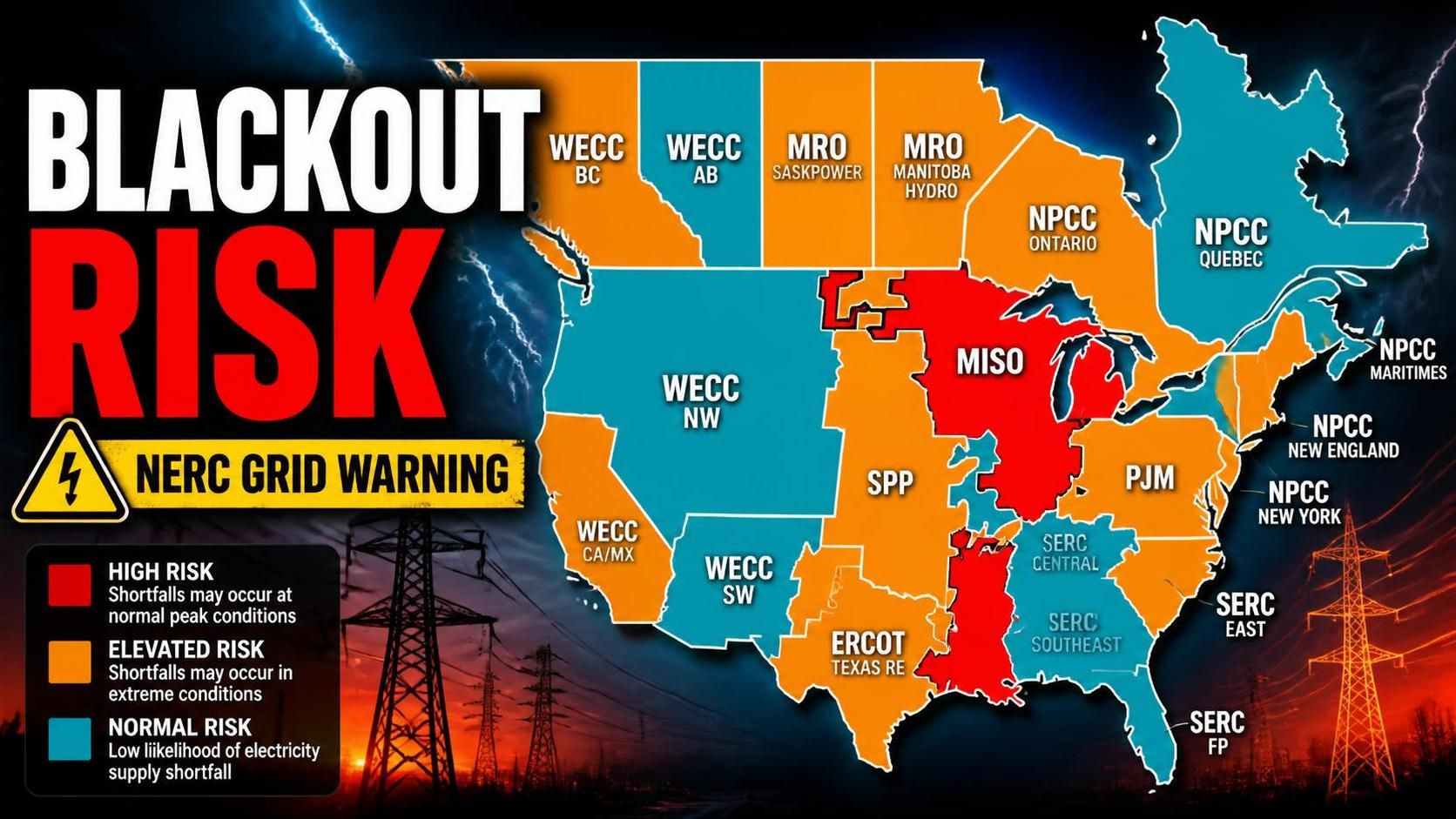
The January 2026 NERC 2025 Long-Term Reliability Assessment (LTRA) finds the overall resource adequacy outlook worsening, with 13 of 23 assessment areas facing challenges over the next decade as demand from AI data centers and other large loads outpaces planned generation and transmission.
Summer peak demand is projected to rise by more than 224 GW over 10 years—69% higher than the prior forecast—while winter demand grows even faster at 245 GW. Most near-term additions are batteries and solar PV, which are weather-dependent and inverter-based, while fossil-fired retirements continue. This mix increases winter shortfall risks. NERC classifies several regions as High Risk (shortfalls possible even under normal peaks) or Elevated Risk (shortfalls more likely in extreme conditions) starting as early as 2026–2029 in areas including parts of MISO, SPP, PJM, ERCOT, the Northwest, and Basin.
The report is a risk assessment based on mid-2025 industry forecasts, not a prediction of outages. It emphasizes expediting resources, managing retirements flexibly, and coordinating on large-load growth.
The July 2026 Data Center Event: A Near-Miss Across Multiple States
A concrete example of emerging risks occurred on July 22, 2026, in Northern Virginia's 'Data Center Alley.' A transmission line fault prompted clusters of data centers to automatically switch to backup power, instantly removing roughly 3–3.8 GW of demand—about 3% of PJM's load at the time. We have talked about this on the ENB channel.
This created a sudden surplus that caused voltage and frequency swings rippling across the Eastern Interconnection. Sensors detected disturbances from Northern Virginia to Chicago, with flickering lights reported in homes. The grid stabilized in about 10–11 minutes with no cascading blackout or customer outages, but PJM initiated a synchronized reserve event. Similar but smaller events happened in 2024 and 2025.
PJM (serving 13 states and 67 million people) and Dominion Energy confirmed the data centers' own protection systems triggered the transfer; the utility did not shed load. Experts called it a warning: as individual campuses approach gigawatt scale, simultaneous 'ride-off' behavior can stress the grid far beyond a local fault. NERC and FERC have flagged large computational loads as a reliability concern requiring better modeling, ride-through standards, and coordination.
PJM is now considering ride-through requirements so data centers stay connected during minor disturbances rather than dropping off en masse. In extreme cases, operators may curtail large loads that lack their own contracted supply to protect residential customers. Texas lawmakers already granted ERCOT similar curtailment authority over new large loads to prevent emergencies.
Major Utility and Grid Operator Messages
Exelon CEO Calvin Butler, whose company serves more than 10 million customers in the Northeast and Midwest (including PJM territory), warned in June 2026 that Americans could 'absolutely' face power losses as early as 2027 due to plant shortages and surging demand. He noted the region came close to curtailing hundreds of thousands of customers during recent winter peaks. PJM has projected significant capacity shortfalls and is running emergency auctions while exploring backstop measures.
Edison Electric Institute (EEI) and individual utilities continue standard storm and wildfire preparedness messaging: update contact information for outage alerts, stock emergency kits, and plan for medical needs. Western utilities use Public Safety Power Shutoffs (PSPS) during high wildfire risk. In Texas, ERCOT posts seasonal updates emphasizing sufficient generation for expected conditions while reminding customers to contact local providers during outages.
Texas ERCOT: Lessons from Winter Storm Uri Applied
We have covered this several times, and ERCOT has made substantial progress since the 2021 Uri disaster. Reforms include mandatory weatherization for generators and transmission (with thousands of inspections), firm fuel supply programs, expanded battery storage (now many times higher than in 2021), new generation, market upgrades such as Real-Time Co-optimization Plus Batteries (RTC+B) implemented in late 2025, and enhanced forecasting.
Recent winter storms, including Fern in early 2026, produced far fewer forced outages than Uri despite higher peak loads. ERCOT reports high compliance on weatherization and has handled record demand without system-wide emergencies. Texas also created funding to speed reliability-focused resources and gave operators tools to manage large-load growth. Challenges remain from rapid demand increases, but the grid has proven more resilient.
Share
Practical Recommendations for Consumers
Utilities and emergency agencies consistently recommend household-level preparedness rather than waiting for rolling blackouts.
Key steps include:
Build a 72-hour (or two-week) emergency kit: one gallon of water per person per day, non-perishable food, medications, flashlights and extra batteries, a battery-powered or hand-crank NOAA radio, first-aid supplies, cash, and important documents. Keep phones charged and have backup power banks.
Register medical equipment needs with your utility so they can prioritize or advise during outages.
Sign up for utility outage alerts and keep account contact information current.
Consider backup power: portable or standby generators (keep at least 20 feet from the house, exhaust pointed away, and never run indoors to avoid carbon monoxide), whole-home battery systems (often paired with solar), or portable power stations for critical loads like refrigerators, medical devices, lighting, and communications. Prioritize essential circuits.
Practice energy efficiency year-round (thermostat settings, insulation, LED lighting) to reduce strain during peaks.
Know how to manually open garage doors and have an evacuation plan if an outage makes the home unsafe.
In wildfire-prone areas, follow PSPS guidance and consider the benefits of covered conductors or undergrounding where utilities offer such programs.
Longer-term options include community microgrids or solar-plus-storage, but start with the basics. NERC recommends that industry, regulators, and policymakers expedite the deployment of resources that provide needed reliability services, keep retirement plans flexible, and leverage large-load flexibility during periods of stress. Consumers cannot control the resource mix, but they can reduce personal risk.
The grid remains reliable under most conditions, and operators have tools to manage extremes. The combination of rapid demand growth, a shifting resource mix, and events such as the July 2026 data-center trip underscores why preparation matters for 2026–2027.
One thing is certain: blackouts will happen. How you prepare is how short or how badly your family will be impacted.
Take note that as Iran gets more desperate, we have already had over 30 water companies hit by cyberattacks this year.
I found this interesting in this article: New Jersey just made plug-in solar panels legal. No roof required.
Very interesting, and having panels that consumers could plug in and get lower bills, or charge Jackery-type units, is smart. This really hit home while I was talking with Meredeth Angwin, the Electric Grandma. She is in a retirement building with no backups, which is bringing to light a huge issue for this group of Americans.
That podcast is in production and rolling through.
National Emergency Securing U.S. Bulk Power Sources and Supply Chains
We have Doomberg and the CEO of Jackery on a panel discussion on Wednesday at 9:00 Central US. Here is the YouTube Link: https://youtube.com/live/gS0fVER55EI
Appendix: Sources and Links
NERC 2025 Long-Term Reliability Assessment (January 2026): https://www.nerc.com/globalassets/our-work/assessments/nerc_ltra_2025.pdf
NERC news release on LTRA: https://www.nerc.com/newsroom/resource-adequacy-risks-intensify-across-north-america-as-demand-growth-surges
Reuters on July 2026 PJM data-center event: https://www.reuters.com/business/energy/massive-disconnect-power-roiled-largest-us-electric-grid-2026-07-22/
TechCrunch analysis of the event: https://techcrunch.com/2026/07/25/one-fallen-power-line-exposed-a-growing-ai-data-center-problem-heres-how-to-fix-it/
Ting Labs report on the disturbance: https://www.tingfire.com/blog/what-happened-when-3-gigawatt-of-data-center-demand-disappeared-from-the-grid/
Utility Dive on PJM ride-through considerations: https://www.utilitydive.com/news/pjm-nerc-data-center-crypto-reliability-standards/827653/
Financial Times / Exelon CEO warning: https://www.ft.com/content/14d2e591-7cd5-4456-904f-1b7fdc5cbc1a
EEI 2026 Storm Season preparedness: https://www.eei.org/news/news/all/2026-storm-season
ERCOT seasonal updates and weatherization: https://www.ercot.com/about/news/seasonal-updates and related PUC rules
Ready.gov emergency preparedness:
https://www.ready.gov
A note on cookies
Newshunt uses essential cookies to keep you signed in and to remember your language and country, so the site works the way you expect. With your permission, we'd also like to use analytics cookies to understand how people use Newshunt and improve it over time.
Accepting only affects analytics. To learn more, view our Privacy Policy or Terms & Conditions.
(0)Comments