


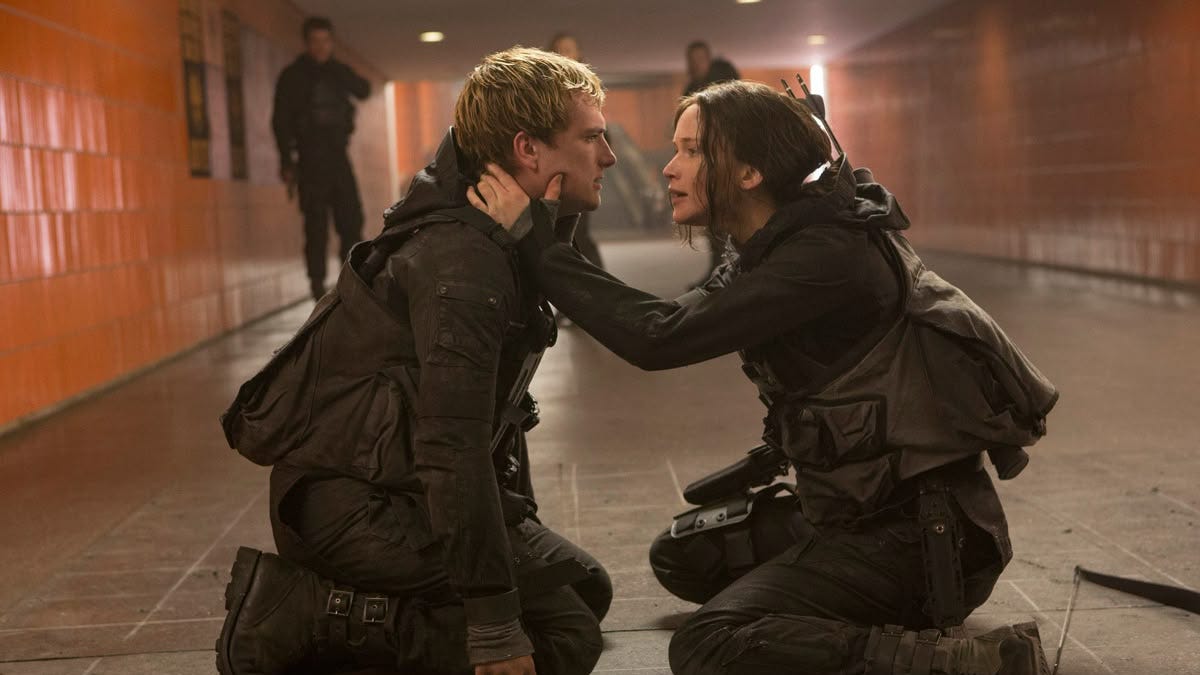
Suzanne Collins is a writing genius, and a lot of it is not talked about enough
Category: Entertainment
Share
Archive
Like
Hi friends,
Pour a cup of whatever you fancy, pull one of your copies of The Hunger Games from your shelf, because today I wanna chat about what makes Suzanne Collins a genius when it comes to writing.
Most people know her as the author of the (iconic) popular Hunger Games. What fewer people know is that she started out writing for children's television, working on Nickelodeon shows long before Katniss ever existed. And when the first book was published in 2008, she was 46.
Not because there's anything wrong with debuting young, but I think we need more reminders that the successful forbes 30 under 30 has become weirdly normalised despite it being quite unattural and not the standard. Suzanne spent decades writing before she wrote the book she's known for.
She is one of my biggest inspirations as a writer, and this could honestly be a full podcast series. But let's dive into a few reasons why (bear with me, I have thoughts).
Dear Suzanne, if I ever would be fortunate enough to pop up on your screen in any shape or form, or have the pleasure of being in the same room, do forgive me in advance for any questions I might ask in rapid succession.
If you haven't seen me before, HELLO! I'm so excited to e-meet you.I'm Elin, passionate about everything storytelling. With a degree in journalism and BA film, here we unpack the story behind our favourite films and books and deep dive into how we can write our own.
in it for the plot is a reader-supported publication. To receive new posts and support my work, consider becoming a free or paid subscriber.
The Hunger Games doesn't shy away from trauma. Horrific things happen to these characters, and while that in itself is not unique, like plenty of books put their characters through hell.
But here, the trauma isn't just a plot event, it very much shapes what the characters do next, chapter after chapter, book after book. Events become trust issues. Fear becomes decisions.
I've always struggled with stories where a character goes through something devastating and then it's business as usual a chapter later. It's such a small thing to get right and such a big thing when a writer doesn't.
In Catching Fire, Katniss comes to the conclusion that the other tributes are trying to protect Peeta because they can all see how wonderful he is. Which is sweet, but not very objective. She can't see that it's her love for him, and everyone else's recognition that if Peeta gets hurt, Katniss will unravel completely and stop playing along.I like to call it emotional logic, that gap between what Katniss believes and what's actually happening.
Here's a thing I feel nobody talks about when it comes to Mockingjay. It's a story about a political revolution and that's deliberately have the readers blinded to almost all of it.
Think about it. A teenager and her friends don't get to sneak into the Capitol and take out the president with a bow and arrow. That's a Marvel movie.
Instead, we get something much smarter. Suzanne weaves us directly into the story's own propaganda machine, including District 13's, including Coin's. Every single thing Katniss does from the moment she volunteers is being shaped, spun, or outright manipulated by someone pulling strings. And we rarely see them on the page.
And by the time you reach Mockingjay, that's the reality check the whole series has been building toward. Nobody in this story, not even our protagonist, ever really has the full picture. Neither do we.
Write the politics too clearly and you lose the claustrophobia of Katniss's perspective. Write it too vaguely and the stakes go.
Synergy, symbolism, and theme are written into this series at every level, from character names to recurring motifs, and I love every bit of it.
She's a master of using the natural world (songbirds, fire, the arena itself) to amplify what's happening to her characters emotionally. Including the smaller choices like minor character names or the colour of an outfit.
"If we burn, you burn with us!"
The Hunger Games is written in first-person, present tense. It puts you inside Katniss's point of view as it happens, it keeps you with her the entire time, which means you only know what she knows, when she knows it.
And yet, somehow, you never feel like you're missing the bigger picture, even though you objectively are. You feel exactly what Katniss feels: like you're catching pieces of something big happening just out of view. That's tense and point of view functioning as structure, that works so well for this series.
The Hunger Games gets talked about as a phenomenon, a franchise, a cultural moment. What gets less talked about is the writing who made it that.
She's proof that you can write something massively commercial and still be doing sophisticated craft work under the hood. I think about her books more as a writer than almost anyone else's.
Have you reread The Hunger Games recently? Which one in the series is your favourite? Curious to hear in the comments.
Leave a comment
All my love Elin
If you enjoyed this essay, becoming a free subscriber massively helps me to keep writing these :)
Join 7K+ writers, readers, and storytellers as we nerd out over our favourite books, films, and shows, break down the storytelling behind them, and help each other become better writers while pursuing our own creative projects.
Want to start writing?I've created free digital workbooks, writing tools, and resources based on what has helped me write my novels and what I learned through my journalism degree.
Click for tools
Let's connect:💌 Reply to this email, I'd love to hear your thoughts📱Come say hi on Instagram
If you enjoyed this essay, feel free to like, comment, or share it so more writers can find this little corner of the internet.
Thanks for reading; I'm so glad you're here. x
A note on cookies
Newshunt uses essential cookies to keep you signed in and to remember your language and country, so the site works the way you expect. With your permission, we'd also like to use analytics cookies to understand how people use Newshunt and improve it over time.
Accepting only affects analytics. To learn more, view our Privacy Policy or Terms & Conditions.
(0)Comments