


The story of the Jews who were kidnapped & murdered in Lebanon
Category: Politics
Share
Archive
Like
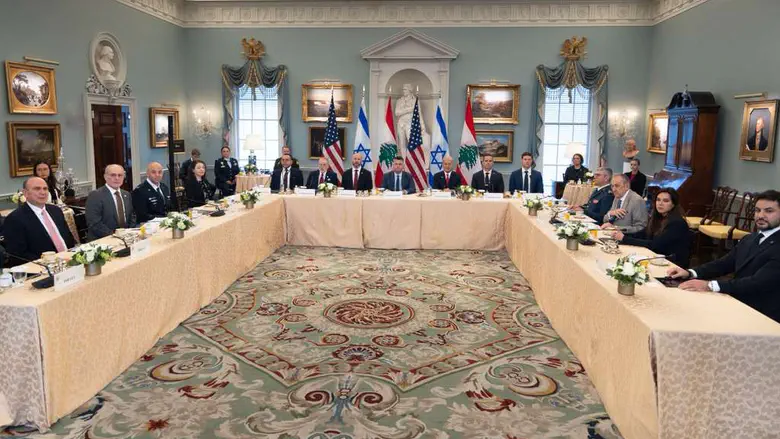
Last week, the Prime Minister's Office announced that Prime Minister Benjamin Netanyahu had instructed the negotiating team with Lebanon to include the issue of returning the bodies of the leaders of Lebanon's Jewish community in the negotiations. According to various reports, efforts to locate the bodies on the ground have also begun.
We spoke about the historic affair, which may finally be approaching a conclusion, with Col. (res.) Dr. Jacques Neriah, a native of Lebanon and researcher of Lebanese Jewry who formerly served as an adviser to Prime Minister Yitzhak Rabin during diplomatic negotiations with Lebanon and Syria and is currently a senior researcher at the Jerusalem Center for Security and Foreign Affairs.
Neriah began by providing some historical background on Lebanon's Jewish community, which has existed in the country for approximately 3,000 years, with evidence of its presence in Sidon, Baalbek, Tripoli and other locations throughout Lebanon. At various points in history, other Jews joined the community, including those who arrived following the expulsion from Spain and, later, those fleeing Nazi persecution. The Jewish community thus came to comprise several groups: native Lebanese Jews, refugees from Syria and Iraq, Jews who fled the Spanish expulsion, and Ashkenazi Jews who arrived during the Holocaust.
Throughout the years following Britain's arbitrary demarcation of the border between the Land of Israel and Lebanon, the Jewish community sided with the local government, Neriah said. This was despite the fact that the identity cards of Lebanese Jews - including Neriah's own when he was young - listed their religion as 'Israeli."
'The community prospered until the first civil war in 1958. Some of the Jews realized that this was not the place for them. This intensified in 1967 following the Six-Day War and riots, when Kurds and Shiites invaded Jewish areas and attacked them, and many Jews fled, leaving behind property and homes. The Shiites and Kurds took over the homes. This weighed heavily on the Jewish presence in Lebanon, as they felt unwanted and began to emigrate. However, they did not view Israel as their destination and preferred the United States, France and South America."
Neriah continued, explaining that alongside the process of Jewish emigration, Hezbollah emerged and grew in strength in Lebanon, having begun as the Amal movement, the 'Movement of the Deprived." In 1982, the organization played a significant role in the war against the Israeli presence in Lebanon.
By 1984, the organization concluded that in order to enhance its stature, it needed to act against Israel. It chose to focus its efforts on securing the release of Shiites who had been captured by Israel and imprisoned. The idea was that the release of those Shiite prisoners could be achieved by kidnapping Jews.
By then, the Jewish community had dwindled considerably. That year, Hezbollah kidnapped 11 members of the community, including the community secretary and president, as well as an electrical engineer, a plumber, a clerk and other ordinary civilians. The threat was that the Lebanese Jews would be executed unless Hezbollah's members were released from Israeli prisons. Rabin later said that capitulating to such a demand had never even occurred to him as a possibility.
When Hezbollah realized that Israel did not intend to give in, it began executing the kidnapped Jews. Among them was the father of Dr. Edy Cohen, who today is the only one whose burial place is known.
Over the ensuing years, through 1987, Hezbollah terrorists executed all 11 Jews, with Isaac Sasson being the last.
Neriah also recounted his personal connection to the affair. He himself arrived in Lebanon in 1985, where he visited the Christian area. During one of his meetings, he was told that someone was waiting for him outside. It was Dr. Eli Hallak, who told Neriah that he was the doctor for the poor in Wadi Abu Jamil.
'I said to him, 'What are you doing here?' He told me, 'I'm guarding the Jewish property.' I told him, 'Get yourself out of here.' He said his family was already in France. I told him to join them because he was in danger here. He refused and said we were exaggerating and that he felt safe. A few months later, he was kidnapped, and a year later he was executed. It pains me that I was unable to convince him to leave Lebanon. It weighs on my conscience," Neriah said.
Neriah added that while in captivity, Dr. Hallak treated Hezbollah members, but even that did not prevent the organization from executing him.
Netanyahu has now instructed the negotiating team to seek information on the whereabouts of the ten victims whose burial places remain unknown. Jacques Neriah believes the chances of locating them are slim to nonexistent, since Hezbollah dumped those it executed in a garbage dump rather than giving them a proper burial.
Nevertheless, he said, efforts can still be made to obtain information that could tell their stories and reveal what happened to them after they were kidnapped.
Neriah also noted that the Lebanese media do not really understand the Israeli request, arguing that the victims were Lebanese citizens rather than Israelis and that there is therefore no reason for their bodies to be transferred to Israel.
A note on cookies
Newshunt uses essential cookies to keep you signed in and to remember your language and country, so the site works the way you expect. With your permission, we'd also like to use analytics cookies to understand how people use Newshunt and improve it over time.
Accepting only affects analytics. To learn more, view our Privacy Policy or Terms & Conditions.
(0)Comments