


From labs to life, Chinese tech redefines innovation at IFA Berlin 2026
Category: SciTech
Share
Archive
Like
People visit IFA Berlin 2026 in Berlin, Germany, Sept. 4, 2026. (Xinhua/Zhang Haofu)
From kitchen robots to smart homes and connected jewelry, this year's IFA Berlin offers a glimpse of a near future increasingly shaped by Chinese innovation.
BERLIN, Sept. 7 (Xinhua) -- From robots stepping into kitchens to living rooms that anticipate daily routines and jewelry that connects partners across distances, this year's IFA Berlin, one of the world's largest trade fairs for consumer electronics and home appliances, offers a glimpse into a near future increasingly shaped by Chinese innovation.
Of the more than 1,900 exhibitors at the five-day trade show, nearly half are from China, making their presence across the event hard to miss. More significant than their scale, however, was a broader shift in how they innovate -- moving technologies more quickly from lab prototypes to commercial applications, building interconnected home ecosystems, and developing personalized consumer tech. People watch a robot combat at the exhibition area of Unitree at IFA Berlin 2026 in Berlin, Germany, Sept. 5, 2026. (Xinhua/Zhang Haofu)
ROBOTS ENTERING REAL LIFE
Humanoid robots offered perhaps the most vivid sign of that shift. At the booth of Unitree Robotics, several humanoids moved in formation to the beat of music, while another took on a far more ordinary task: making a sandwich. It picked up slices of bread, added lettuce and neatly stacked the layers. The futuristic technology suddenly felt unexpectedly familiar. Nearby, Dobot Robotics' panda-shaped robots danced from side to side, drawing visitors with its playful moves.
At PrimeBOT's booth, an 88-centimeter-tall PrimeBOT Q1 humanoid stood out with a fluid sequence of martial arts moves. Its flexible joints carried it smoothly through punches, turns and a crisp finishing stance. Beside it, the PrimeBOT T1 demonstrated a different capability: within seconds, it shifted from a two-legged humanoid posture into a four-legged configuration, drawing surprised reactions from onlookers.
Beyond the spectacle, the real test is whether these eye-catching demonstrations can translate into real-world applications
"China is moving robots rapidly from products in the laboratory into real industrial and consumer markets," Zou Jiyuan, chief marketing officer for international markets at PrimeBOT, told Xinhua.
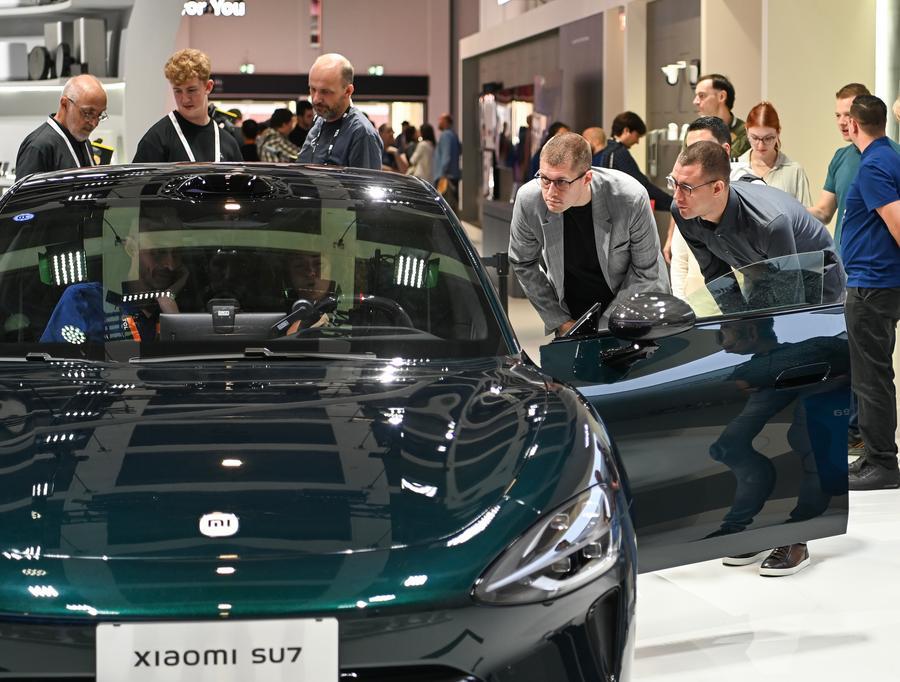
Zou attributed that speed in part to China's extensive manufacturing base and well-developed supply chains. "With strong support across key components such as motors, sensors, batteries and chips, robotics companies can shorten development cycles, bring down costs and iterate products more quickly," he said. People view a Xiaomi SU7 car at the exhibition area of Xiaomi at IFA Berlin 2026 in Berlin, Germany, Sept. 5, 2026. (Xinhua/Zhang Haofu)
FROM PRODUCTS TO LIFESTYLES
The efforts to bring technology closer to everyday life extended well beyond robotics. In the home appliance sector, Chinese companies are presenting not just smarter products, but entire living environments built around them.
TCL turned its booth into a glimpse of future living. Large-screen televisions anchored the space, while AR glasses brought digital content directly into view. Nearby, an AI-enabled air conditioner adjusted indoor comfort based on room conditions, while a smart washing machine could sense factors such as load size and fabric type and tailor the wash accordingly. Walking through the space felt more like stepping into a home where technology worked as part of a single, connected experience.
"What we are presenting here is more than a collection of smart products. It is a vision of how people may live in the AI era, with different devices working together around real-life needs," Daniel Sun, CTO of TCL Industries, told Xinhua in an exclusive interview.
He noted that the move from individual products to scenario-based experiences reflects a broader evolution in China's home appliance industry. "Companies are now combining pure manufacturing scale with design, software, and system integration to build complete home ecosystems."
Hisense echoed that approach with an AI-powered home system linking televisions, refrigerators, air conditioners, and other devices. In one demonstration, a simple request to "watch the game tonight" prompted the system to coordinate lighting, room temperature, and a food-delivery reminder, illustrating how appliances are being designed to work within a shared living environment.
"Chinese companies are showcasing more than a wider range of products and faster iteration," said Yan Ronghua, head of overseas portfolio operations at Hisense Global Commercial Center. "They are actively defining how technology can reshape everyday lifestyles, a shift that emerged as a clear hallmark at this year's IFA." People look at refrigerators on display at the exhibition area of Hisense at IFA Berlin 2026 in Berlin, Germany, Sept. 5, 2026.(Xinhua/Zhang Haofu)
INNOVATION GETTING PERSONAL
Beyond robots and connected homes, Chinese companies were also pushing into more specialized corners of consumer technology.
At the booth of smart jewelry brand TOTWOO, Chinese innovation found a more intimate expression in bracelets and necklaces. Connected via Bluetooth to a mobile app, the smart pieces turn a simple touch into a signal that can travel across distance: tap one, and its paired piece lights up and vibrates in response. Intangible emotions -- longing, companionship and connection -- are soon translated into a soft glow and a subtle pulse.
For TOTWOO founder and CEO Wang Jieming, bringing technology into such delicate spaces is part of a broader trend. As he told Xinhua, Chinese tech firms are expanding into specialized, high-emotion markets.
"Backed by mature hardware supply chains and advances in AI and smart interaction, Chinese brands are moving beyond high-profile categories like smartphones, appliances, and robotics," Wang said. "We are entering niche areas like smart jewelry, where personalization and emotional experience take center stage."
The move into new product categories also reflects a broader change in how Chinese companies are expanding overseas. "Chinese companies are moving from simply selling products abroad to building brands and establishing a long-term presence in global markets," said Ye Can, head of Europe at WeBranding Global, which helps Chinese companies expand internationally.
Ye said the competitiveness of Chinese companies comes from a combination of supply-chain strength, technological innovation and operational efficiency. "As new sectors such as AI hardware and smart homes grow, Chinese firms are playing a bigger role in shaping new products and technologies for global markets." A boy tries a FPV drone while wearing FPV goggles at the exhibition area of Insta360 at IFA Berlin 2026 in Berlin, Germany, Sept. 5, 2026. (Xinhua/Zhang Haofu)■
A note on cookies
Newshunt uses essential cookies to keep you signed in and to remember your language and country, so the site works the way you expect. With your permission, we'd also like to use analytics cookies to understand how people use Newshunt and improve it over time.
Accepting only affects analytics. To learn more, view our Privacy Policy or Terms & Conditions.
(0)Comments