


Flu Vaccination for our children: What we aren't being told
Category: Health
Share
Archive
Like
Independent. Unfiltered. Yours.
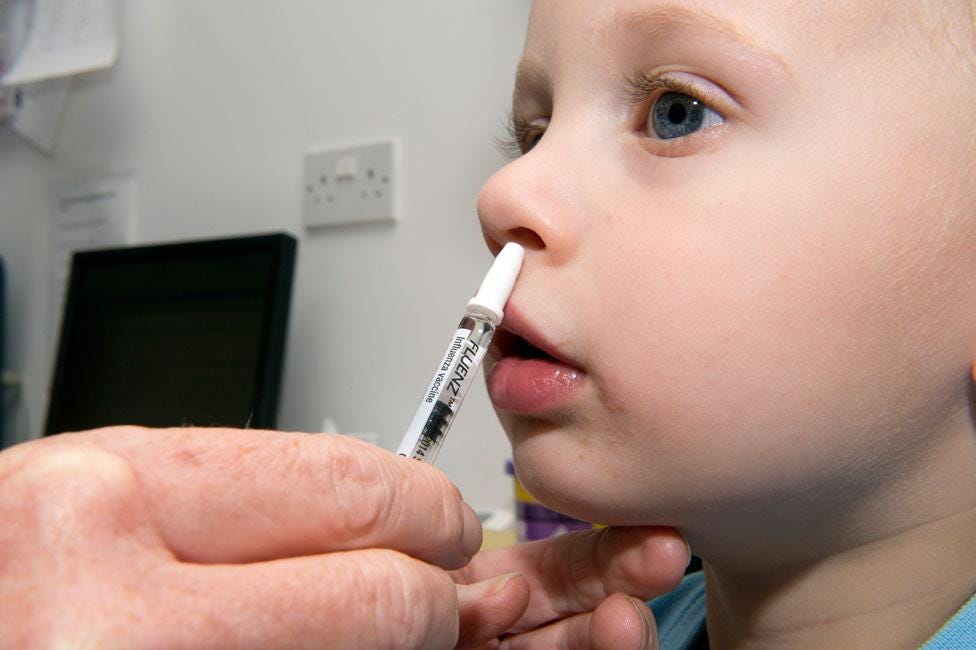
Despite pulling my children out of school this year and home educating them full time, a letter still landed in my inbox this week from the NHS immunisation team. 'Dear Parent or Carer, your child's annual flu vaccination is due this autumn'. I no longer send my children into that building, and yet the system still assumes it owns a say over what goes into their bodies. So I read the letter properly for the first time in years, and then I read what it left out.
This is how you can support the show directly →
A warning before you begin. This is a long read, and it can only be that. This is not the kind of issue that can be dissected in a short, snappy, bullet pointed fashion with soundbites, because that format cannot properly unpick decades of conditioning and propaganda alongside it. Doing this subject justice means a proper, analytical walk through, start to finish. So please, dear reader, bear with me. Please share this with your spouse, children and friends so that our kids can be protected from this unnecessary intervention.
Share
Despite home educating my children this year, a letter still landed in my inbox this morning. It came from the local council School Aged Immunisation Team, part of the local Healthcare NHS Trust.
'Dear Parent or Carer, your child's annual flu vaccination is due this autumn. Children in Years R to 6 are being offered a free flu vaccination in school.'
Free. Let us deal with that word straight away, because it sets the tone for everything that follows. It is not free. It is free at the point of delivery. We pay for it through our taxes, every one of us, whether or not our children ever receive it.
The letter continues:
Flu can make children feel very poorly and, for some children, can lead to complications such as chest infections, pneumonia or ear infections.
Well, yes. So can a great many things. At no point does the letter state how common these complications actually are, or which children are actually at risk. Look at the real figures and the overwhelming majority of children who catch flu have a mild illness and recover quickly on their own. Serious complications belong almost entirely to children who are already severely immunocompromised, hospitalised, or living with multiple co-morbidities. None of that context is offered. Parents are simply given the word 'complications' and left to imagine the worst.
So let us look at the real figures, in the government's own words and the government's own data.
UKHSA, the UK Health Security Agency, is the government body responsible for public health protection and infectious disease surveillance in England. The Green Book, the official UK immunisation reference produced by UKHSA and the Department of Health and Social Care, describes flu in otherwise healthy individuals in its own words as'an unpleasant but usually self limiting disease with recovery usually within 2 to 7 days.'This is the reality for the overwhelming majority of children who get the flu, in the government's own words.
Across all ages, roughly 14 of every 100,000 people were hospitalised weekly with flu during the peak of the 2024 to 2025 season in England, figures published in UKHSA's own national surveillance reports. Remember, that is an all age figure, not child specific. When you look specifically at children, a peer reviewed analysis published in the Journal of Infection, using UK national data across the 2000 to 2001 through 2007 to 2008 seasons, found thathospitalisation risk from flu is concentrated in children under 6 months of age and in children with underlying health conditions.The Green Book itself states plainly that the risk of serious illness is higher'amongst children under 6 months of age.'
The paediatric intensive care picture makes this even clearer. A study using the national Paediatric Intensive Care Audit Network, PICANet, looked at every flu related paediatric intensive care admission for children aged 0 to 15 in England between 2003 and 2017. It found 929 admissions across those 14 flu seasons, anaverage admission rate of 1.32 per 100,000 children per year, and nearly half of all those admissions, 48.3 per cent, were in children under 2 years old. So when the government and health authorities talk about flu causing 'complications' and 'hospitalisation,' what they are actually describing, in their own data, isa risk to your child of just over one in 100,000 per year, and roughly half of even that small risk sits in children too young to be eligible for the nasal vaccine at all.
A related PICANet based study covering 2003 to 2015 found that of 1,961 flu related paediatric intensive care admissions, 78.5 per cent were in children who already had a recognised high risk medical condition.Roughly four out of every five children who ended up in intensive care with flu already had an underlying illness that put them there.
On deaths, a peer reviewed statistical analysis published in the Journal of Infection, using national data across multiple seasons, estimated an annual average of around 12 in hospital flu deaths per year in children under 15 across the whole of England, a mortality rate of roughly 1.3 per million children. The same paper found the majority of all flu attributable deaths in hospital, across every age group, occurred in the 65 and over age group with existing co-morbidities.
So a reminder of who is actually at elevated risk, in the government's own numbers. The Green Book's own Table 19.1, drawn from a PHE, now UKHSA, analysis of the 2010 to 2011 season, shows the relative risk of flu death by clinical risk group. Being in a recognised clinical risk group carried roughly 11 times the mortality risk of not being in one. Chronic liver disease carried the highest relative risk, roughly 48 times baseline, followed by immunosuppression, for example a child on chemotherapy, at roughly 47 times, and chronic neurological disease at roughly 40 times.
And here is something genuinely interesting. Current UKHSA data shows only 55.5 per cent of eligible primary school children actually received the nasal vaccine in the 2025 to 2026 season, below pre pandemic uptake levels. Parents, it seems, are growing more sceptical and more wary of this vaccination programme, and I think that can only be a good thing.
So, in summary, using the government's own figures: flu is a mild, self limiting illness lasting under a week for the overwhelming majority of children who get it. Hospitalisation, and in particular intensive care admission and death, are concentrated overwhelmingly in the very youngest children under 6 months, the exact group not even eligible for the nasal vaccine, and in children with pre existing conditions, roughly 80 per cent of intensive care admissions and the majority of the small number of annual deaths. In absolute terms, deaths in previously healthy school aged children are staggeringly rare, we are talking about a handful amongst millions of children at most. None of this context is conveyed in any of the official letters or NHS documentation sent home to parents.
I do not believe flu, on this evidence, justifies a mass public vaccination campaign. It frankly doesn't justify any vaccine campaign. The long term risks and complications remain inadequately studied, as we will discuss below. We simply have no idea of the impact on our children's longterm health. This is an expensive campaign that carries real risk for, according to the government's own numbers, no gain, but real and potential harm.
Going back to the letter I received. It states:
'Children can catch and spread flu easily.'
That assumes a settled question about contagion that I am no longer as confident in as I once was. I have been sick while nobody else in my house so much as sniffled. I have also watched an entire family come down with something within a day of each other. I am genuinely on the fence about contagion, and feel the official mainstream narrative is misleading and incorrect, a position many now hold.
Then comes the line that bothers me most:
'Vaccination also helps protect others who may be more vulnerable, including babies, older people and those with health conditions.'
No. We should never take a medical intervention purely to protect someone else. That is not how informed consent works, and it should not be how parenting works either. If my child needs an umbrella to keep me dry, something has gone badly wrong with the logic. If a vaccine genuinely works, give it to the vulnerable person and let that be enough. Why does an unvaccinated child need to be vaccinated so that someone else's vaccine can work?
An Informed Consent Letter That Contains No Cons
The letter is presented as the vehicle for obtaining parental consent. When I read it closely, I noticed something important was missing: any actual discussion of risk. There are benefits, vaguely stated ('helps protect your child,' 'supports them to stay well'), but there is nothing else. No mention of what percentage of children experience side effects. No mention of the contraindications that genuinely matter, including the fact that children with severe asthma should not receive the nasal spray at all. No mention of alternative approaches, whether that is vitamin D, vitamin C, rest and fluids, or simply doing nothing and letting a mild childhood illness run its course, as parents have done for generations. The form itself makes it technically possible to decline, 'complete the form even if you are declining the vaccination,' but nowhere does the letter clearly present declining as a legitimate, ordinary option sitting alongside vaccinating.
Informed consent is supposed to involve understanding the natural history of the illness honestly, acknowledging the real individual risk, being informed of real substantiated benefits, while weighing up the genuine risks and complications, knowing what other treatments are available, accepting that 'doing nothing' is a valid choice and finally that the patient's choice will be respected regardless of their decision.
The letter I received today does none of that. It delegates the substance of 'informed consent' to an external NHS leaflet, linked but not included, which brings us to the next problem.
https://www.gov.uk/government/publications/flu-vaccination-for-children-leaflets-and-posters--2/protect-your-child-against-flu-information-for-parents-and-carers
Five Reasons, Zero Numbers
The letter points parents toward the government's own flu vaccination leaflet, published under gov.uk, titled Protect Your Child Against Flu. It is labelled as promotional material from the very top of the page. Read that again. A document meant to inform parents ahead of a medical decision, announces itself as 'promotional'. If we are serious about informed consent, there should be no promotion in the material at all, simply a neutral statement of fact that lets a parent draw their own conclusion.
The leaflet opens with five reasons to vaccinate. Let's have a look at them and what I make of them.
Protect your child. The vaccine will help protect your child against flu and serious complications such as bronchitis and pneumonia.
Protect from what, exactly? Will the child simply not catch flu, or will they catch it with milder symptoms? What is the actual absolute risk reduction? None of this is stated.
Protect you, your family and friends. Vaccinating your child will help protect more vulnerable friends and family.
This is the same umbrella logic as before, somewhere along the way we normalised the idea that children should function as medical shields for the adults around them, and I think that idea deserves to be challenged rather than accepted.
No injection needed. The nasal spray is painless and easy to have.
That a product is painless to administer is not, on its own, a reason to take it. It says nothing whatsoever about whether the product is worth taking.
It's better than having flu. The nasal spray helps protect against flu, has been given to millions of children worldwide and has an excellent safety record.
Says who, and based on what data? We have quietly demonised ordinary childhood illness. Not so long ago a child with flu had chicken broth, rest, fluids, some vitamin C and vitamin D, and got better. Flu remains, for the overwhelming majority of healthy children, exactly that kind of illness. And how can you claim 'excellent safety record' when the studies have no long term follow up or true placebo controlled studies?
Avoid costs. If your child gets flu, you may have to take time off work or arrange alternative childcare.
Read plainly, that reason is about the parent's convenience, not the child's health.
The leaflet then lists flu symptoms, fever, extreme tiredness, aching muscles and joints, a stuffy nose, a dry cough, a sore throat, and states children usually feel better within about a week. Hold that list in mind, because it becomes important again a few paragraphs from now. It goes on to mention complications of the flu, bronchitis, ear infections, pneumonia, without ever stating what percentage of children experience them or which children are actually at risk. Hospital admission is mentioned in the same vague way, 'some children may need to go to hospital,' again with no numbers, no percentages, no description of which children. And as I have already discussed above, the risk to your school age healthy child is practically nil.
On vaccine effectiveness the leaflet states plainly that the flu vaccine is the best protection we have against this unpredictable virus. Says who, and where is the citation? Nothing in the document is referenced to a single piece of published literature. So much for 'trust the science,' when the science itself is nowhere to be found in the document telling parents to trust it.
Side Effects That Read Suspiciously Like Flu Itself
The section on side effects is genuinely worth pausing on.
'Children may develop a runny or blocked nose, a headache, general tiredness, and some loss of appetite.'
Read that list again slowly. That is, symptom for symptom, the description of a mild flu given earlier in the same document. The leaflet insists these are milder than flu itself and states plainly that the vaccine cannot cause flu, because the 'virus' has been weakened. Isn't it at a minimum worth asking why so many children who receive the nasal spray go on to become miserably unwell shortly afterwards, symptoms indistinguishable from the illness the vaccine is meant to prevent?
The one reference offered anywhere in the government leaflet points to the manufacturer's own Patient Information Leaflet for Fluenz, hosted on the electronic Medicines Compendium, the official UK repository where drug companies publish their regulator approved product information, and this is where the story gets genuinely interesting.
https://www.medicines.org.uk/emc/product/15790/smpc
What Is Actually In It, and What The Prescribing Information Actually Says
Fluenz contains three live, weakened influenza virus strains, propagated in fertilised hens' eggs and produced in cells using reverse genetic technology. The product formally contains genetically modified organisms. If you are the kind of household that avoids GMO food on principle, it is worth knowing that this vaccine is a genetically modified product injected, or rather sprayed, directly into a child.
The excipient list includes egg protein, trace gentamicin (an antibiotic), sucrose, dipotassium phosphate, potassium dihydrogen phosphate, gelatin, arginine hydrochloride, and monosodium glutamate monohydrate. None of these individually is exotic or unheard of in medicine, egg protein and gelatin are common allergens, gentamicin is a manufacturing residue (to prevent bacteria contamination), MSG and arginine are used as stabilisers. But the parent reading a friendly letter about a'quick and simple nasal spray'is never told any of this. They would need to go looking for it themselves, as I did.
Here is something else worth understanding. The three 'virus' strains inside Fluenz are not fixed, they are swapped out every single year. The World Health Organization predicts which flu strains are likely to circulate each winter roughly 6 months in advance, and tells manufacturers what to include, and AstraZeneca reformulates the vaccine accordingly for that season. This means the vaccine your child receives this September contains entirely different strains to the one used in MI‑CP111 back in 2004 to 2005, or in any of the other trials that the authorities use to justify your childs vaccination this year. The delivery method and manufacturing process stay the same, but the actual contents are updated annually. What that means in practice is that the vaccine given to your child this year has never itself been through a placebo controlled safety and efficacy trial. The original trials tested a different formulation, made with different strains, and the safety and efficacy conclusions from those trials are simply carried forward, year after year, onto a product that is chemically new every single time.
Now to the parts of the official prescribing information that never made it into the school letter or the government leaflet.
'Fluenz should not be administered to children and adolescents with severe asthma or who are currently wheezing, because these individuals have not been adequately studied in clinical studies.'
That single sentence should stop every parent of an asthmatic child in their tracks, and it appears nowhere in the letter asking for their consent.
Vaccination should also be postponed in children with a 'severe acute febrile illness, an acute infection, or nasal blockage.'
'Syncope (fainting) has been observed following intranasal administration of Fluenz (see section 4.8). Procedures should be in place to prevent injury from fainting and manage syncopal reactions.'
Consider for a moment where this vaccine is actually delivered, directly into the nasal cavity, in close proximity to the blood brain barrier…..
'No data exist regarding the possible effects of Fluenz on male or female fertility.'
That sentence sits in section 4.6 of the prescribing information, in black and white, for a vaccine given routinely to millions of children every autumn.
Under undesirable effects, the list includes hypersensitivity reactions including facial oedema and anaphylaxis, decreased appetite, headache, nasal congestion and nosebleeds, rash, muscle aching, malaise and fever. Syncope and Guillain Barre syndrome are listed as 'not known,' meaning they are acknowledged as complications, but is anyone actually watching for it?
And then, buried in the paediatric population section of the prescribing information, the sentence that sent me down this entire path.
The Study Behind The Sentence
In an active controlled clinical study, MI-CP111, an increased rate of hospitalisation for any cause through 180 days after final vaccination was observed in infants and toddlers 6 to 11 months of age, 6.1 per cent on the nasal vaccine against 2.6 per cent on the injectable vaccine. The same study found an increased rate of wheezing through 42 days in infants and toddlers 6 to 23 months of age, 5.9 per cent against 3.8 per cent.
I decided not to take that sentence on trust. I went looking for the actual study, and then further still, for the confidential clinical study report behind the published paper. What I found is worth setting out properly.
MI-CP111 was not a placebo controlled trial.It compared the live nasal vaccine directly against the injectable inactivated vaccine, one active product against another.There was no arm in this trial that tells you what would have happened to a child given nothing at all.Every efficacy figure quoted from this study, the 44.5 per cent, the 54.9 per cent, the '44.5 per cent fewer flu cases,' is relative efficacy against a different vaccine, not against nature. When a parent reads '44.5 per cent more effective' they naturally assume that means protection compared with no vaccine at all. It does not. It means one vaccine outperformed a different vaccine, with neither one ever compared against doing nothing.
The trial was large, 8,475 children randomised across 249 sites worldwide, roughly a 1 to 1 split. But children with a history of recent persistent or severe asthma were excluded from taking part at all, and that exclusion was tightened further partway through the trial by protocol amendment. The population studied was healthier at baseline than the real children who receive this vaccine every autumn in British schools, a meaningful number of whom do have asthma or a history of wheeze.
Follow up ran for a single flu season. Reactions and adverse events were tracked for just 42 days after the final dose.Serious adverse events were tracked for 180 days. That is the entire evidence base on safety, one season, six months. Nothing here speaks to what happens with repeated annual exposure, or to any effect emerging further down the line.
The wheezing endpoint mattered specifically because it was named in advance, before the trial began, as the primary safety endpoint of interest. This was not a stray signal stumbled upon by accident in a spreadsheet. It was exactly what the trial was designed to look for, and it still showed up.
On hospitalisation, in children 6 to 11 months old, the rate was 6.1 per cent on the nasal vaccine against 2.6 per cent on the injectable. The manufacturer's own report states that most of the excess hospitalisations occurred more than six weeks after vaccination, were not clustered in time, and were 'commonly expected' events for this age group, gastrointestinal and lower respiratory infections. Then comes the sentence that, for me, is the whole story in a single line:'a biological rationale for the association between receipt of CAIV-T and these late occurring hospitalisations cannot be readily explained.'The company that ran this trial found a signal, could not explain it, and its practical response was simply to narrow the licensed age range upward rather than investigate or explain the mechanism publicly.Fluenz today is licensed only from age two. This is precisely why.
Who Ran This Study, and Who Ended Up Owning It
MI-CP111 was designed, run and funded by MedImmune. Several authors on the published paper disclosed consulting or lecture fees from MedImmune and other manufacturers. On its own that proves nothing, but thats a huge conflict of interest and worth recognition.
Here is the detail that genuinely surprised me. AstraZeneca announced its agreement to acquire MedImmune on 23 April 2007, an all cash deal worth roughly 15.6 billion dollars, 58 dollars a share. The tender offer completed on 1 June 2007, and MedImmune became a wholly owned AstraZeneca subsidiary by 18 June 2007. The confidential clinical study report for MI-CP111 is dated 21 September 2007, finalised roughly four months after AstraZeneca had already absorbed the company that ran the trial. AstraZeneca's own acquisition announcement specifically named 'the refrigerated formulation of FluMist' as one of the two late stage assets it was buying, with a planned US launch that same year. In other words, the nasal flu vaccine programme was explicitly part of what AstraZeneca paid for. MedImmune designed, ran and funded the trial while independent, sold itself to AstraZeneca while the study report was still being finalised, and the same vaccine now sits on pharmacy and school shelves as Fluenz Tetra, under the AstraZeneca name that inherited the entire safety file along with the product. AstraZeneca went on to retire the MedImmune name entirely in 2019, folding it fully into its own operations.
A Pattern, Not A One Off
MI-CP111 was not the only study behind this vaccine, so I looked at the others too, because a single flawed trial is a footnote, but a pattern across the whole evidence base is a story.
D153-P514 and D153-P515, the two other large studies used to support use in the higher risk children who need it most, recurrent respiratory tract infections and asthma, were open label rather than blinded. Parents and doctors knew exactly which vaccine each child received. That is a real step down from MI-CP111's own double blind, double dummy design, and it matters enormously for a trial measuring something as subjective as reported respiratory illness.Both studies again used an active comparator, injectable vaccine against nasal vaccine, with no placebo or unvaccinated arm anywhere. Both again excluded the sicker end of the very population the study was meant to represent, children with severe or recent persistent asthma.
The older studies tell a different and more revealing story. AV006, run in the late 1990s, and published in the New England Journal of Medicine in 1998, was genuinely double blind and placebo controlled, in children specifically selected for having no underlying chronic illness, the paper states plainly that children "with underlying chronic illnesses, for whom the inactivated vaccine would be recommended" were excluded from taking part at all. Its headline efficacy figure, 93 per cent against culture confirmed influenza, drawn from 1,070 vaccine recipients against 532 placebo recipients.
This particular trial was not purely industry run, it was conducted through the NIH funded Vaccine and Treatment Evaluation Units network and supported by six separate NIH grants alongside funding from Aviron, the original manufacturer. Worth noting no wild type influenza A(H1N1) circulated at all during the 1996 to 1997 season the trial ran in, only A(H3N2) and B. So this landmark 93 per cent figure, still the single most repeated number associated with this vaccine three decades later, was never actually tested that season against one of the three strains the vaccine itself is designed to protect against. And one further point worth flagging honestly, this 1998 paper carries no conflict of interest disclosure at all beyond its funding acknowledgement, not because none existed, but because journals did not yet require authors to itemise financial ties at the time, a reporting standard that only became routine in the following decade.
The D153-P50x series, run across Europe, Africa, Latin America and Asia between 2000 and 2003, were also genuinely placebo controlled, and produced efficacy figures ranging all the way from 62.2 per cent up to 85.4 per cent depending on the year, the region and the strain in circulation that season. Most of these I was able to trace to their actual published papers. D153-P501, in Asia, 72.9 per cent efficacy in 3,174 children, was published in the Pediatric Infectious Disease Journal in 2007. D153-P502, in Europe, 85.4 per cent efficacy in 1,616 children, was published in Pediatrics in 2006. But two of the smaller studies in this series, D153-P513 and D153-P522, could not be traced to any independently published paper at all, everything known about them comes solely from the manufacturer's own summary table in its own product literature, with no way to independently check their conduct. D153-P513 also carries the widest confidence interval of any study in the whole placebo controlled series, 43.6 to 75.2 per cent around its 62.2 per cent headline figure, a spread of nearly 32 percentage points on a trial of only 1,041 children.
Put the whole package together and a clear trend emerges, and it runs in exactly the wrong direction. The oldest studies, the ones with genuine placebo arms, show wide, inconsistent efficacy swinging between roughly 62 and 93 per cent depending on time and place, and in two cases cannot even be independently verified beyond the manufacturer's own word. As the evidence base moved closer to today's actual use case, repeated annual vaccination in a real world, mixed risk school population, the placebo arms disappeared entirely, replaced by active comparator designs, and two of the three key remaining studies dropped blinding altogether. The methodology got weaker and less verifiable, not stronger, precisely as the stakes for interpreting it correctly got higher.What This Means For The Letter In Your Inbox or Kitchen Table
None of this requires exaggeration, the primary documents carry the story on their own. A vaccine licence built substantially on trials with no placebo comparator. A key infant safety signal that the manufacturer itself admits it cannot explain, resolved quietly by narrowing the age range rather than by public explanation. Studies in the very children who need reassurance most, asthmatic children, recurrent infection children, conducted unblinded. A company that ran the pivotal trial being bought out by the company that now sells the product, mid way through writing up the results.
And at the end of that entire chain sits a letter, warm in tone, offering a 'free,' 'quick and simple' nasal spray, with no cons, no alternatives, and no real acknowledgement that saying no is every bit as legitimate a choice as saying yes. It never explains what a mild condition flu actually is for the overwhelming majority of children, or how tiny the number genuinely affected really is, and that those few who are tend to already be suffering from other serious illnesses and co-morbidities.
This is not informed consent. This is not about health. This is about selling a product, one you already pay for through your taxes, and one that the pharmaceutical industry collects again through government contracts on top. This is an example of the dark side of public health and government, exposed for anyone willing to look.
I was cancelled because of articles like this. I will not stop. Please support my work and upgrade to a paid subscriber
And look at who is doing the pushing. Your GP. Your child's school. Your local public health team. Your local hospital. The community nurses. The media. The politicians. The WHO. All of them, in near unison, pressing you to vaccinate a child against a disease that, for the overwhelming majority of children, does not need treating at all, with a product that, on the evidence actually behind it, has never been properly proven either safe or effective. And if you dare to ask a single question, you are the one labelled unhinged and a crazy 'anti-vaxxer'.
Ask yourself honestly, after everything you have just read, who is really the one not thinking straight here. Is it the parent who reads the actual studies, the actual prescribing information, the actual government data, and decides to say no? Or is it the parent who signs the form purely because a letter arrived saying to, without ever being shown a single one of the numbers in this article? Following an instruction simply because an authority gave it, with none of this evidence in view, is not the reasonable choice. It only looks reasonable because everyone around you is doing the same thing.
Your child does not need their immune system interfered with for a mild illness they will, in the overwhelming majority of cases, shake off in a week on their own. Your beautiful child does not need their immune system to be harmed by being vaccinated, either by injection or an intranasal spray spray.
I do not believe in what I call 'original medical sin'. And what do I mean by that? Well, I do not believe that the body is flawed, that our immune system needs enhancing by a vaccination.
My final words, please read the primary sources yourself before you sign anything. They are not hidden. They are simply never handed to you. Question everthing.
Thank you for being here.
Independent. Unfiltered. Yours.
Love, Doc Malik
ps If you get triggered by this newsletter because of mentions of viruses, remember this article is for the public at large, so please don't be triggered.
Doc Malik Honest Health is built by and for freedom loving people. Back the work, become a paid subscriber.
Sources
UK Health Security Agency. Latest data shows twice as much flu among school children. Press release, October 2024.
UK Health Security Agency and Department of Health and Social Care. Immunisation against infectious disease, the Green Book, Chapter 19, Influenza. Version dated 25 August 2026.
Cromer D, van Hoek AJ, Jit M, Edmunds WJ, Fleming D, Miller E. The burden of influenza in England by age and clinical risk group, a statistical analysis to inform vaccine policy. Journal of Infection, 2014, 68(4), 363 to 371.
Hardelid P, Kapetanstrataki M, Norman L, Fleming SJ, Lister P, Gilbert R, Parslow RC. Impact of the introduction of a universal childhood influenza vaccination programme on influenza related admissions to paediatric intensive care units in England. BMJ Open Respiratory Research, 2018, 5(1), e000297.
Hardelid P, Fleming SJ, Gilbert R, Parslow RC, et al. Characteristics and mortality risk of children with life threatening influenza infection admitted to paediatric intensive care in England, 2003 to 2015.
Belshe RB, Edwards KM, Vesikari T, Black SV, Walker RE, Hultquist M, Kemble G, Connor EM. Live attenuated versus inactivated influenza vaccine in infants and young children. New England Journal of Medicine, 2007, 356(7), 685 to 696.
Belshe RB, Mendelman PM, Treanor J, King J, Gruber WC, Piedra P, Bernstein DI, Hayden FG, Kotloff K, Zangwill K, Iacuzio D, Wolff M. The efficacy of live attenuated, cold adapted, trivalent, intranasal influenzavirus vaccine in children. New England Journal of Medicine, 1998, 338(20), 1405 to 1412. This is the primary publication corresponding to study AV006, matched by design and population.
Tam JS, Capeding MR, Lum LC, Chotpitayasunondh T, Jiang Z, Huang LM, Lee BW, Qian Y, Samakoses R, Lolekha S, Rajamohanan KP, Narayanan SN, Kirubakaran C, Rappaport R, Razmpour A, Gruber WC, Forrest BD, for the Pan Asian CAIV-T Pediatric Efficacy Trial Network. Efficacy and safety of a live attenuated, cold adapted influenza vaccine, trivalent, against culture confirmed influenza in young children in Asia. Pediatric Infectious Disease Journal, 2007, 26(7), 619 to 628. This is study D153-P501.
Vesikari T, Fleming DM, Aristegui JF, Vertruyen A, Ashkenazi S, Rappaport R, Skinner J, Saville MK, Gruber WC, Forrest BD, for the CAIV-T Pediatric Day Care Clinical Trial Network. Safety, efficacy, and effectiveness of cold adapted influenza vaccine trivalent against community acquired, culture confirmed influenza in young children attending day care. Pediatrics, 2006, 118(6), 2298 to 2312. This is study D153-P502.
Ashkenazi S, Vertruyen A, Aristegui J, et al. Superior relative efficacy of live attenuated influenza vaccine compared with inactivated influenza vaccine in young children with recurrent respiratory tract infections. Pediatric Infectious Disease Journal, 2006, 25(10), 870 to 879. This is study D153-P514.
Fleming DM, Crovari P, Wahn U, et al. Comparison of the efficacy and safety of live attenuated cold adapted influenza vaccine, trivalent, with trivalent inactivated influenza virus vaccine in children and adolescents with asthma. Pediatric Infectious Disease Journal, 2006, 25(10), 860 to 869. This is study D153-P515.
MedImmune LLC. Study D153-P504, registered trial record. ClinicalTrials.gov identifier NCT00192400. Its individual published journal paper was not located.
Studies D153-P513 and D153-P522 are cited in this piece only as reported in Table 2 of the Fluenz Summary of Product Characteristics below, their individual primary publications were not located and are not independently confirmed here.
MedImmune. Clinical Study Report, Study MI-CP111, a randomised, double blind trial to assess the safety and relative efficacy of CAIV-T against inactivated influenza vaccine in children 6 to 59 months of age. Final report dated 21 September 2007.
AstraZeneca PLC. Recommended cash tender offer for MedImmune. Regulatory announcements, April and June 2007.
Fluenz nasal spray suspension, Summary of Product Characteristics. AstraZeneca UK Limited, electronic Medicines Compendium, last updated 24 August 2026.
You're not alone in questioning the narrative. Join a growing community of freedom loving readers, become a paid subscriber today.
Book a consultationFeeling rushed and unheard by your doctor? As your independent health advocate, I help you navigate the mainstream and alternative health systems, saving you time and trouble.(Educational and advisory only, I am not GMC registered)Book your consultation →
"A second opinion is what we were looking for, and the guidance and research the Doc put in was excellent... it was reassurance that you often don't get from a system under pressure."— Olly B ★★★★★
Become a paid subscriberEverything I do is listener funded. No corporate money, no strings. Paid subscribers are the reason this stays independent.Join the paid tribe →·Gift a subscription →
Make a donationPrefer a one off contribution instead of a subscription? Every coffee helps keep this independent.Buy me a coffee →
Shop the affiliate pageA few things my family actually uses daily, food, skincare, sauna, Seagreen iodine and micronutrients. All in one place with your discount codes.See the full affiliate list →
I am heavily shadow banned, so word of mouth is genuinely how this survives. Three things help more than anything:
Follow the podcast.
Leave a five star review.
Send this to one person who needs to hear it.
Share
A note on cookies
Newshunt uses essential cookies to keep you signed in and to remember your language and country, so the site works the way you expect. With your permission, we'd also like to use analytics cookies to understand how people use Newshunt and improve it over time.
Accepting only affects analytics. To learn more, view our Privacy Policy or Terms & Conditions.
(0)Comments