


Spin Is Not Rotation — It Is Phase Handedness
Category: SciTech
Share
Archive
Like
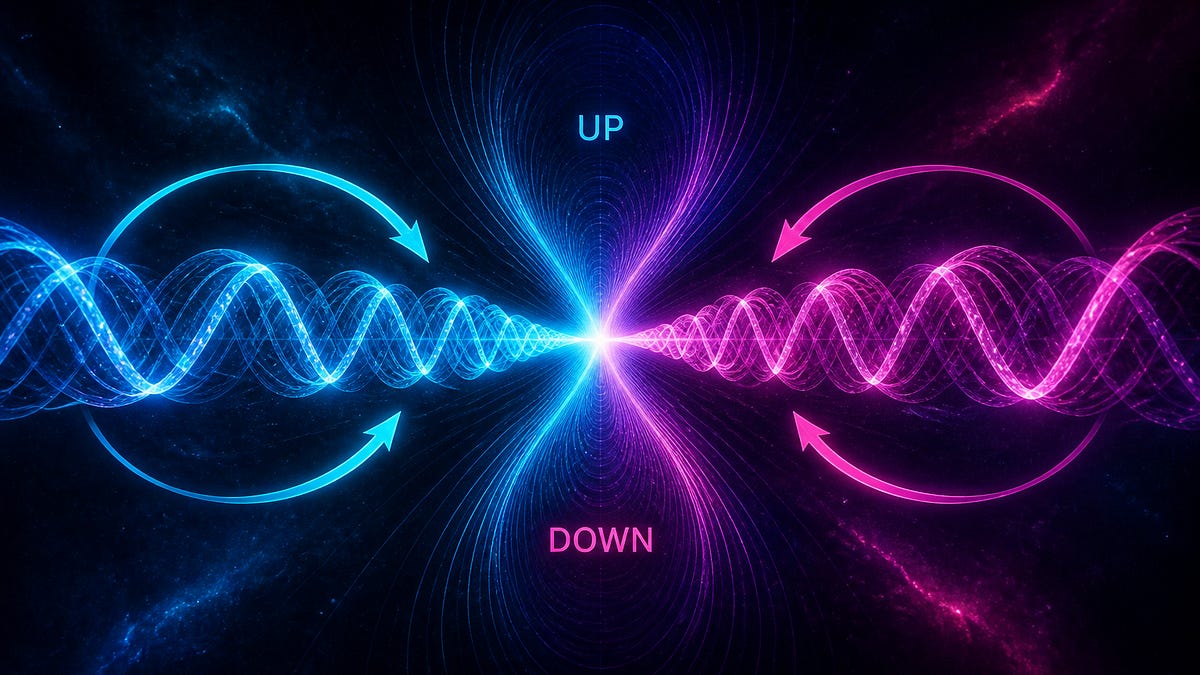
TL;DR:Textbooks draw spin as a tiny top. Frequency Wave Theory says that picture is theater. Spin is phase handedness — a preferred swirl direction in a standing wave. Up and down are not little arrows glued to a ball. They are opposite ways a pattern can lock its timing around itself.
.
We inherited a cartoon.
An electron spinning like a marble on an axis. North pole. South pole. Angular momentum like a gyroscope.
That cartoon helped early quantum pioneers talk to each other.
It also lied in a friendly way.
Because if an electron were a literal spinning ball of charge at the speeds the numbers demand, the surface would break special relativity into pieces.
So physics kept the word 'spin' and quietly dropped the marble.
Frequency Wave Theory goes one step further:
Keep the handedness. Drop the ball.
In FWT, a 'particle' is a standing oscillation — a locked rhythm in a shared medium.
Some standing patterns are mirror-symmetric.
Some are not.
Spin is the name we give to a preferred circulatory phase around a locked mode.
'Spin up' leans one way in the swirl ledger.
'Spin down' leans the opposite way.
Same frequency family. Opposite handedness.
When two patterns meet, their swirls either agree, cancel, or fight for the medium's local clock.
We call the bookkeeping of that fight magnetic moment, selection rules, and spin statistics.
No tiny tops required.
Write it in plain ASCII:
s ~ H * A
Read it like this:
s is the effective spin (what instruments report as up/down strength and orientation)
H is the handedness of the circulatory phase (+1 or -1 in the simple two-state case)
A is the amplitude of that swirling mode (how strongly the preference shows up)
Spin is not a marble twisting in empty space.
It is which way a standing wave prefers to wrap its own phase
.
Why not three? Why not a continuous dial?
Because the simplest closed swirl on a locked mode has two consistent completions.
Clockwise lock.
Counterclockwise lock.
Anything in between is not a stable standing pattern — it is a transient that wants to fall into one of the two handed wells.
That is why Stern-Gerlach looks discrete.
The apparatus is not 'measuring a little arrow.'
It is forcing a swirl preference to declare which well it belongs to.
ling to the bias map of the medium.
Moving charge bias makes magnetism (as yesterday's force and charge essays sketched).
Standing circulatory phase is the quiet cousin: a pattern that already swirls, even when its center of mass sits still.
mu ~ gHA
Read it like this:
mu is the magnetic moment (how hard the pattern couples to a magnetic environment)
g is a geometry factor for that mode family (the 'g-factor' in lab language)
H * A is handedness times swirl amplitude — the spin content
The lab formulas still work.
The ontology changes: magnetism was always phase geometry talking to phase geometry.
irls, even when its center of mass sits still.
mu ~ gHA
Read it like this:
mu is the magnetic moment (how hard the pattern couples to a magnetic environment)
g is a geometry factor for that mode family (the 'g-factor' in lab language)
H * A is handedness times swirl amplitude — the spin content
The lab formulas still work.
The ontology changes: magnetism was always phase geometry talking to phase geometry
.
Entanglement Without Magic Beads
Two electrons in a singlet are not two tops that somehow pinky-promise forever.
They are one joint phase constraint with opposite handedness slots.
Measure one swirl well, and the joint constraint finishes writing the other.
No signal races across space faster than light.
The correlation was in the shared phase ledger from the start.
That is Frequency Wave Theory's calm reading of 'spooky': not telepathy between marbles — one unfinished standing pattern, two readout ports.
Anywhere you can stabilize or scramble circulatory phase independently of ordinary orbital motion, FWT expects spin-like signatures to track handedness coherence, not little mechanical RPM.
Practical fingerprint:
Hold total energy roughly fixed
Change only the coherence of circulatory phase modes
Watch spin-dependent interference, selection, or moment coupling shift with that coherence.
If 'spin' were literal tops, coherence theater should not retune the identity so cleanly.
If spin is phase handedness, protect the swirl lock and you protect the spin physics.
Spin is not a microscopic gyroscope.
It is phase handedness in a standing wave.
Up and down are opposite ways a pattern can wrap its clock around itself.
Magnets, Stern-Gerlach, and singlet pairs all look less mystical once you stop hunting for tiny tops and start reading swirl preference.
If Frequency Wave Theory is right, then controlling spin technology is not about spinning harder.
It is about locking — and reading — which way the wave prefers to turn.
Explore more at frequencywavetheory.com
A magnetic moment is usually drawn as a tiny bar magnet stuck to the particle.
In FWT, that bar is a compressed cartoon of circulatory phase coup
A note on cookies
Newshunt uses essential cookies to keep you signed in and to remember your language and country, so the site works the way you expect. With your permission, we'd also like to use analytics cookies to understand how people use Newshunt and improve it over time.
Accepting only affects analytics. To learn more, view our Privacy Policy or Terms & Conditions.
(0)Comments