


Ping An AI Platform Earns Hang Seng ESG Upgrade: China Data Laws Still Apply
Category: Business
Share
Archive
Like
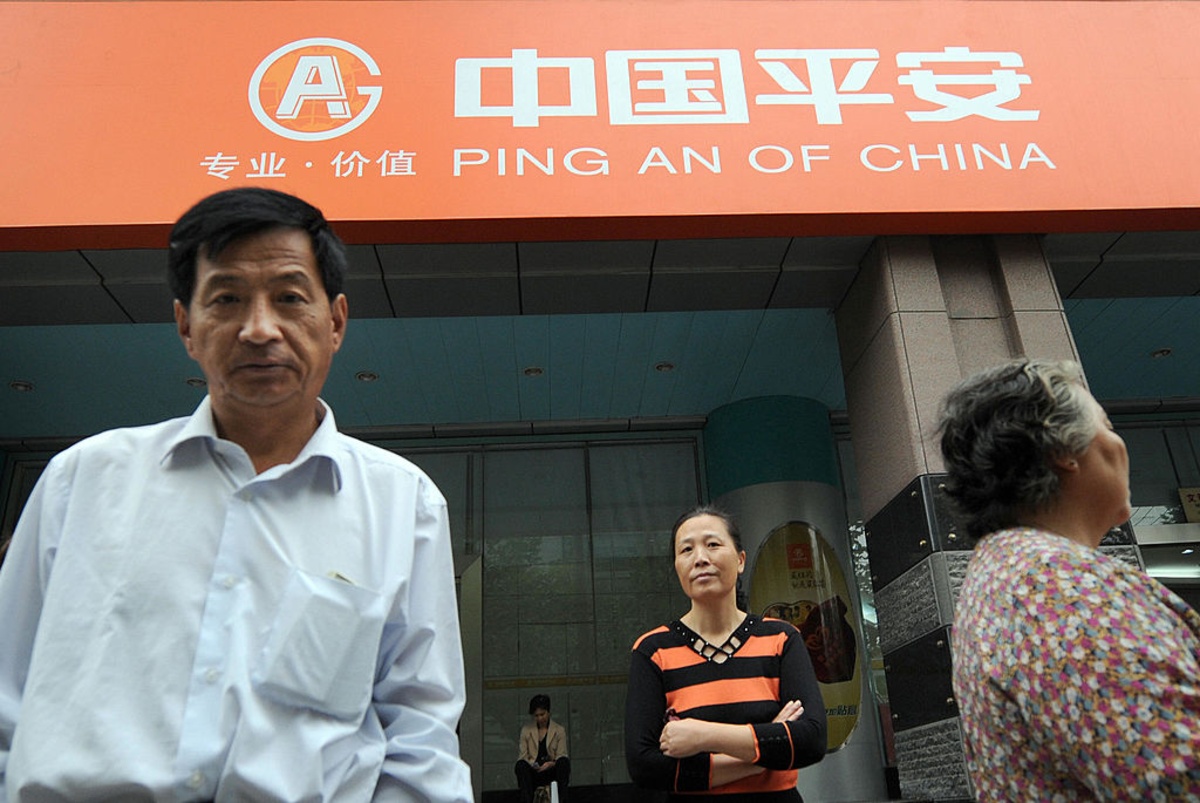
MARK RALSTON/AFP via Getty Images
Ping An Insurance (Group) Company of China — the Shenzhen-based financial conglomerate whose AI representatives now handle roughly 90% of its customer service interactions — has received an A+ from Hang Seng Indexes Company in the 2026 annual sustainability assessment. The upgrade, from A in 2025 and A- the year before, makes Ping An the first Chinese financial company to reach the A+ tier under the current Hong Kong Quality Assurance Agency (HKQAA) rating scale, which was redesigned in 2021 on a new ladder ranging from AAA down to D. That scale is not the same as the pre-2021 framework under which Ping An also had an A+ designation — and the current scale goes higher: companies including CLP Holdings, Sun Hung Kai Properties, and Sino Land hold AAA ratings. For institutional investors holding ESG-mandated funds, the A+ matters anyway, because it gates index membership. What the rating does not measure — China's National Intelligence Law and its implications for 253 million customers' data — is the question every fund manager now mechanically invested in Ping An should be asking.
What the 2026 Hang Seng Rating Actually Measures
The Hang Seng Sustainability Rating is the primary ESG screening criterion for the family of Hang Seng Sustainability Indexes. The 2026 assessment covered 636 Hong Kong-listed constituents of the Hang Seng Composite Index and 1,562 A-share constituents of the Hang Seng China A (Investable) Index. Those numbers — up from roughly 500 HK-listed and 1,300 A-share companies in 2025 — represent the full competitive field for the rating. A+ is genuinely hard to achieve in that universe: Ping An's A-share listing (SSE: 601318) ranked in the top 10% of all A-shares assessed, as well as the top 10% of financial companies on the Shanghai exchange. Its H-share (HKEX: 2318) placed in the top 20% of Hong Kong-listed companies and the top 10% within the financial industry.
The HKQAA evaluates environmental, social, and governance dimensions using a fact-based scoring methodology grounded in verifiable implementation evidence. This is a more rigorous process than pure self-reporting — an important distinction at a moment when ESG data quality remains contested. According to Stanford Rock Center researchers David Larcker and colleagues, whose
But "better than self-reporting" is not the same as "complete." The governance dimension that lifted Ping An's score assesses board structure, standardized procedures, and financial transparency. It does not assess — and no major ESG rating framework publicly accounts for — the legal condition that any organization headquartered in mainland China must satisfy under Article 7 of China's National Intelligence Law.
What the Governance Score Does Not Measure
The
Ping An holds data on 253 million retail customers — financial transaction records, health consultations through its AI Doctor platform with over 9.7 million users, insurance claims, and location data from its property-casualty operations. Its AI representatives handled approximately 487 million customer interactions in Q1 2026 alone, covering 82% of total service volume at that point, according to
This structural condition does not change when a board adds an independent director, improves disclosure procedures, or raises its interim dividend — as Ping An did with its RMB 0.98 per share (approximately $0.15 USD) interim dividend representing a 3.2% annual increase. Ping An Board Secretary Richard Sheng described sustainability as a "core competitive strength" in comments tied to the rating. That framing is accurate within Ping An's own terms. It does not resolve the data-governance question that the ESG rating does not ask.
How Ping An's AI Platform Actually Works
For TechTimes readers who track the technology rather than the corporate narrative, the more substantive story is what Ping An's AI infrastructure has become — and why the ESG rating upgrade follows directly from it.
In April 2026, Ping An launched what it describes as the first AI financial assistant in China capable of completing complex multi-step transactions from a single natural-language prompt. The
That architectural distinction matters for scale. Serving 90 million monthly active users across 300+ connected services without rebuilding integrations for each query requires a pre-built orchestration layer rather than a chatbot querying external APIs at runtime. The practical result: in 2025, Ping An's AI representatives handled more than 1.7 billion customer service interactions — 80% of total service volume — with AI-powered anti-fraud detection in its property-casualty business saving approximately RMB 3.65 billion (approximately $543 million USD) in fraudulent claims in Q1 2026 alone. In H1 2026, the group's EagleX enterprise safety platform monitored more than 29,000 businesses, addressed nearly 8,000 safety risks, and prevented 66 major incidents.
The underlying LLM has externally measurable performance. In March 2026, Ping An's financial large language model reached the top position on the CNFinBench leaderboard, according to the
This is the AI infrastructure that now underlies Ping An's ESG score. The green finance flows that supported the environmental pillar — RMB 647.6 billion (approximately $96.4 billion USD) in green investments held by insurance funds and RMB 273.4 billion (approximately $40.7 billion USD) in green loan balances as of June 30, 2026 — are tracked and reported through the same digital infrastructure. The social pillar's reach — 11.51 million life insurance customers accessing health or elder care services in H1 2026, proactive risk alerts sent to 120 million customers, RMB 212 million (approximately $32 million USD) in customer losses prevented — is delivered through and validated by the same AI platform. The HKQAA assessment, in effect, scored the outputs of that platform.
What the Index Upgrade Means for Capital Flows
For funds operating under ESG-linked mandates, Ping An's A+ rating has direct mechanical consequences. As a result of the upgrade, the group is now a constituent of seven major Hang Seng sustainability indexes, including the Hang Seng (Mainland and HK) Corporate Sustainability Index (HSMHSUS) and the Hang Seng (China A) Corporate Sustainability Index (HSCASUS). Passive and rules-based funds benchmarked to those indexes are obligated to hold or increase their positions in Ping An's shares, creating structural demand independent of Ping An's quarterly earnings.
The
Ping An's financial performance in the first half of 2026 supports the investment thesis on its face: operating profit attributable to shareholders grew 8.3% year-on-year to RMB 84.2 billion (approximately $12.5 billion USD), and net profit attributable to shareholders surged 36.1% to RMB 92.6 billion (approximately $13.8 billion USD), according to the
None of that financial performance or that multi-rater ESG recognition resolves the structural legal condition described above.
Does ESG Scoring Account for Authoritarian-Jurisdiction Legal Risk?
The short answer from the research: no ESG rating system currently applied to Hang Seng constituents publicly accounts for state data-access mandates as a governance risk factor. The HKQAA framework evaluates board structure, operational risk management, ESG integration, and disclosure quality — not the legal obligations that supersede all of those governance arrangements under the National Intelligence Law.
Broader ESG rating criticism offers context. Stanford Rock Center researchers David Larcker and colleagues argued in their widely cited paper that ESG ratings have "significant shortcomings" in methodologies and incentives and show low inter-rater correlation across providers — making it dangerous to treat any single ESG score as a complete risk picture. A BNP Paribas poll of 420 institutional investors found 71% viewed inconsistent and incomplete data as the biggest barrier to ESG investing. The Hang Seng assessment, because it uses an independent agency (HKQAA) with verifiable evidence requirements, is better positioned than self-reported indexes — but "better positioned" is not a complete answer to what the governance dimension measures versus what it structurally cannot reach.
Investors considering ESG-linked positions in Ping An based on the index upgrade should cross-reference the Hang Seng A+ against Ping An's MSCI AAA designation and forthcoming disclosures from the group's annual sustainability report, while factoring in the National Intelligence Law as a fixed legal condition of operating under Chinese jurisdiction — one that does not appear in any of those ratings' governance scores.
Frequently Asked Questions
What is the Hang Seng Sustainability Rating, and is A+ the highest possible?
Hang Seng Indexes Company — through its designated assessment body, the Hong Kong Quality Assurance Agency — annually rates listed companies in Hong Kong and mainland China on environmental, social, and governance performance. In 2021, HKQAA replaced an older rating scale with a new one running from AAA (highest) down to D. Under that current scale, A+ is not the maximum: several companies, including real estate and utility firms, hold AAA ratings. Ping An's A+ in 2026 is the first time the company has reached the A+ tier under the current scale — a genuine milestone in its scoring trajectory, and a meaningful result in a pool of nearly 2,200 assessed companies, but not the ceiling of the system.
How does Ping An's AI financial assistant work?
Ping An's Express Service, launched in April 2026, is designed as a service execution platform rather than a chatbot. A user submits a single sentence — a claim request, a financing query, an emergency alert — and the system uses Ping An's financial large language model to parse intent, then routes that intent across more than 300 pre-integrated digital services, coordinating workflows and activating offline resources (hospitals, service outlets, emergency providers) where needed. The company's financial LLM (PingAnGPT-Qwen3-32B) ranked first overall on CNFinBench in March 2026, and its medical AI topped OpenAI's HealthBench Hard benchmark as of April 2026 — third-party benchmarks that provide independent validation of the platform's performance against global competitors.
Does China's National Intelligence Law actually affect how Ping An handles customer data?
Article 7 of China's National Intelligence Law (2017) requires all organizations and citizens to support, assist, and cooperate with national intelligence work. Article 28 of the Cybersecurity Law (2017) separately requires network operators to provide technical support and assistance to security organs. These are not hypothetical risks — the US National Counterintelligence and Security Center has explicitly cited them in business risk advisories. Ping An holds data on 253 million retail customers, including health consultations, financial transactions, and insurance records. While Ping An is not a state-owned enterprise and has not been publicly cited in any enforcement action related to these laws, the laws apply to any organization operating under Chinese jurisdiction, regardless of ownership structure. No ESG rating currently addresses this legal condition in its governance scoring.
Why does an ESG rating upgrade trigger automatic buying by funds?
Hang Seng sustainability index membership is used as a constituent-selection criterion by passive and rules-based funds — particularly pension funds, sovereign wealth vehicles, and ESG-dedicated ETFs operating under mandated benchmarks. When a company moves into a new index tier or gains additional index membership, funds tracking those indexes are required to buy or increase positions in that stock regardless of their view on its business fundamentals. Ping An's 2026 A+ upgrade added it to seven Hang Seng sustainability indexes simultaneously, affecting both its Hong Kong-listed H-shares and its Shanghai-listed A-shares — creating structural demand from two separate institutional capital pools.
A note on cookies
Newshunt uses essential cookies to keep you signed in and to remember your language and country, so the site works the way you expect. With your permission, we'd also like to use analytics cookies to understand how people use Newshunt and improve it over time.
Accepting only affects analytics. To learn more, view our Privacy Policy or Terms & Conditions.
(0)Comments