


Cloudburst floods disrupt life across Ghizer and Hunza
Category: Tourism
Share
Archive
Like
Summary GILGIT: Severe weather has disrupted daily life in several parts of Gilgit-Baltistan after cloudburst-triggered floods damaged homes, farmland, orchards and roads.
The Gilgit-Baltistan Disaster Management Authority said the region experienced 120 floods linked to cloudbursts and glacier melting between June and August this year.
The region is increasingly experiencing cloudbursts, flash floods, rapid glacier melting, glacial lake outburst floods, landslides and periods of unusually high temperatures.
AI Generated Summary
GILGIT: Severe weather has disrupted daily life in several parts of Gilgit-Baltistan after cloudburst-triggered floods damaged homes, farmland, orchards and roads.
Heavy rain in Ghizer district caused flash floods during the early hours of Saturday. Several villages were affected.
Naubahar village was among the worst-hit areas. Floodwater damaged the Gushgush Jamaat Khana and destroyed crops, fruit trees and agricultural land.
Flooding also blocked the road linking Immit with Barjangle. Electricity transmission lines along the route were damaged, leaving residents facing further difficulties.
Locals urged the administration to take immediate steps to clear the blocked roads. They also called for emergency assistance for families who suffered losses.
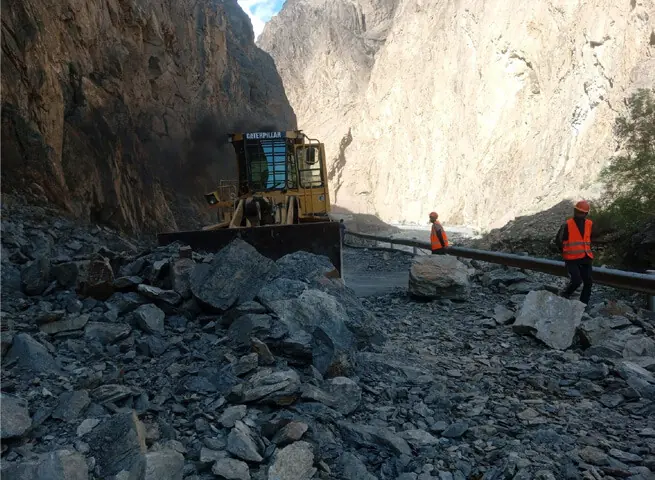
The Karakoram Highway (KKH) was also affected by landslides. The route between Sost and Khunjerab Top was closed to traffic.
Authorities said teams were working to remove debris and restore connectivity. Tourists were advised to avoid unnecessary travel until conditions improve.
In Hunza, the KKH section between Murtazaabad and Hassanabad was reopened after landslides blocked traffic.
Intermittent rain, thunderstorms and lightning have continued in different parts of Gilgit-Baltistan since August 1.
Residents said the recent rainfall was unusually intense.
Many locals reported panic as powerful thunderstorms and heavy downpours struck the region.
The persistent rain has also caused a noticeable drop in temperatures across the mountainous region.
Meanwhile, Babusar Top in Diamer received the first snowfall of the season on Saturday morning.
Despite the snowfall, traffic on Babusar Road continued.
The Gilgit-Baltistan Disaster Management Authority said the region experienced 120 floods linked to cloudbursts and glacier melting between June and August this year.
The disasters damaged homes, agricultural land, orchards, trees, irrigation channels and roads.
Electricity infrastructure was also affected in several areas. Some communities remained cut off for days after roads were washed away or blocked by debris.
Experts have warned that weather patterns in Gilgit-Baltistan are changing rapidly.
The region is increasingly experiencing cloudbursts, flash floods, rapid glacier melting, glacial lake outburst floods, landslides and periods of unusually high temperatures.
Climate change is placing additional pressure on the fragile mountain ecosystem.
Gilgit-Baltistan is home to thousands of glaciers and hundreds of glacial lakes. Its mountainous terrain makes communities particularly vulnerable to sudden weather-related disasters.
Residents say weather conditions that were once considered predictable are becoming increasingly difficult to anticipate.
They recalled that summer traditionally began to give way to colder conditions by mid-August, with freezing temperatures at higher elevations reducing the risk of flash floods.
However, locals say this pattern has changed in recent years.
Communities across the region are now facing greater uncertainty as extreme weather events become more frequent and intense.
A note on cookies
Newshunt uses essential cookies to keep you signed in and to remember your language and country, so the site works the way you expect. With your permission, we'd also like to use analytics cookies to understand how people use Newshunt and improve it over time.
Accepting only affects analytics. To learn more, view our Privacy Policy or Terms & Conditions.
(0)Comments