


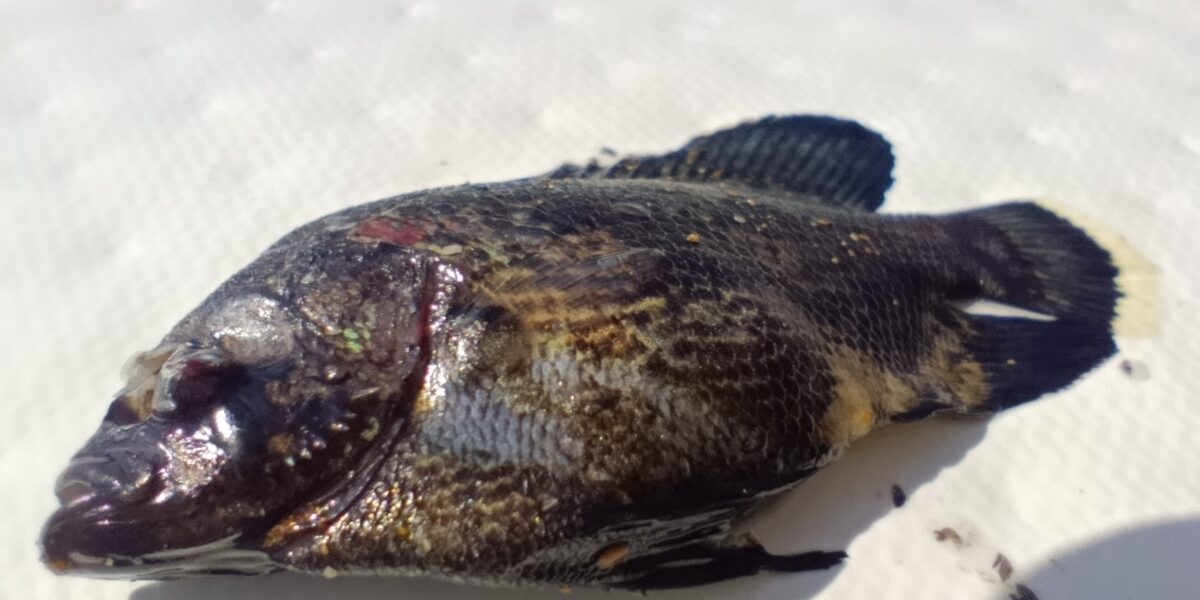
Exceptional discovery in Crotone: a leaf fish, a rare and non-native species in the Mediterranean, captured at Capo Colonna
Category: SciTech
Share
Archive
Like
Add the Gazzetta del Sud as a source
A new and significant signal of the profound changes that are affecting the Mediterranean comes from the waters of Capo Colonna. Yesterday, 6 September 2026, during a coastal inspection and monitoring activity conducted by members of the IBIS Environment Club, a specimen of leaf fish (Lobotes surinamensis) was captured during a dive, a species of particular interest for the study of the presence and spread of non-indigenous organisms in the Mediterranean. The discovery occurred as part of the activities envisaged by the agreement between the IBIS Environment Club and the Capo Rizzuto Marine Protected Area, as well as the association's participation in the AlienFish scientific project, dedicated to the monitoring of alien and non-indigenous marine species.
The captured specimen was immediately preserved and will be sent to the University of Catania, where it will be subjected to scientific in-depth analysis and genetic DNA analysis, thus contributing to the collection of new data on the distribution and origin of the species in the Mediterranean. Lobotes surinamensis, belonging to the Lobotidae family, is a species with an immediately recognizable appearance. In fact, it has a tall and laterally compressed body and dorsal, anal and caudal fins characterized by large rounded lobes, a conformation that gives it the typical appearance of a large floating leaf. Young specimens, in particular, exploit this extraordinary camouflage, letting themselves be carried by the currents and blending in with leaves and other floating materials. The species can reach considerable dimensions, exceeding one meter in length. The Leaffish is widespread mainly in the tropical and subtropical waters of the Atlantic and Indo-Pacific oceans. Its presence in the Mediterranean is considered of particular interest and is carefully monitored in the study of non-indigenous species and changes in the distribution of marine fauna. Observations of this species in the Mediterranean have long been sporadic, but in recent years reports have highlighted a growing presence in the central basin and in Italian waters, making each new discovery particularly significant from a scientific point of view.
«This discovery demonstrates once again how important it is to maintain constant observation of our coasts and seabeds – declares Girolamo Parretta, president of the IBIS Environment Club –. The Mediterranean is going through profound changes and the appearance, increase or movement of species from other seas represent phenomena that we must document with scientific attention'. 'The involvement of citizens, fishermen, divers and all the people who frequent the sea is today a fundamental tool for understanding what is happening. Our Club will continue to make its experience and network of volunteers available to concretely contribute to scientific research. Every observation can be important: a photograph, a video, the precise indication of the place and date of a sighting can provide precious data to reconstruct the distribution of species and understand their evolution in the Mediterranean'. The AlienFish project represents an important monitoring tool for non-indigenous and unusual marine species in Italian waters, enhancing the contribution of citizen science and the direct involvement of fishermen, divers, freedivers and ordinary citizens in the collection of scientifically useful data.
A note on cookies
Newshunt uses essential cookies to keep you signed in and to remember your language and country, so the site works the way you expect. With your permission, we'd also like to use analytics cookies to understand how people use Newshunt and improve it over time.
Accepting only affects analytics. To learn more, view our Privacy Policy or Terms & Conditions.
(0)Comments