


The Makkah Alliance, Part 2: Between Branding and Substance
Category: Politics
Share
Archive
Like
Part 1 traced why Saudi Arabia, Türkiye, and Pakistan converged on a signing in August. Three states arrived at the same instrument from three different directions: Saudi Arabia built it to manage partners it needed but did not want to answer to; Türkiye and Pakistan built it as a door into a regional role and a market neither had before. That convergence, rather than a shared threat, is what produced a signing on August 7 and a named alliance three weeks later.
In this piece we will explore what the Makkah Defense Alliance is, and what it is not. As of writing, there is no published agreement text to work from, only statements. What follows works through what those statements confirm and what they leave out, how that record holds up against the threats and obligations each member actually carries, and what the alliance can be ruled out as once it's tested against precedent. What's left once the ruling-out is done, and whether it's built to last, is where the third and final piece in this series picks up.
Subscribe now
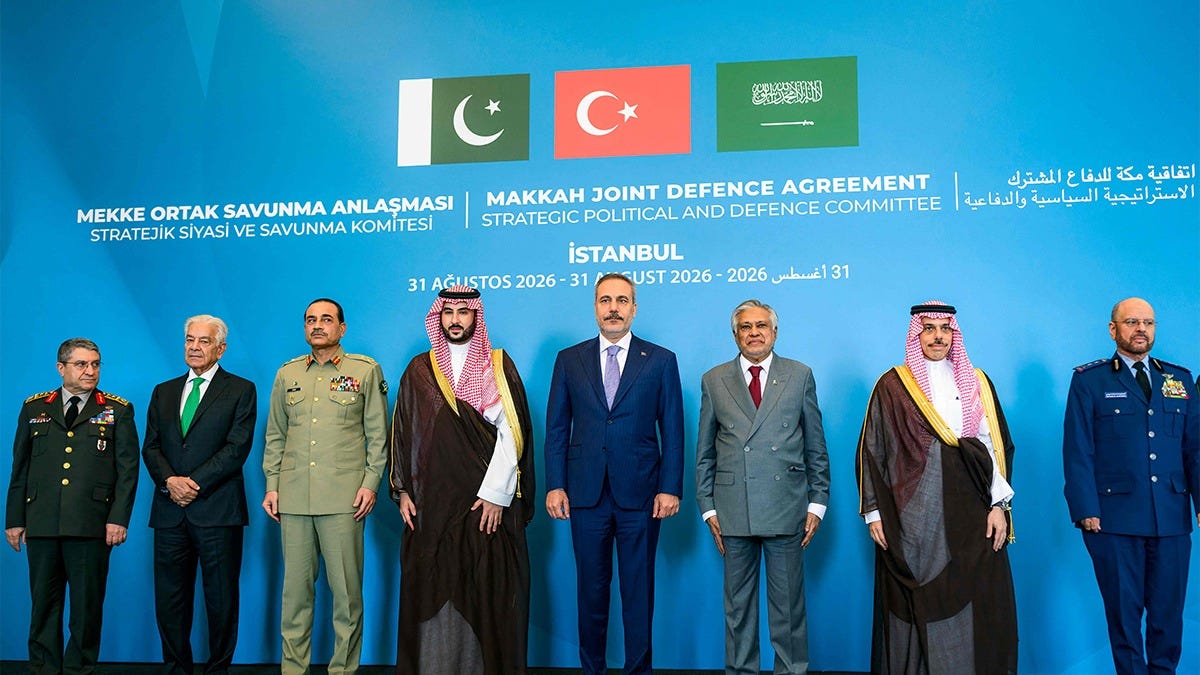
Several statements, some joint, some individual, sketch the outlines of what the agreement rests on. It was signed on the 7th of August, and itsStrategic Political and Defense Committeeheld its first official meeting in Istanbul on the 31st of the same month. Statements from the foreign ministers and government spokespersons across both events touch on several consistent themes.
The foundational points, according to theseofficial statements, are that this is a defensive alliance, that it does not target a specific named enemy or threat. Central to these statements is the clause that an attack on one member will be considered an attack on all.
However, various statements from those same officials downplayed the similarities with NATO's article 5, with the Turkish Foreign Minister stating that thiswas not an automatic response, and that the affected country would have to request support and identify the nature of the requested support (military, logistic, intelligence, or otherwise). The caveat itself is indicative of inbuilt dilution of the collective defense framing.
It is designed to restore regional stability through regionally owned architectures and ownership of the defensive and security processes. The alliance, according to these same statements, seeks to establish collective deterrence, althoughwhois supposed to be deterred remains unnamed, that it will enhance cooperation, intelligence sharing, and interoperability between the member states. It is also designed to test a new model of regional cooperation on matters of defense and security among regional actors, limiting simultaneously external influence in the region.
The alliance will take the shape of an international organization, with a permanent secretariat to behoused in Riyadh, led by a Pakistani Secretary General for the first three years. This concrete step seeds the potential for further organizational development and momentum, but for the moment remains rooted in calibrated logistical coordination.
The alliance is open to accession by other states, and is expected to welcome other members, with the potential for expansion resting upon the foundational basis which is currently being built.
That language, those statements and descriptions, is the extent of official confirmation. No public text exists, no threat is named, no automatic trigger is defined. What's confirmable rests entirely on statements officials chose to make and those statements carry more interpretive leeway to construct narratives aligned with political direction than to reflect the agreement's actual contents and the obligations it imposes.
If we were to take the official narrative construction acontextually, this alliance would appear to be a seed for a future Middle Eastern NATO in the making. However, when rubbed against the grindstone of reality, the emerging picture takes on a different shape entirely.
The first and most important element of a collective defense alliance is a common threat shared among the members, a common problem to solve through the pooling of resources. This is explicitly absent from the agreement itself, and a collective defense agreement against no one is not, functionally, a collective defense agreement.
The actual picture is that each of the three founding members has a different threat ecosystem, military doctrine, and immediate concerns on the strategic defense layer, presenting a structural hurdle to a collective defense agreement rather than a simple inconvenience. Pakistan's core concern and rival remains its nuclear neighbor, India, while Türkiye's current strategic locus includes the levant and the Mediterranean, with friction increasing with Israel on the one hand and Greece on the other, while simultaneously eyeing its northeastern corridor. Meanwhile Saudi Arabia is contending with the Yemen conflict to its south, with the persistent concerns of Iran to its east, and the web of threats against its interests through proxy rivalries in the region, including with the UAE, where the two countries' interests have diverged across the regional and international arenas.
With a threat matrix with limited overlap, the road to collective defense becomes more difficult to pave; the costs of being dragged into conflicts that are not part of an existing threat matrix for each country outweigh the benefits of being bound by a collective defense agreement. Which brings us back to the caveats to the framing of 'an attack on one is considered an attack on all,' which represent an inbuilt escape hatch for the members requiring detailed requests and a scaling level of support that does not automatically engage collective defense.
Which brings us to the geographical factor in play: the power projection capabilities of the three countries do not align with the narrative framing built into the statements regarding collective defense: Riyadh and Ankara's reach in a scenario with an active war between Pakistan and India, for example, are limited by logistical constraints that would have to be solved through basing rights, and other tangible on the ground improvements that would likely run against the grain of the inbuilt constraints officials themselves have mentioned regarding sovereignty and non-interference. Pakistan's ability to do the same, for conflicts in the Middle East would face similar challenges.
Saudi Arabia is deeply entangled within regional American security architectures. It is one of the most important clients for American military equipment, with deals in 2025touching the 142 billion dollar mark. Its systems rely heavily on American technology and despite itsrecent diversification effortsremains connected to those systems. Absent concrete steps to truly diversify and develop locally centered defense architectures, Riyadh will not be, in the medium term, in a position to challenge American interests should they contrast with its own, as evidenced by the fact that the war on Iran went ahead in February despite the direct risks it posed to Saudi national security, with no indication Riyadh had the leverage to prevent it.
Similarly Türkiye is deeply connected to the U.S. through its NATO alliance membership, and for Ankara, NATO is the more dependable alliance when it comes to military matters than any collective defense agreement that does not offer the same amplification of power that NATO offers. While Ankara retains significant leeway within the NATO architecture, positioning itself at different moments of the Russia Ukraine war as an intermediary, it nevertheless remains grounded within that structure to a degree.
Pakistan similarly has along-standing partnership with the U.S., dating to the Cold War-era Afghan front against the Soviets, and renewed after 2001 as a key partner in American counterterrorism efforts in the region.
So while the current alliance is not as severely constrained by external interests as for example the Baghdad Pact of 1955, which was heavily influenced by external influence and super power rivalry during the cold war, it is nevertheless not as free topursue regionally centered policies as the name and the public framing would suggest: none of the member states for instance would be likely to prioritize their relations under this pact over their interests and partnership with Washington, which gives the latter significant sway over policy direction albeit indirectly.
The bilateral floor beneath Makkah is also already dense. Egypt and Türkiye signed their own standingdefense framework in February 2026. Türkiye and Pakistan have built a substantial defense-industrial relationship independent of this pact — four MILGEM-class corvettes for the Pakistan Navy undera roughly $1.5 billion program, a planned Turkish combat-drone assemblyplant on Pakistani soil, and early-stage talks on Pakistani participation in production of Türkiye's KAAN fighter. And Saudi Arabia and Pakistan already have their own mutual defense agreement,signed in September 2025, which Makkah folds into a trilateral structure rather than replaces. Most of what Makkah does, in other words, was already being done bilaterally before the trilateral instrument existed.
Russia and China both have an interest in eroding American influence through this alliance — for instance, by incentivizing Iran's eventual accession — though the success of such efforts isn't assured. This isn't merely speculative: Russian Foreign Minister Sergey Lavrov has alreadyfloated Iran's accessionas a step toward the Gulf security framework Moscow has proposed for some time, alongside potential Egyptian and Algerian membership. Whether that materializes remains to be seen; the point here is only that great-power interest in shaping this alliance's trajectory is already visible, which roots Makkah partly under the umbrella of great-power competition rather than purely as a locally centered structure.
None of this was invisible to the three governments when they signed. They built this instrument anyway, in the middle of a live war in Iran, continuing flashpoints around Israel, and unresolved fighting in Yemen, which suggests the calculation was never really about the alliance matching NATO's standard.
Share
When we take together the facts we have about the alliance, precedent, and the surrounding ecosystem, we can begin eliminating options of what it is not, to better understand what it is and what it could be.
First and foremost this is not a NATO analog. This alliance, in its shape today, is not in the strictest sense a collective defense alliance. It has no clear common enemy, no clear common threat, its members face different threat ecosystems, and have diverging defense and security priorities. Their militaries are not designed around the same (or even similar) problems, nor do they pose significant collective deterrence for their respective rivals.
Similar agreements have been signed before in the region, including the1950 Joint Defense and Economic CooperationTreaty among Arab League states, theBaghdad Pact of 1955, and the GCCJoint Defense Agreementof 2000. They all included the language of an attack on one is an attack on all, and none of them materialized into tangible regional defense structures. The rivalries between the member states and the individual interests, bilateral agreements and regional priorities all took precedence over their commitment to collective defense, and there is no reason to think that once today's crises abate, the pattern won't repeat.
At the same time, the question of whether this alliance is designed to contain Iran, or designed as an anti-Iran bloc, does not hold against the evidence. Pakistan, a founding member, is actively involved as a mediator with Iran and the U.S. in their active conflict. It is intensifying engagement with Tehran on trade and coordination, and did not take any action against Iran even when the latter struck Saudi territory earlier in the conflict; its foreign minister instead reaffirmed the 2025 Saudi-Pakistan Defense Agreement rather than threaten retaliation against Tehran. That Riyadh pressed forward after that to form this trilateral alliance including Pakistan once again signals that Riyadh is not expecting Islamabad to operate as a kinetic spearhead against Iran in the near term.
Iran's own posture reinforces this. Foreign Ministryspokesman Esmaeil Baghaeisaid the pact gave Tehran no reason for concern. Foreign Minister Araghchi went further,welcoming it outrightand framing it as a step toward Muslim-world unity and self-reliance.
Similarly, the alliance, while its members are individually and collectively opposed to Israel, only one of its members is competing with it directly in overlapping spheres of security influence. While the adversarial posture between Türkiye and Israel has escalated considerably since the fall of Assad and their competition in Syria, both the current Israeli and Turkish governments benefit in their domestic political fronts from this posture as it gives them legitimacy with their respective populations, but the risks and costs of direct confrontation bear a significantly higher cost threshold. Saudi Arabia has no interest in being dragged into a direct confrontation with Israel, as this would severely complicate its relations with Washington, and Pakistan has a similar cost benefit calculation. While the three countries have considerable political alignment against Israel, their military posture is very different.
And then comes the question of the nuclear element provided by Pakistan. Pakistan's status as a nuclear power features heavily when discussing this alliance, but the real constraints paint a very different picture. Pakistan and India's respective nuclear arsenals are primarily designed against each other. Extending that arsenal as a deterrent for Gulf allies would require a demonstrated willingness to risk direct confrontation on their behalf that Islamabad's declared doctrine doesn't show. The idea that Pakistan would extend that umbrella to the alliance's members is predicated on a rather generous view of both the reach and the political will of Islamabad to risk significant repercussions for relatively limited gains.
This alliance as it stands today, and from what official statements have described, is also not geared to become a substitute for the American security guarantee; it does not have the power-projection capacity the US brings to the Gulf: carrier presence, the naval reach to secure maritime chokepoints, and forward basing among others. Further, the depth of cooperation between the three member states with the United States predicates any rapid movements away from that toward other partnerships, and while the alliance and agreement may lay the foundations of a greater degree of maneuver, it nevertheless does not confer on its members the option of rapid decoupling from existing architectures, even if they wanted to do so. This is compounded by the fact that other actors in the region, whether they have indicated intentions to accede or not, have not signaled any intentions of moving away from the current status quo towards other mechanisms, and the states that do take steps to decouple would possibly find themselves at a competitive disadvantage.
None of this settles what the Makkah Alliance is, rather, it reframes the question. If the region's most detailed prior attempt at exactly this kind of commitment, public, ratified, institutionally staffed, never translated into operational reality, then the honest question about Makkah becomes whether another iteration, riding on the same underlying logic, has any real chance of doing better.
On the evidence so far, no — not in kind, only in packaging. It has been labeled as a defensive alliance, one where an attack on one is an attack on all, as have others that came before and never panned out. It has been hailed as a seed of regional independence, one where regional states would take ownership and set the course of regional defense and security, and yet its three founding members remain anchored in their respective bilateral and multilateral obligations.
The institutional shell is real and growing: a secretariat, a Secretary General, a committee that has met on schedule — while nearly every marker of operational substance remains either absent or unconfirmed. The Arab League's 1950 treaty and the GCC's own defense agreement, the latter twenty-six years old this year, took the same shape, and both have spent every year since as a durable, muted political signal without much operational reality behind it.
The actors were not unaware of these constraints going in; they assessed that the benefits outweighed the costs, and the joint-defense language, the regional-ownership rhetoric, and the reduced-external-influence discourse became the branding. It sells well domestically: it signals governments taking proactive steps on security, and in the current political climate that improves legitimacy and produces a rally-round-the-flag effect.
It is real, but it is not what it has been branded as, at least for today. In the third and final piece we look at the different prospective scenarios of where this alliance could be headed.
A note on cookies
Newshunt uses essential cookies to keep you signed in and to remember your language and country, so the site works the way you expect. With your permission, we'd also like to use analytics cookies to understand how people use Newshunt and improve it over time.
Accepting only affects analytics. To learn more, view our Privacy Policy or Terms & Conditions.
(0)Comments