


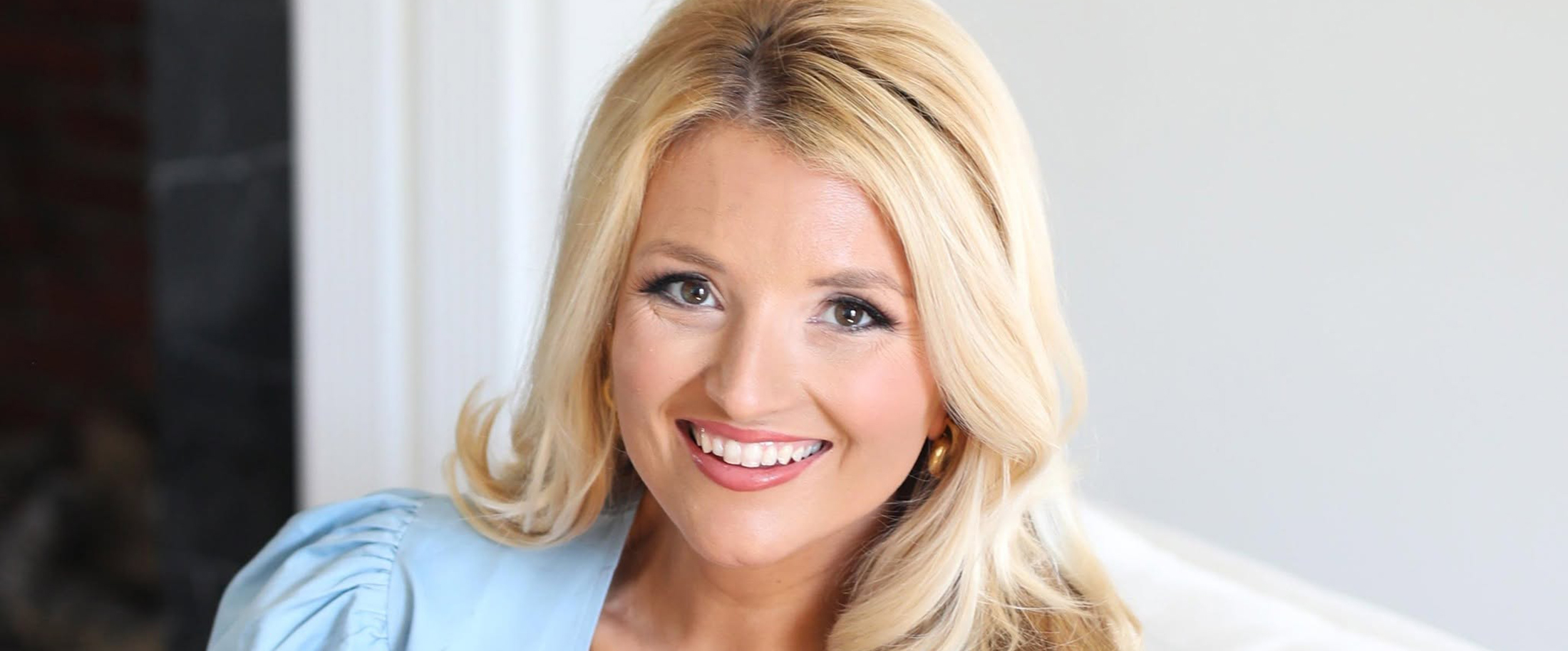
In conversation with Kendall Mariah
Category: Entertainment
Share
Archive
Like
I'm wearing Jordan sneakers. Kendall Mariah is wearing Lilly Pulitzer. That probably tells you almost everything you think you need to know about us. It also tells you almost nothing.
I met Kendall while interviewing to become her pastor. She was sitting on the pastor search committee of a Baptist church in a small North Carolina town. A few questions into the interview, this white woman with perhaps the thickest Southern accent I had encountered in some time told me she was raising a Black daughter. Then she asked what it might mean for her daughter to grow up seeing a Black man as her pastor. I remember thinking, 'Oh, we're going there already.' Kendall addressed race head on in our first conversation.
Afterward, I did what Millennials do when we meet someone interesting, I used the Google machine. That only made Kendall more confusing.
She is a military spouse, mother, deacon, content creator and author. She grew up Baptist and still loves the church. Her first book was published by one of the largest publishers in the evangelical Christian world. And that book covers doubt, deconstruction, racism, purity culture and mental health. The questions many Christians often are told they shouldn't ask.
Kendall looks at home in spaces that might be uncomfortable with some of the things she says. She speaks a language that can get her into rooms where the questions she asks may not always be welcome. That tension isn't incidental to her story. It is the story.
'I think I'm called to the friction,' she told me.
Her book, This Little Fire of Mine: How Flickers of Doubt Can Spark a Bolder, Brighter Faith , grew from what Kendall describes as friction — those places where what we have been taught to believe rubs against what we actually experience. Soul friction, perhaps. The uncomfortable space between what we inherited and what we are discovering.
Between the God we were told about and the God we keep encountering. Kendall grew up singing 'This Little Light of Mine,' but when it came time to name her book, light felt too tame.
'I've always loved the analogy of fire,' she said. Fire illuminates. But it also warms, refines and exposes. 'It's going to bring out some shadows and darkness sometimes.'
Kendall came of age amid purity culture and carefully constructed ideas about Christian womanhood. Be nice. Be agreeable. Be pure. Don't take up too much space. But then she would open her Bible. And the women she found there weren't always particularly interested in being agreeable.
'I just saw women in the Bible as they looked around and said, 'Who else but me?''
Maybe that explains some of Kendall. She was raised in a Baptist church where women led, served as deacons and were called 'Reverend.' She also was taught that questions did not necessarily represent a failure of faith.
Kendall Mariah
Eventually, though, her questions became bigger. What happens when doing everything Christianity told you to do doesn't produce what Christianity promised? What happens when the theology you inherited no longer explains the life you're living?
'My frustration, thank God, was never with God,' Kendall said. 'God kept showing up.'
Her deconstruction wasn't an attempt to get rid of God. It was an attempt to figure out what was God and what we had simply attached to God.
If Kendall's faith taught her to ask questions, motherhood changed which questions she was willing to ignore.
Kendall and her husband adopted their daughter, Zadie Ann, shortly before the upheaval of 2020. Her husband deployed. The pandemic came. Ahmaud Arbery was killed. George Floyd was murdered.
Other white mothers could turn the news off. Kendall couldn't, not really, because the news wasn't an abstraction happening to somebody else's children anymore. It was happening to the child asleep down the hall. And suddenly this white Southern woman was looking at America through the eyes of the Black little girl she was raising.
'I had never considered safety,' she told me. This confession matters, too.
Kendall had grown up around Black people. Black children sat beside her in school. Played the same sports. Went to church with her. She thought proximity meant understanding. Then she became Zadie Ann's mother. She remembers calling a Black friend and apologizing after realizing they could occupy the same spaces without experiencing those spaces the same way.
'There was no anger like a mother's anger,' she said.
So Kendall took to her online Bible study group and began talking about race publicly. And people were surprised and many were not happy.
Because people do what people do: We categorize. White. Southern. Military spouse. Baptist. Lilly Pulitzer. We think we know her story. Kendall complicates it.
Some of her most meaningful conversations began happening privately with other white women who looked like her, sounded like her and perhaps had inherited some of the same assumptions. 'I have so much grace for people that don't know what they don't know,' she said, 'because that was me.'
'Eventually, the thing we learn has to change the way we live.'
But grace is not permission to remain where we are. Eventually, the thing we learn has to change the way we live. That is friction.
I asked Kendall what she would say to the person whose faith currently feels like it is coming apart. Maybe they aren't trying to leave Christianity. Maybe they're simply discovering the version they inherited no longer holds everything they now know to be true.
'You can deconstruct while continuing to seek and see the beauty in the work of God,' she said.
That may be the sentence some Christians need permission to believe. You can question purity culture without questioning whether God loves you. You can confront racism in the church without abandoning the church. You can reconsider theology without surrendering Jesus. You can admit that some of what you were taught was wrong without deciding everything was a lie.
Perhaps God is bigger than the boxes we inherited.
'Allow it to expand your heart and mind to see God in ways that you might have limited him before,' she advised. Of course, seeing more creates its own problem. 'It'll cause you to see racism. It will cause you to see injustice.'
And once you've seen something, it becomes considerably harder to pretend you haven't.
'What people are so scared of is change,' Kendall said.
Whew. There it is. Change costs us something. Sometimes a theology. Sometimes a relationship. Sometimes the comfort of believing the world is exactly as simple as we were taught it was. Sometimes our seat at the table.
Maybe that's why we call it deconstruction when sometimes what we're really describing is growth.
'God never left me in my deconstruction,' Kendall said. 'God sat there with me and was like, 'All right, go. Keep going.''
Near the end of our conversation, I asked Kendall what is feeding her soul these days. Her answer: 'Seeing the world through my daughter's eyes.'
Zadie Ann reminds her why the friction is worth it. 'If I don't do it, who else will?'
Kendall believes everybody has a place around the table of God's kingdom. Some people build the table. Some extend it. Some sit at it. Some decorate it.
Kendall? 'My job was to flip it.' Because, of course it is.
Maybe I should have known that the first time we met. Maybe I should have known when the white lady in the Lilly Pulitzer dress interrupted the predictable pastor search conversation to ask the Black man in Jordans what it might mean for her Black daughter to see somebody who looked like her standing behind the pulpit.
Maybe that was the friction. The moment when the categories stopped working. The moment when what I thought I knew rubbed against what actually was. I had walked into that room ready to talk theology and vision. I wasn't ready for a woman in Lilly Pulitzer to ask me something that honest.
Kendall told me this season of her life has not offered much peace. Her husband is deployed. She is raising Zadie Ann, navigating church transition, writing, working and watching a world that gives her plenty of reasons to worry about the little girl sleeping under her roof. But she has discovered something else. 'Sometimes when you can't have peace,' she said, 'I think God gives you clarity.'
Maybe that is what soul friction does. It rubs against the easy answers until they no longer satisfy. It burns away some of the categories we thought we needed. It forces us to see what we would rather leave unseen. And if we let it, perhaps the friction doesn't destroy our faith at all. Perhaps it starts a fire.
Braxton Wade
Braxton Wade is a Clemons Fellow with BNG. He is a graduate of the University of Richmond and Chicago Theological Seminary and lives in Richmond, Va.
A note on cookies
Newshunt uses essential cookies to keep you signed in and to remember your language and country, so the site works the way you expect. With your permission, we'd also like to use analytics cookies to understand how people use Newshunt and improve it over time.
Accepting only affects analytics. To learn more, view our Privacy Policy or Terms & Conditions.
(0)Comments