


Wilton officials consider ordinance to regulate all-terrain vehicles on public ways
Category: Politics
Share
Archive
Like
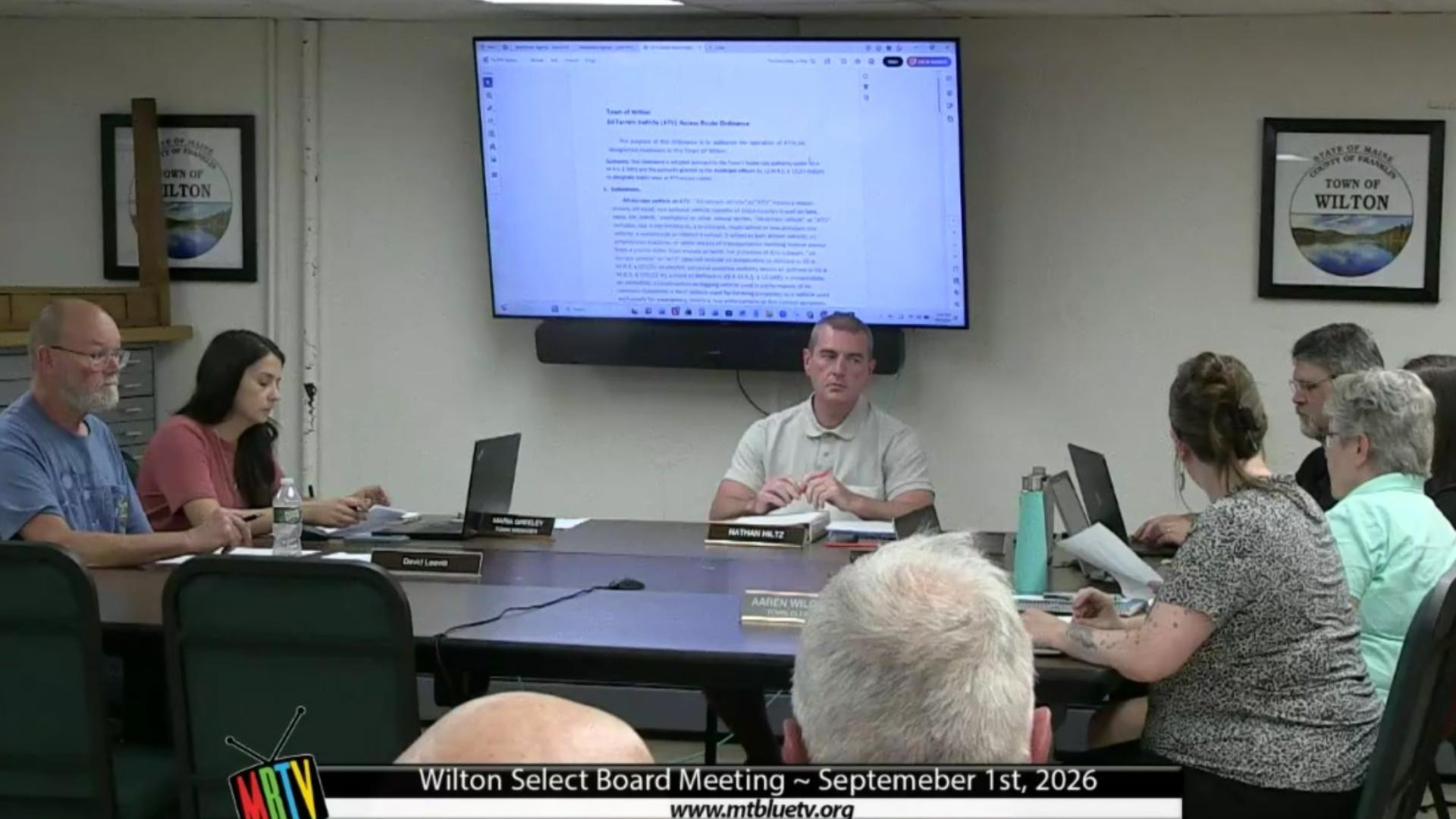
WILTON, Maine — The draft of an ordinance to regulate the use of all-terrain vehicles on public ways was introduced Tuesday night to the Board of Selectpersons.
Board Chair David Leavitt told the board and audience that he hoped the ordinance can be voted on by its second regular meeting in February, which would be Feb. 16, 2027. Police cannot enforce ATV regulations until the town has an ordinance. More in Regional
The draft ordinance comes after a long process of public comments and board actions.
People attending board meetings had asked for tighter regulations. On June 10, about 85 people attended a meeting called by the board to hear ideas about an ATV ordinance.
The board rescinded the town's ATV policy on Jan. 6 after receiving legal advice that it was unenforceable because it was a policy rather than an ordinance. The policy had been in place since April 2022.
If approved, the ordinance would, in large part, enshrine the provisions of the previous policy. The primary route for ATVs in Wilton would remain the Whistle Stop Rail Trail, which roughly parallels U.S. Route 2 and is the roadbed of the old Maine Central Railroad spur between Livermore Falls and Farmington.
The draft ordinance specifies three access routes along public ways to the Whistle Stop Trial. They are: Temple Road, from the Temple town line to Main Street in East Wilton; Main Street in East Wilton, from Temple Road to the Whistle Stop Rail Trail; Main Street, from Depot Street (also known as Route 156) to the downtown memorial, with boat landing access via Canal Street; and Depot Street, from the Whistle Stop Rail Trail to Main Street.
Additional ATV access routes could be established and the current routes altered or dropped by action of the Select Board.
The draft ordinance sets ATV speed limits at 20 miles an hour on Temple Road and 25 mph on the other streets. ATV riders would be required to stay as far right as possible on all public ways.
ATVs would be allowed on the specified public ways between sunrise and sunset from May 15 to Oct. 31, 'unless otherwise posted by the Wilton Public Works Director at the direction of the select board,' according to the draft.
At the June 10 public meeting, riders from Temple and Jay told the board that they ride into downtown Wilton on those routes for shopping and recreation.
Justin Anderson, a Wilton resident and business owner, told the board that outdoor recreation has become a $3.4 billion industry in Maine.
'The economy has changed,' he said. 'We need to tap into this economy. The ATV is vital to bringing people into our town. We really need to provide access to our economy.'
Select Board Chair David Leavitt had said earlier that Wilton can replace its lost manufacturing base — Forster Manufacturing Co., G.H. Bass & Co. and Wilton Tanning Co. have all ceased operations in the town — by expanding recreational opportunities.
The draft ordinance also provides for an exemption for residents to use their ATVs on public ways if they live more than 500 yards from the Whistle Stop Rail Trail or one of the 'ATV access routes' set out in the draft.
Those residents would need to obtain a permit from the chief of police to ride more than 500 yards to get to one of those routes. Selectman Phil Hilton asked whether the exemptions would be written or oral.
Police Chief Ethan Kyes said, 'We'll figure it out.' The police department could keep a central file of those exemptions, which an officer could check when pulling over an ATV rider, or the chief could issue a written certificate of exemption for riders to carry.
Selectman Nathan Hiltz asked whether the writer of the draft ordinance was at the meeting. He said he would like the board to be able to question the author.
Leavitt replied that the town's attorney had prepared the draft and that he and Selectwoman Tiffany Maiuri had reviewed it to prepare it for presentation to the board.
Hiltz said that his research turned up no instances of a draft ordinance having been given a first reading by the board.
In another matter, the board unanimously appointed four women to the Blueberry Festival Committee: Faith Jones, co-owner of Dreamin' Fahm in East Wilton; Mary Beane, co-owner of Salt & Pepper & Sugar Too restaurant in East Wilton; Nancy Merrow, who lives on the McCrillis Corner Road and regularly attends board meetings; and Grace Soule, a farmer and home-schooling mother.
Their appointments came after Hiltz had asked whether the committee had enough members to make up a quorum to review and assess the festival, which was held on Aug. 7 and 8. He noted that the four people who had applied that afternoon had not been on the committee during the runup to the festival, so might not have enough information to evaluate it.
Town Manager Maria Greeley said the town's department heads also review and assess the festival each year.
Instead, on Hiltz's motion, the board appointed the new committee members. Hiltz informed Monitor Local on Thursday that the festival committee will hold a public meeting at 6 p.m. Wednesday at the Farm and Home Museum, 10 Canal St.
Greeley also asked the board to schedule a workshop to review board procedures. She suggested a workshop on Oct. 13.
In other business, the board accepted a grant of $10,760 to buy video equipment for the Police Department to use at the public safety building on Main Street.
And, the board heard a report from Robert Rogers, president of the Friends of Wilson Lake, on the status of the lake at the edge of downtown that is the headwaters of Wilson Stream, which flows into the Sandy River.
Rogers reported that the lake level had dropped by about three feet between August 2024 and August 2025. Despite the low water level, the dam gate at the head of the lake is still discharging 56 gallons of water a second, which meets the requirement for water flow 'to sustain the dilution ratio' for the town's sewage plant, he said.
Rogers reported that an expected federal grant to help control non-point-source pollution has not arrived.
According to the Environmental Protection Agency, non-source-point pollution 'is caused by rainfall or snowmelt.' As the runoff moves, 'It picks up and carries away natural and human-made pollutants, finally depositing them into lakes, rivers, wetlands, coastal waters and ground waters,' the EPA states.
The absence of the grant is delaying implementation of the Watershed Based Protection Plan, a 10-year program to reduce and prevent non-source pollution, among other goals, Rogers said.
The implementation plan calls for total spending of $570,724. Of that, $149,996 is the federal EPA grant and $420,728 is matching funds, some of it from in-kind contributions and some of it in cash from various sources, including the town and the Friends of Wilson Lake.
Answering a question from Selectwoman Nancy Allen, Rogers said the non-point-pollution abatement grant for 2026, which was due in January, has been delayed by the EPA. He said the town can expect to receive it 'in October, hopefully.'
This story was originally published by The Maine Monitor, a nonprofit and nonpartisan news organization. To get regular coverage from The Monitor, sign up for a free Monitor newsletter here.
For more local stories, continue with us on our NEWS CENTER Maine streaming app.
A note on cookies
Newshunt uses essential cookies to keep you signed in and to remember your language and country, so the site works the way you expect. With your permission, we'd also like to use analytics cookies to understand how people use Newshunt and improve it over time.
Accepting only affects analytics. To learn more, view our Privacy Policy or Terms & Conditions.
(0)Comments