


Grok 4.7 Launches September 12: What Developers Must Do Before It Drops
Category: SciTech
Share
Archive
Like
Grok 4.7 launches September 12 with 2.1T parameters and SpaceX training data By By ByteBot
Share
Grok 4.7 has a launch window. On September 2, Elon Musk posted that the model arrives 'in 10 days' — which points squarely at September 12, four days from now. xAI's official documentation still lists Grok 4.6 as the current model. No model card. No API identifier. No pricing. That gap between a founder's social media post and actual developer documentation is exactly where production systems get burned. Here is what is confirmed, what is still speculation, and five concrete actions to take before the model card drops.
What xAI Has Actually Confirmed (Very Little)
Let's be precise about the source. The September 12 date comes from a single Musk post on X, not from xAI's official changelog or release notes. When you check docs.x.ai/developers/models today, Grok 4.6 is still listed as the latest model. There is no grok-4.7 model identifier, no published pricing tier, no context window specification, and no benchmark table from xAI.
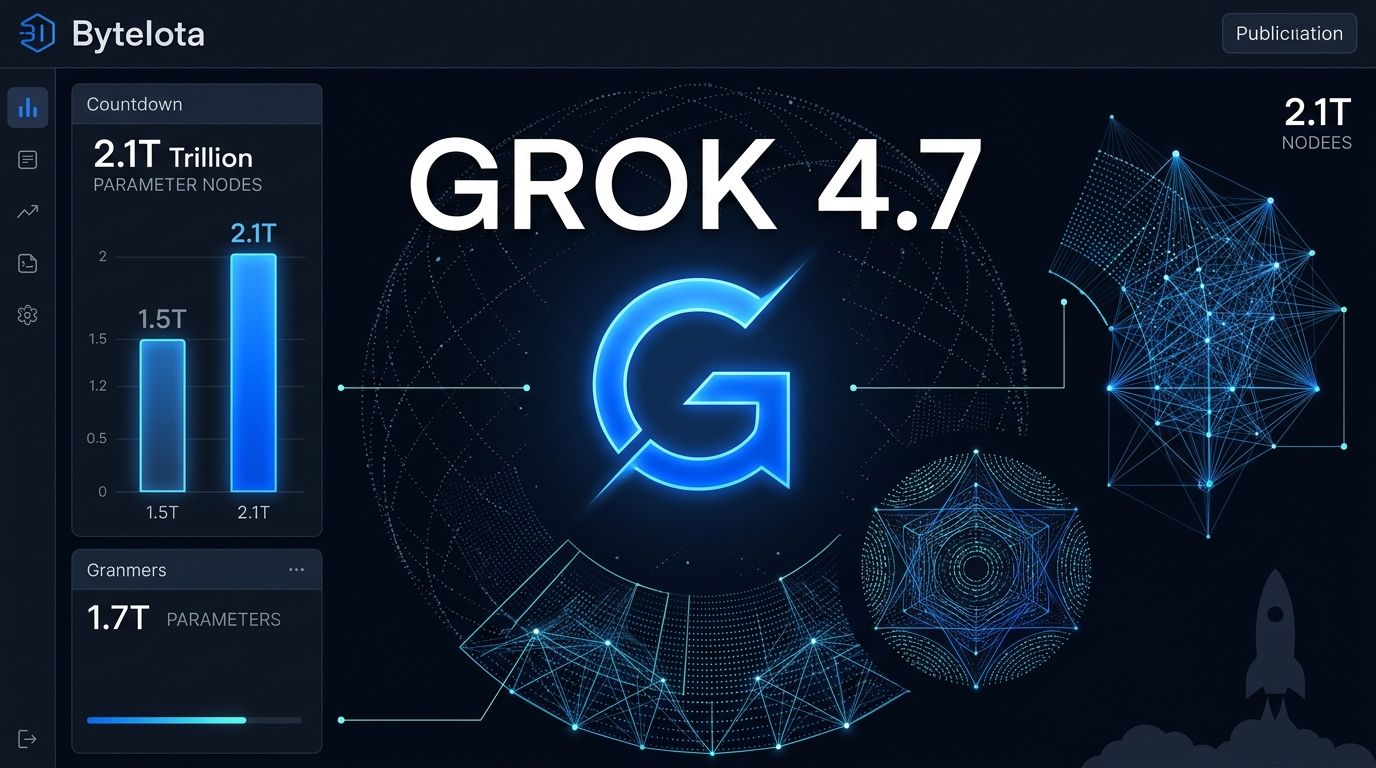
What Musk has stated, and what xAI has not contradicted: a 2.1 trillion parameter count — a 40% increase over Grok 4.6's 1.5 trillion — supplemental training data drawn from SpaceX engineering records, and a performance claim that 4.7 'outperforms 4.6 in all aspects, except slightly slower.' His previous release estimates slipped by five to seven days on average. Treat September 12 as the target, not the guarantee.
The SpaceX Data: What It Actually Buys You
The SpaceX training angle gets overplayed in the AI press, so let's be direct about what it does and does not mean for your workloads. SpaceX has 24 years of aerospace engineering data across Falcon, Dragon, Starship, and Starlink programs: design files, flight test results, failure analyses, simulation outputs, and structured technical documentation generated from iterating hardware until it works. No other AI lab has access to this class of data at scale.
Where this training advantage likely shows up: physics and engineering reasoning, mathematical optimization, systems reliability analysis, and technical documentation for complex engineering systems. Where it almost certainly makes no difference: standard web application development, business logic, marketing copy, and customer service chatbots. If your use case is in the second list, wait for benchmarks on your actual tasks before drawing any conclusions. '40% more parameters' is a hardware claim, not a promise about React component quality.
Know Your Grok 4.6 Numbers Before 4.7 Arrives
The most useful thing you can do before September 12 is establish a clean baseline on the model you are already running. Current Grok 4.6 specs: model ID grok-4.6 , 500,000-token context window, $2.00 input / $6.00 output per million tokens (under 200K tokens), $4.00 / $12.00 for long-context requests. Benchmark scores: 61 on the Intelligence Index, 65.9 on DeepSWE, 57.5 on APEX-Agents. Available on the xAI API, OpenRouter, Cursor, Vercel, Cloudflare, Amazon Bedrock, Google Vertex AI, and Microsoft Foundry.
Run your eval suite on 4.6 today and record the results — quality scores, token counts, latency, and cost per task. When 4.7 drops, you will have something concrete to compare against instead of relying on xAI's marketing benchmarks.
Five Actions to Take Before September 12
Audit your codebase for model ID strings. Search for grok-4.6 , grok-4.5 , and any other xAI model identifiers. Know exactly which services will need updating and which are abstracted behind a routing layer. Run your eval suite on Grok 4.6 now. Record quality scores, token counts, latency, and cost per task. This is your migration baseline — without it you cannot objectively measure whether 4.7 is worth switching to. Check your latency budget. A 40% parameter increase at equivalent hardware density typically means 10-30% slower inference. Flag any real-time or streaming endpoints that could be affected before the model lands. Watch docs.x.ai, not X. When grok-4.7 appears in the official model list with pricing and a context window specification, the model is ready for production evaluation. Not before. Do not migrate production on Day 1. xAI's historical deprecation pattern is non-breaking: retired model slugs auto-redirect rather than hard-fail. Let the community run 4.7 for a few days, collect real-world reports, then make the call.
Multi-Cloud Rollout Timeline
Based on xAI's previous model launch patterns, expect Grok 4.7 to roll out as follows: xAI API and OpenRouter on Day 1 within hours of the official announcement; Cursor, Vercel, and Cloudflare within one to three days; Amazon Bedrock, Google Vertex AI, and Microsoft Foundry one to two weeks post-launch. If your production stack depends on a specific cloud provider integration, factor that timeline into your migration planning.
The Bottom Line
Grok 4.7 is coming, and the 2.1 trillion parameter count with SpaceX training data is a genuinely interesting development. xAI has shown real model quality progress across successive releases. But the documentation gap is real: a Musk post is not an API model card. The correct response right now is preparation, not action. Run your baselines, audit your dependencies, and wait for the official specs before deciding whether — and when — to migrate. The model will still be there on Day 5.
Share
A note on cookies
Newshunt uses essential cookies to keep you signed in and to remember your language and country, so the site works the way you expect. With your permission, we'd also like to use analytics cookies to understand how people use Newshunt and improve it over time.
Accepting only affects analytics. To learn more, view our Privacy Policy or Terms & Conditions.
(0)Comments