


Plain of Jars, an ancient stone landscape above Phonsavan
Category: Tourism
Share
Archive
Like
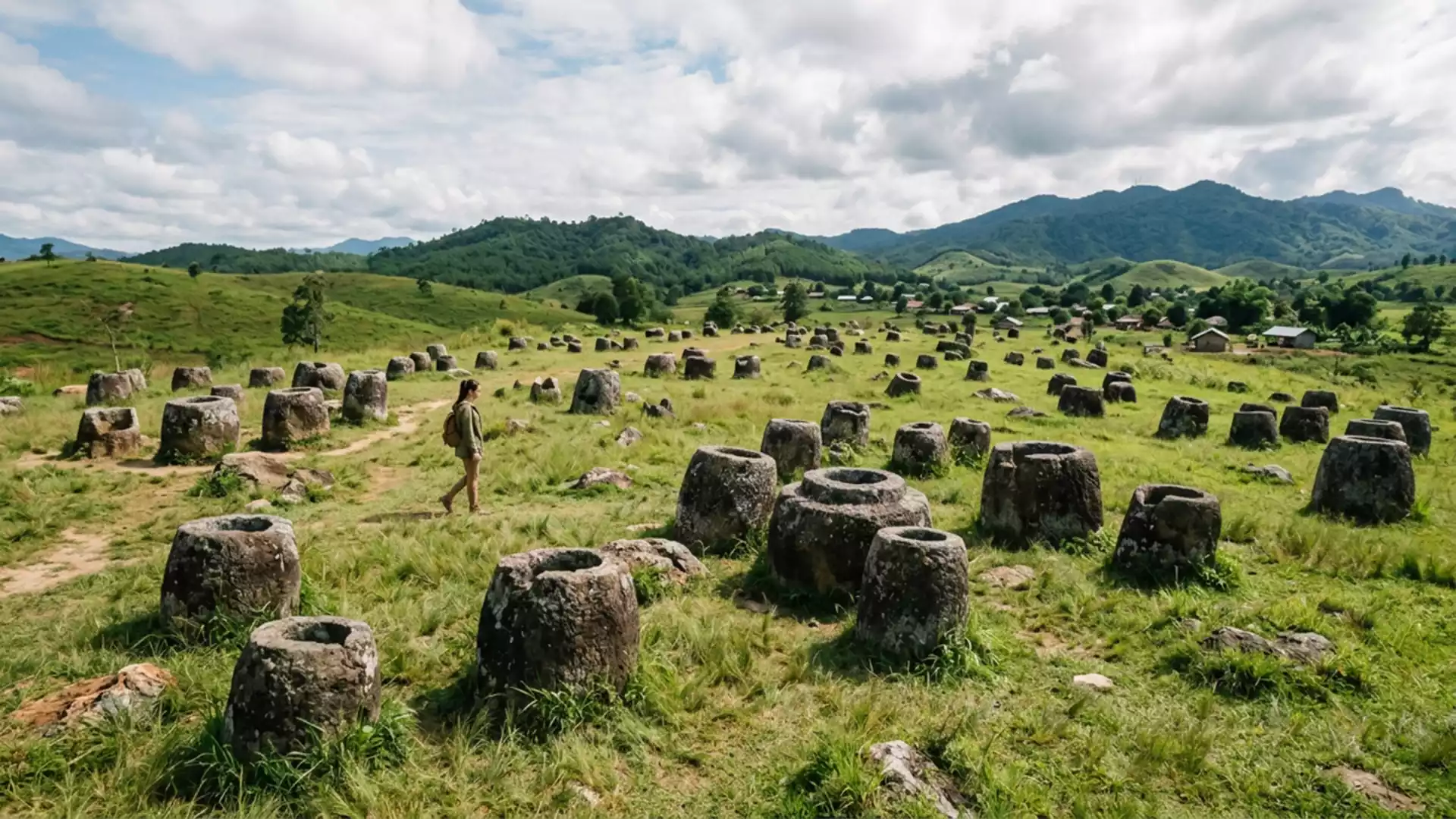
Plain of Jars near Phonsavan in Laos spreads hundreds of carved stone jars across a high plateau, turning an Iron Age funerary landscape into a striking walk.
Plain of Jars in northern Laos is an Iron Age megalithic landscape where hundreds of carved stone jars sit across grassy hills above Phonsavan, turning a remote plateau into an open-air archaeological field.
An Iron Age jar field on the Xiangkhoang Plateau
The Plain of Jars occupies the dissected inner region of the Xiangkhoang Plateau in north-central Laos, a highland area drained by tributaries of the Mekong.Xiangkhoang Plateau in Laos Around Phonsavan, upland valleys and lower foothills form the central plain where the jars stand on low ridges and gently sloping ground.upland valleys and foothills
Archaeological work dates this jar landscape to the Iron Age between about 500 BCE and 500 CE, with funerary practices continuing across several centuries.Iron Age dating between 500 BCE and 500 CE The jars were discovered by French explorers in the nineteenth century and have since become a key prehistoric site in Southeast Asia, linking this remote plateau to wider regional history.prehistoric site in Southeast Asia
Stone jars, materials and archaeological features
The jars themselves are massive stone vessels carved from sandstone, granite and other sedimentary rock, ranging roughly between 1 m and 3 m (3 ft to 10 ft) in height and weighing several tonnes.sandstone and granite jars Many stand alone, while others form clusters of dozens set across open fields, scrub-covered slopes or among scattered trees.clusters ranging from one to several hundred
Across the wider property, more than 2,100 tubular stone jars have been recorded, together with stone discs, grave markers, secondary burials and quarry traces that anchor the funerary interpretation.more than 2,100 stone jars Megalithic Jar Sites in Xiengkhuang – Plain of Jars were inscribed on the UNESCO World Heritage List in 2019 as a serial property of 15 components, recognising both the scale of the jars and the associated archaeological features.UNESCO inscription in 2019
Plain of Jars and Phonsavan today
For travellers, Plain of Jars is approached from Phonsavan, the main town of Xieng Khouang Province in north-eastern Laos, where roads and local services connect the plateau with Vientiane and other centres.around Phonsavan in Xieng Khouang Province The town sits amid limestone and sandstone hills rising roughly 900 m to 1,100 m (3,000 ft to 3,600 ft), giving the jar fields a highland climate and broad views across open country.limestone and sandstone hills at 900–1,100 m
Dozens of jar sites are known across the province, though only a limited number are cleared and waymarked for visitors, including Jar Sites 1, 2 and 3 near Phonsavan.Thong Hai Hin, Hai Hin Phu Salato and Hai Hin Laat Khai These accessible fields allow close views of the jars, associated discs and occasional excavations, while the wider landscape continues to support small-scale agriculture by Khmu and Hmong communities.subsistence agriculture by Khmu and Hmong
Visiting Plain of Jars: what travellers from Western Europe should know
Plain of Jars lies near Phonsavan in Xieng Khouang Province in north-eastern Laos, reached by road links from major Lao towns and by flights serving Phonsavan airport.
Jar fields stand on uneven ground with low rises, rock underfoot and grass; paths at the main sites include stretches on soil and stone with short slopes.
The official language is Lao and the currency is the Lao kip.
Entry requirements depend on your nationality; UK travellers can check the FCDO travel advice at gov.uk/foreign-travel-advice, Irish travellers the Department of Foreign Affairs at ireland.ie.
Searching for Plain of Jars on social platforms
These links open searches for Plain of Jars on each platform.
Frequently asked questions about Plain of Jars
Where is Plain of Jars located?
Plain of Jars is on the Xiangkhoang Plateau in north-central Laos, around Phonsavan in Xieng Khouang Province.
What can visitors expect on a visit?
Visitors walk among large carved stone jars set on grassy hills and ridges, following marked paths through a highland agricultural landscape.
What makes Plain of Jars distinctive?
The concentration of hundreds of Iron Age megalithic jars, combined with associated funerary features and highland setting, makes the landscape distinctive in Southeast Asia.
A note on cookies
Newshunt uses essential cookies to keep you signed in and to remember your language and country, so the site works the way you expect. With your permission, we'd also like to use analytics cookies to understand how people use Newshunt and improve it over time.
Accepting only affects analytics. To learn more, view our Privacy Policy or Terms & Conditions.
(0)Comments