


The Specter of Loss in America Today Makes Death More Symbolic
Category: Politics
Share
Archive
Like
Death has been on my mind lately.
Dolly and Gloria. The blue jay we tried to save but couldn't. My father.
Maybe it's my age, maybe it's the times we're living through, but every death bears down on us with symbolism and meaning. Partly, I believe, it's because we are witnessing a steady and potentially fatal erosion of the country we have known and taken for granted for many decades, if not for the entirety of our lives. This tragic era brings other tragedy and loss in stark relief.
When Leonard Cohen died on Nov. 7 2016, a day before the presidential election, I remember saying to my husband, 'at least he won't have to live through a Trump presidency.' Though think of the ballad he may have written.
Dolly was 80, Gloria was 92 – both must have been aware we are in the thick of an existential American crisis. Was that on their mind as their lives wound down? When we take stock of our days on this orb, how important is the undoing of a country you love and have fought for through music and words and activism? Does it make leaving harder? Does it weigh on your heart?
If you are of a certain age – and I mean 60 or older – you can tell yourself America is experiencing an aberration in our democracy, a blip, a dark quirk, and the pendulum will swing back to something familiar and reaffirming. But will it? In our lifetime?
I've heard people I know say, 'I just hope I can outlive this blighted moment.' We wonder when will this be over – like a fraught nightmare we want to wake from. We ask ourselves if the well is deep enough to find the patience to see this through – or whether this is it.
Each time Donald strips away freedoms, destroys a piece of the culture, diminishes the rule of law, undermines environmental safety, instigates hatred, it adds a looming sense that the loss will be too great to recover and that our way of life will be impossible to recapture. We feel increasingly off kilter, the despair becomes more difficult to rein in. Some say it will take a decade to put the country back together again – but that's an estimate based on a political sea change and anyone's best guess.
Under Donald's influence, the board of the Kennedy Center for the Performing Arts felled 40 weeping willows planted along two sides of the center to symbolize the nation's mourning after the death of President John F. Kennedy in 1963.
It would take 10 to 15 years for a willow tree to grow to a mature height of 30 to 50 feet.
In a short span of time, maybe around a decade, we've been fundamentally reprogrammed to view ourselves as being on one side or the other of a civil war created by titans who understood that through division and unease, they would take the spoils. They've used White Supremacy, Christian fundamentalism and fear of wokeism, to kill off civility, community, and a shared respect for the U.S. Constitution.
We are in the throes of death even if we plod about in our daily lives with as much normalcy we can muster. Sure, many use coping mechanisms that protect them from the daily barrage of Donald changing the names of gulfs, lakes and oceans, or using American treasure to fight a senseless war in Iran. But the casualties pile up to the point that nothing normal seems normal.
Over the summer, I attended festivals and outdoor concerts – large gatherings of people of all stripes. While there, those with microphones offered up asides and comments conceding to the abnormal times we are living in. An emcee at the Hudson Valley Hot Air Balloon festival over Labor Day weekend waved the proverbial American flag while saying something like, 'and don't let anyone tell you we're not great.'
The battle to hold onto our wild and precious American life is palpable, if you're paying attention. It's not a coincidence that mature people with creases on their faces and notches on the belts line streets in every town and city with protest signs every weekend. This is a generation that understands its privilege and knows what's at stake. They have the long view: in looking back, they know what's been hard won and in looking forward they wonder how hard the fight will be to win back what's been lost.
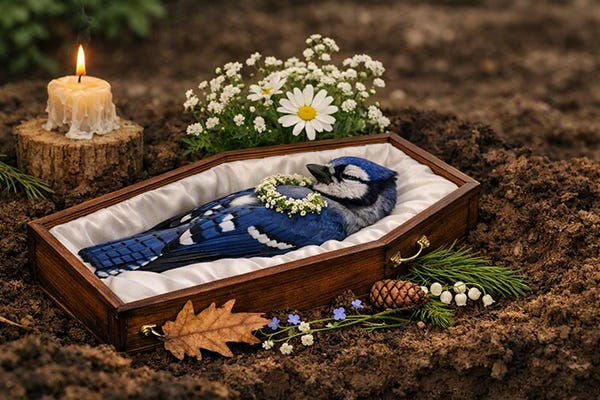
The other day my husband noticed a blue jay sitting on a low-lying branch on a privet hedge. He'd noticed that the bird had been clinging to the branch for hours, and when he got near, it didn't take off. He asked me what I thought. The bird seemed to have labored breathing, its eyes were closed and it sat very still. It made a couple of attempts to flutter its wings but failed to lift off. With one futile attempt, he ended up upside down. We assumed a plummet to the ground would kill him, so we put a wooded box underneath him and scooped him up. We tried to locate a rehabilitator but in the 10 or 15 minutes while we were making calls, the bird flapped one more time and died. My husband and I were in tears because we wanted nothing more to save this spectacular creature. It wasn't obvious what ended his life – there were no visible wounds. It could have been internal bleeding from striking a window.
My husband found a small box. We laid him in and buried him on our land.
The blue jays regularly gather around our feeders – wowing us with their 'blue' plumage (an illusion) and necklace collars. They squeal the loudest and sometimes bully the sparrows, nut hatches, even the cardinals. Slightly smaller than crows, they appear to be resilient, noisy, and territorial.
Many cherish blue jays as joyful signs of divine presence or nature's beauty. There's a saying: 'When people feel that God sends a blue jay, they usually view it as a spiritual sign of comfort, guidance, protection, or a message from a loved one who has passed away.'
Perhaps the death of this feathered avian somehow spoke to the sadness of the moment. Or maybe it was telling us to protect the nest, to squawk louder, to be the guidance others need.
Subscribe now
Share
A note on cookies
Newshunt uses essential cookies to keep you signed in and to remember your language and country, so the site works the way you expect. With your permission, we'd also like to use analytics cookies to understand how people use Newshunt and improve it over time.
Accepting only affects analytics. To learn more, view our Privacy Policy or Terms & Conditions.
(0)Comments