


The Digital Divide Has Moved
Category: SciTech
Share
Archive
Like
There is some unexpectedly good news about education in England today.
The latest PISA results put the UK among the top ten education systems in the world for mathematics, reading and science. England performed particularly strongly. In reading, its 15-year-olds were ahead of Australia, the United States, Finland and France.
Look more closely, though, and something else is going on.
England has not suddenly got dramatically better. Its reading performance is essentially where it was in 2022. What has changed is the performance elsewhere.
Much of the world has gone backwards.
Across OECD countries, reading scores have fallen substantially since 2018. The OECD estimates that the average 15-year-old in 2025 is performing at a level that would previously have been expected of a 14-year-old. The decline began before Covid, which makes the familiar explanation of pandemic disruption increasingly difficult to sustain.
The OECD points towards something else as part of the explanation: digital distraction.
That should concern us, because I think we are still having the wrong conversation about children, technology and inequality.
For more than twenty years, one of our dominant ways of thinking about digital inequality has been the 'digital divide'. Some children have plentiful access to computers, broadband and digital resources; others do not. Access becomes an educational good, and unequal access becomes the problem.
There are still children for whom this is true, and they matter enormously. But they are no longer the whole story.
For millions of children, the problem may now be almost the reverse.
They have too much access.
I published a paper last week inGlobalisation, Societies and EducationcalledInequality of becoming: childhood, futurity, and the governance of time in algorithmic societies.
In it, I argue that we need to think differently about inequality in an algorithmic society. We need to ask what technology does to the conditions under which children grow up, rather than concentrating only on who possesses it.
A smartphone is extraordinarily cheap entertainment. One device provides television, games, music, social interaction, video, shopping and an effectively endless stream of short-form content.
For families under pressure, this matters.
A screen can occupy a child while a parent works. It can provide respite while somebody cooks, cleans or cares for another family member. For a parent living with disability, exhaustion, several jobs, inadequate childcare or simply too few hours in the day, cheap digital entertainment can be enormously useful.
That is often perfectly understandable parenting under difficult material circumstances.
But it also means that access is no longer an adequate measure of digital advantage.
A child whose parents can provide books, clubs, sport, music lessons, travel, gardens, bedrooms, conversation, adult attention and carefully controlled access to technology may actually havelessaccess to the digital world.
That may increasingly be an advantage.
The scarce resource becomes the ability to disconnect.
The latest PISA findings are difficult to ignore.
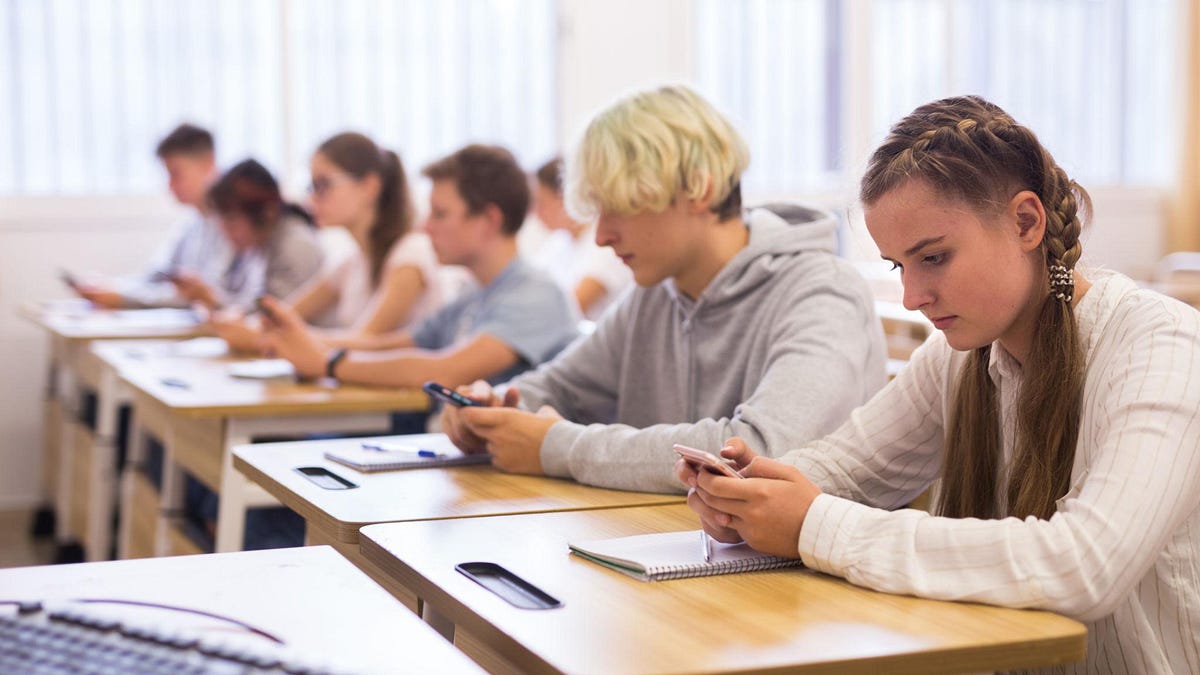
The OECD reports that students who use digital devices for leisure at school for longer periods tend to perform worse. Across OECD countries, 28% of students say their peers are distracted by digital devices during most or every science lesson.
There is a socioeconomic dimension too. Digital distraction is reported more frequently in disadvantaged schools than advantaged ones.
The OECD is rightly careful about causation. There are many things happening at once: declining reading for pleasure, absenteeism, Covid, changing family life and wider changes in education systems.
But Andreas Schleicher, the OECD's director for education and skills, asks a remarkably simple question: are devices deliberately designed to capture and hold our attention actually compatible with sustained academic attention?
We should probably have asked that much earlier.
Because attention is what interests me here.
Reading a difficult book requires staying with something that does not continuously reward you. Mathematics involves frustration. Writing means sitting with a sentence that does not work. Learning involves boredom, repetition, memory, uncertainty and time.
So does growing up.
The problem with the contemporary screen is not simply that children are looking at it. Some of the most sophisticated companies in the world employ extraordinary computational power to make sure they keep looking.
That changes the inequality question.
We are still using a map drawn for an earlier technological world.
In 2000, asking whether a child had access to a computer made considerable sense.
During Covid, asking whether a child had a laptop and reliable internet access was essential because schooling itself had moved online.
But it is now 2026.
The smartphone is ubiquitous across much of everyday life. Increasingly, the important question is not whether children can enter the digital environment.
It is whether they can leave it.
Who gets uninterrupted time? Who gets boredom? Who gets sustained conversation, or the chance to read for an hour without a notification arriving? And who has adults around them with enough time, money and energy to put boundaries around technology?
These are questions of inequality too.
InInequality of Becoming, I argue that inequality should be understood partly through the different conditions societies provide for children to become. Children do not simply possess unequal resources. They inhabit unequal temporal environments.
PISA may now be showing us some of the educational consequences.
There is another part of these results that caught my attention for a more personal reason.
I work at the University of Nottingham Ningbo China, in Zhejiang province.
PISA groups Zhejiang with Beijing, Shanghai and Jiangsu. Together, B-S-J-Z and Singapore are the highest-performing education systems in the 2025 assessment.
The digital figures are fascinating.
Only 5% of students in B-S-J-Z report that their peers are frequently distracted by digital devices during science lessons, compared with an OECD average of 28%. Eighty-three per cent attend schools where mobile phones are prohibited on school premises.
I don't think this tells us that China has discovered a simple solution that Britain should copy. Education systems cannot be lifted out of their cultural and institutional settings and transplanted elsewhere.
But the comparison deserves attention.
The UK is now among the relatively small group of systems performing strongly across reading, mathematics and science. So is the Chinese region containing Zhejiang.
For those of us working within the Nottingham–Ningbo relationship, there is something rather encouraging in that. The two ends of the same university sit within educational environments that have, to differing degrees, resisted a much wider international decline.
There is surely a conversation worth having there.
None of this means we should stop worrying about children who genuinely lack digital access.
But the world has changed, and our language for talking about digital inequality has not quite kept up with it.
A disadvantaged child might lack a laptop suitable for writing an essay while having almost unlimited access to TikTok, YouTube, gaming and algorithmically curated entertainment through a smartphone.
Calling both conditions 'digital access' does not tell us very much.
Perhaps the digital divide has moved.
The privileged child of the coming decade may not be the child with the most technology.
It may be the child who is sometimes able to escape it.
Read the PISA study here:
https://www.tes.com/magazine/news/general/pisa-2025-scores-revealed-england-uk-ranking
https://www.theguardian.com/education/2026/sep/08/england-teenagers-outperform-peers-in-most-countries-in-maths-reading-and-science
Read my work onInequality of Becominghere:https://www.tandfonline.com/doi/full/10.1080/14767724.2026.2728095#abstract
Or here:
A note on cookies
Newshunt uses essential cookies to keep you signed in and to remember your language and country, so the site works the way you expect. With your permission, we'd also like to use analytics cookies to understand how people use Newshunt and improve it over time.
Accepting only affects analytics. To learn more, view our Privacy Policy or Terms & Conditions.
(0)Comments