


The rediscovered route
Category: Entertainment
Share
Archive
Like
It is neither a race nor a nautical rally: the Atlantic Challenge International is a test of spirit, memory and courage. Every 2 years, for almost 4 decades, young crews from all over the world confront each other in a series of seafaring exercises aboard Bantry yolas, faithful replicas of 18th-Century French military lances. They row, sail, rescue a man overboard, perform precision manoeuvres: all without electronic instruments, with mixed crews and strict regulations.
But the beating heart of the Challenge is the encounter: living for a week in an international village, getting to know each other amidst different languages, shared rules and headwinds. 'The main point is to spread the knowledge of the sea and to foster acquaintance among these crews,' explains Luca Tagliafico, President of Atlantic Challenge Genova. 'It is a lot of fun, because you row and sail together, but also stop at strategic places, linked to local places and histories.'
Underlying the Atlantic Challenge is a historical event: in December 1796 revolutionary France attempted to land in Ireland to support an anti-English uprising. A storm scattered and sank the fleet (48 ships, thousands of men): only 1 service boat managed to land in Bantry Bay. Captured by the British, it became a war trophy and was passed down from generation to generation until, two centuries later, it arrived at the National Maritime Museum in Dublin, where it is now kept as the French Navy's oldest wooden vessel.
From that model, in 1984, the first replicas built for the centenary of the Statue of Liberty were born: French and Americans challenged each other in oar strokes in front of Manhattan, creating the Atlantic Challenge. Today, more than 80 Bantry yolas are active around the world, in the hands of groups, associations, schools and enthusiasts. Races are held in rotation between Europe and the Americas: New York, Bantry, Douarnenez, Roskilde, Rockland, Fishguard. And in 2006, Genoa too.
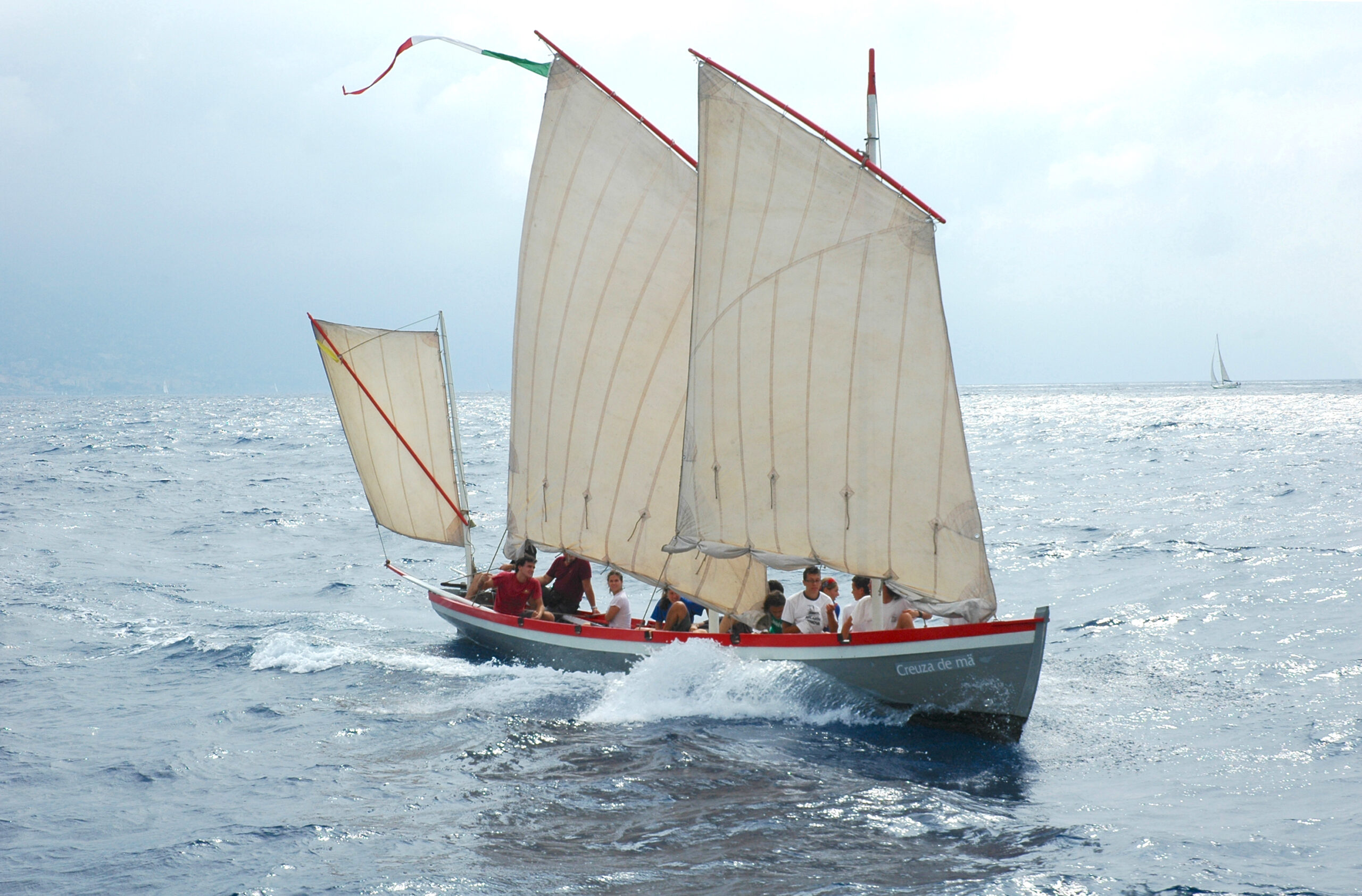
The Ligurian adventure began in 2002, when a small group of enthusiasts built the first Italian yole: the Atlantic Challenge Genova association was born. The boat, christened 'Creuza de mä' in homage to Fabrizio De André, was launched in 2003 after months of work in the Genoa Fishermen's Union shipyards.
'American shipwrights came, we hosted them, and together with the local fishermen we built this marvel,'' Tagliafico recalls. He continues: 'We presented it at the International Contest of Fishguard, the first time Italy participated'.
In the years that followed, the association represented Italy in various editions and, in 2006, Genoa was also the official host of the Contest. Then, however, like many associations, the activity waned, also due to the pandemic. 'There were only a few of us left, the historical crew members had passed 40, and without young people you can't go far. But the boat was always there, ready to set sail,' says Tagliafico.
'Creuza de mä' is much more than a replica: it is a living object that requires respect, skill and patience. 11.64 m long, just over 2 m wide and with a sail area of around 40 sq.m, the boat weighs 1 t and moves with 10 oars and 3 removable masts.
'Upwind it doesn't exist,' smiles Tagliafico, 'but we have done as much as 12 knots when sailing upwind, and when rowing we can reach 6 knots. Everything is done with strength, skill and coordination'.
The set-up involves 13 people on board: 10 rowers (5 on the starboard and 5 on the port side), 2 sailors for manoeuvres and a helmsman. Masts are hoisted and lowered as required, every detail is faithful to the Napoleonic navy. It is no coincidence that the entire boat is checked and certified before each contest.
The Bantry yola is therefore not simply a historical replica, but the heart of an traditional sailing training experience in which physical effort, seamanship, coordination and knowledge of historical techniques come together.
After the forced hiatus caused by the pandemic, the Atlantic Challenge Genova association found itself with a boat ready and sailing, but no crew.
The turning point came with the involvement of the ITTL 'Nautico e Aeronautico San Giorgio e C. Colombo' of Genoa and Camogli, which embraced the initiative and turned it into an educational project for students. 'We were contacted by them to create an ongoing collaboration,' says Professor Torre, lecturer and project contact person for the institute. 'The idea was to relaunch the activity, to make this reality known to the students and, perhaps, bring them closer to the association'.
The response has been enthusiastic: 'We already have over 40 interested students, most of them in the 2-year course, and we are organising sea trips to test them,' adds Torre. 'The goal is to build a stable crew between now and November that can train, grow and participate in competitions'.
The project with the 'San Giorgio e C. Colombo' represents for the institute a rare opportunity to combine technical learning, motor activity and team spirit. It is no coincidence that the Physical Science teachers Prof. Laura Ghia and Prof. Stefano Ulivi were also involved.
'It is a fascinating boat: 10 oars, 3 masts, demanding manoeuvres. You need coordination, strength, attention. And above all, you need to listen to yourself,' explains Torre.
The boat is currently moored in the Yacht Club Italiano area, at Porticciolo Duca degli Abruzzi, in the heart of Genoa harbour. 'We are in the start-up phase,' Torre continues, 'but we are already thinking of a three-year course, where the youngsters can become an active part of the crew. For some, it could also open up future professional or sporting prospects. For everyone it remains a profound training experience'.
This educational dimension is one of the defining elements of youth sailing education, creating a direct connection between nautical school training, practical experience and the cultural heritage of traditional seamanship.
The Atlantic Challenge is much more than a competition. It is an international educational programme, promoting friendship between peoples, seafaring skills, respect for tradition. The rules are strict: the crew must be mixed in gender and at least 6 of the crew on the gig for each event shall be between 15 and 21 years of age (inclusive) at the time of the event.
Each yole follows precise construction rules, with no technological aids. Only sail and oars are used, and every test – from navigation to mooring, from charting to jackstay transmission – is carefully evaluated.
'There is a regatta of elegance,' says Tagliafico, 'you dock a mothership, take on board a guest in period dress, the 'captain's daughter', and have to perform a perfect manoeuvre. You don't reward speed but grace, precision and coordination. It is a gesture of style: this is the Atlantic Challenge'.
In this context, maritime heritage education becomes an essential part of the experience. Young sailors are not simply learning how to row or sail: they are discovering the history, techniques, values and traditions that have shaped generations of seafarers.
After Belfast 2024, the next stage of the Atlantic Challenge will be in Denmark 2026. The goal of the Genoese group – boat, association, school – is to arrive ready. 'The refitting of the boat has just been completed, now the crew is needed' says Tagliafico. 'And thanks to the 'San Giorgio e C. Colombo' we are training a new generation of sailors.'
The collaboration does not stop at sea trials. 'We are imagining a broader educational offer' confirms Torre. 'A permanent laboratory, periodic outings, interdisciplinary activities. After all, the Atlantic Challenge combines everything: history, science, civic education, sport and, above all, passion'.
One day, perhaps, among those youngsters there will be a future captain, a teacher, a shipbuilder. Or perhaps just an adult who, for a few years, has learned to keep the rhythm of the oar, to read the wind, to understand each other.
A note on cookies
Newshunt uses essential cookies to keep you signed in and to remember your language and country, so the site works the way you expect. With your permission, we'd also like to use analytics cookies to understand how people use Newshunt and improve it over time.
Accepting only affects analytics. To learn more, view our Privacy Policy or Terms & Conditions.
(0)Comments