


Immigration arrests
Category: Politics
Share
Archive
Like
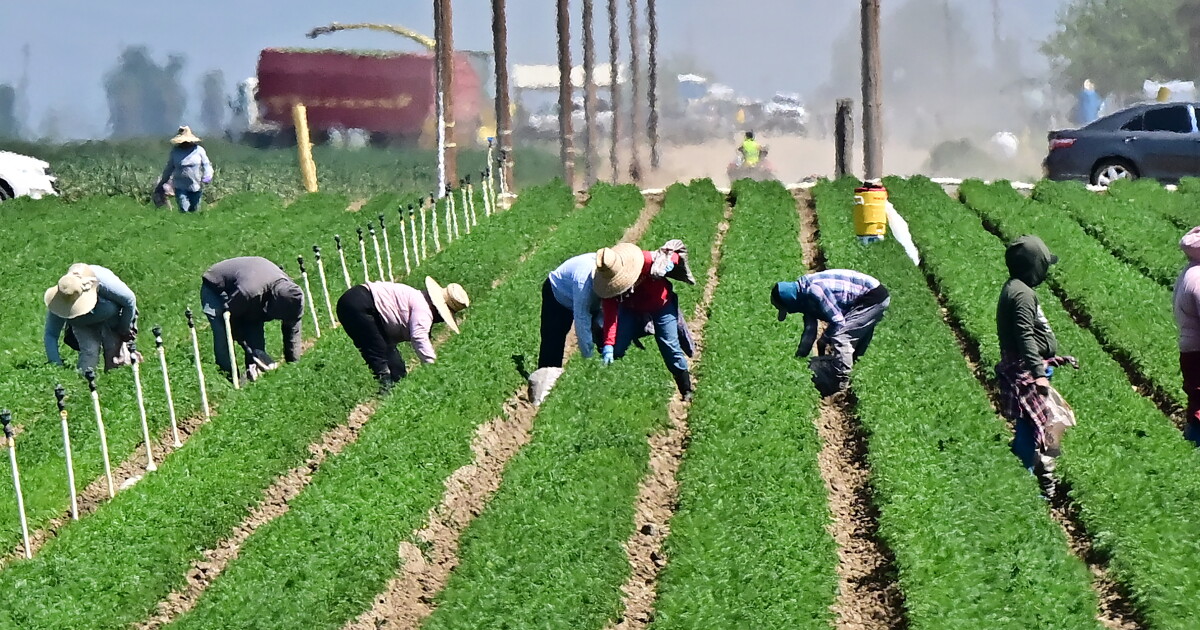
Farmworkers in California's Central Valley in April 2025, the month an order from a federal judge put new restrictions on immigration officials arresting people without warrants. While that order is now on hold, a similar case is under consideration in L.A.
Where things stand: We visited farmworkers in Bakersfield to get understand how the now-on-hold injunction changed day-to-day life in an agricultural region dependent on immigrant labor and what they could mean if a similar order is issued in the L.A. area.
About the timing: That decision, expected any day, echoes a fight already playing out in the Central Valley, where farmworkers had won a court order that shielded them for more than a year. On Aug. 24, a 9th U.S. Circuit Court of Appeals panel put that Central Valley injunction on hold.
Full Story
A federal judge in Los Angeles is weighing whether to place new restrictions on immigration agents arresting people without warrants — a decision that could shape enforcement across Southern California. That decision, expected any day, echoes a fight already playing out in the Central Valley, where farmworkers had won a court order that shielded them for more than a year.
On Aug. 24, a 9th U.S. Circuit Court of Appeals panel put that Central Valley injunction on hold.
That order had blocked Border Patrol from the race-based stops and warrantless arrests that swept through Bakersfield in January 2025, when agents fanned out through farm towns as part of "Operation Return to Sender."
For Rosa, a 37-year-old farmworker from Oaxaca, Mexico, news of the raids arrived by text message. She was working a grape field near Bakersfield on Jan. 8, 2025, when word spread that immigration agents were sweeping the town. Her son was at school. She remembers wanting to go to her son and fear freezing her and other parents in place.
"We just wanted to reunite with them and know they were OK," Rosa said in Spanish.
She said her son called her asking if she was OK and he warned her: "... things are happening. The school has started telling the kids that [immigration agents are] everywhere, and I want you to take care of yourself.'"
Editor's note
Rosa, as well as other sources identified with one name in this story, agreed to speak with LAist using pseudonyms or first names only due to fears of drawing attention from immigration officials.
What happened in Bakersfield matters in Los Angeles now because the same tactics — and some of the same lawyers — are at the center of the case pending before U.S. District Judge Maame Ewusi-Mensah Frimpong. United Farm Workers and the American Civil Liberties Union, who won the Central Valley injunction, are also representing plaintiffs in the L.A. case.
What happened in Bakersfield
'Operation Return to Sender' took place before the new Trump administration even began, and it set the tone for immigration enforcement actions to come. Around 60 Border Patrol agents moved into the Central Valley in a show of force. After the three-day operation, Department of Homeland Security officials issued a statement claiming to have arrested 78 people.
Of those arrested, all but one person had no criminal history, according to court documents filed in the case .
In a Facebook post, Border Patrol called the operation an 'overwhelming success.' Federal officials made statements signaling the agency intended to return to Bakersfield and deploy the same tactics throughout California.
Lawyers representing several people caught up in the raids and the United Farm Workers called the operation disruptive and unlawful.
In a lawsuit in February 2025, they asked the courts to put a stop to tactics used during 'Operation Return to Sender' saying 'agents indiscriminately arrested people…, including people with pending immigration applications, no criminal history, established residences in the community, steady employment, family in the United States, or other community ties mitigating any purported flight risk.'
They argued those tactics violated the Constitution, immigration law and the Department of Homeland Security's stated policies.
The raids shook the Central Valley 'to its core,' the plaintiffs argued. 'Agricultural fields were deserted and school attendance dipped, as farmworkers and their families feared being profiled by Border Patrol Agents.'
In April 2025, District Court Judge Jennifer Thurston, who serves the Eastern District of California, made two key findings: that the plaintiffs were likely to win their case, and that the practices described in the lawsuit threatened irreparable harm to people living in the district. To stop that immediate harm, she issued a preliminary injunction barring Border Patrol from using those tactics there until the lawsuit could be resolved.
That order stood until the ruling late last month when, more than a year and four months after it was put in place, a panel of judges on the 9th Circuit Court of Appeals put the injunction on hold. The federal government did not defend Border Patrol's conduct in the Eastern District, but instead argued the plaintiffs' allegations did not describe an imminent threat of harm, so they lacked standing to call for an injunction. The 9th Circuit said the lower court must now address the issue of standing.
The 9th Circuit's decision strips the Eastern District of the injunction's protections, but Mayra Joachin, an attorney with the ACLU of Southern California, said it does not give the government free rein.
'The order itself does not give Border Patrol any license to violate the Constitution or federal law,' Joachin said. 'The government does nonetheless still need to comply with the law when conducting stops and arrests.'
The order also recognizes the lower court can issue new forms of relief in response to new allegations of harm, Joachin said. 'We will be monitoring to see what happens, and we will be prepared to return to court in the event that we see any unlawful stops or arrests.'
LAist asked DHS officials about the stay and how that might change their enforcement actions in Bakersfield. We also asked whether they'd challenge a similar injunction in the L.A. region.
The emailed response did not directly address those questions but said:
'ICE has authority for lawful arrests where authorized under 8 USC 1357. Law enforcement officers use 'reasonable suspicion' to investigate immigration status and probable cause to make arrests consistent with the statute and the Fourth Amendment to the U.S. Constitution. The Supreme Court has already vindicated us on these practices.'
How to reach us
If you have a tip, you can reach Jared Bennett on Signal. His username is Jbennett.18. You can follow this link to reach him there or type his username in the search bar after starting a new chat.
For instructions on getting started with Signal, see the app's support page.
And if you're comfortable just reaching out by email you can find us at jbennett@laist.com or jbarajas@laist.com.
What this means for other litigation
Similar lawsuits to the one being fought out in Bakersfield have been filed in districts across the country, including one in the Central District of California which covers Los Angeles and parts of Southern California. U.S. District Judge Maame Ewusi-Mensah Frimpong in Los Angeles is now considering issuing a preliminary injunction setting limits on immigration officers' practice of arresting someone without a warrant.
The case before Frimpong was brought in July 2025 by five people and three organizations: the Los Angeles Worker Center Network, United Farm Workers, and the Coalition for Humane Immigrant Rights. The plaintiffs quickly secured a temporary restraining order that same month that barred immigration agents from stopping people without reasonable suspicion that they were violating immigration law and from relying on their race, spoken language or occupation as a basis for the stops. The U.S. Supreme Court voted to stay that order in September 2025.
Joachin said the decision by the Supreme Court has, in part, led the court to speed up the discovery process, so the plaintiffs have been able to take depositions from federal immigration officials.
'Through those depositions, as well as other evidence that we've uncovered through the government, it has confirmed what we understood to be the nature of these operations,' Joachin said. 'Which is that they are indeed unlawful, lacking any information about the person that they're stopping before they proceed to the stop, and also unlawful with regards to conducting arrests without warrants and any assessments of escape risk.'
Joachin and other attorneys on the case said they are hopeful Frimpong will issue an injunction regarding those warrantless arrests soon.
Fear spreads through the Central Valley
At the height of the raids in Bakersfield, Erika Navarrete, vice president of the United Farm Workers, said she heard stories of people across the Central Valley sleeping in fruit orchards to avoid contact with immigration authorities.
'People would speak in hushed tones — 'Don't be scared, come out, they're gone, they're gone,'' Navarrete told LAist in Spanish. 'But many people didn't want to come out; they waited because they didn't trust the situation — they just didn't trust it.'
'People would speak in hushed tones — 'Don't be scared, come out, they're gone, they're gone.'
— Erika Navarrete, vice president of the United Farm Workers, speaking in Spanish
The lawsuit, which is ongoing, alleges Border Patrol agents subjected plaintiffs and people to three unlawful acts:
Stops based on race and occupation, rather than grounded in evidence of legal status, which violates the Fourth Amendment protecting people from unreasonable search and seizure.
Warrantless arrests conducted without an individualized determination that the person violated immigration law and was likely to escape before a warrant could be obtained, as required by immigration law .
. Coercing people to accept voluntary deportations without fully understanding their right to an immigration court hearing, which violates the Fifth Amendment protections of due process.
Those same tactics are described in the lawsuit against ICE and DHS in the Central District. UFW is also one of the plaintiff organizations in that lawsuit.
Navarrete said that fear lingered for months after the January raids, slowing work in the fields and disrupting daily life throughout the region.
'Our people didn't want to leave their homes; they didn't want to go to the store. I mean, they weren't living their daily lives,' she added.
Erika Navarrete, vice president of the UFW, has been helping farmworkers and their families deal with the raids' aftermath.
Julia Barajas
/
LAist )
Navarrete said she still gets goosebumps when she thinks about how the raids impacted children in the area.
'If they saw any white van or white car . . . or vehicles that didn't have California license plates or whatever, they'd immediately ask, 'Mom, is that la migra?' Is la migra going to take us away?'"
Other kids would tell Navarrete they had a backpack ready so they could go with their parents if they were deported.
Preliminary injunction provides some relief
In issuing the now-on-hold injunction in April 2025, Judge Thurston wrote: 'The evidence before the court is that Border Patrol agents under DHS authority engaged in conduct that violated well established constitutional rights.'
Despite public statements indicating they planned to come back to Bakersfield, Border Patrol never returned with the same kind of large-scale operation.
In July 2025, when Border Patrol agents staged a raid at a Home Depot in Sacramento, the government was required under the court order to provide documentation to the plaintiffs.
'Having carefully examined the entire record, including the recorded footage of the Sacramento action, the court finds that Defendants have again detained people without reasonable suspicion for doing so,' Thurston wrote in her order enforcing the preliminary injunction .
Federal agents submitted 11 forms, known as I-213s, documenting the circumstances of the arrests in Sacramento. Thurston determined that those forms 'rely on unsupported assumptions, hunches and generalizations.'
During the proceedings, federal agents admitted to retroactively modifying at least two of the forms 'to reflect descriptions of the circumstances that are flatly incorrect,' Thurston wrote in the order, which required immigration officials to improve the way they document arrests.
The 'clear lesson,' according to Joachin, 'is that injunctions work.'
'While one would expect federal agents to comply with the law, we know that they're not,' Joachin said. 'When we see immigration agents asked to comply with the law, the number of stops and arrests significantly plummet.'
The injunction, while it was in place, didn't completely ease the fears of community members. Immigration officials have continued to arrest people in the months since. But in small, important ways, it did provide a return to some kind of normalcy for the people in Bakersfield.
Leticia, who's been a farmworker for over two decades, takes a break with her daughter at a park in Bakersfield.
Jared Bennett
/
LAist )
Leticia, a 40-year-old mother of four, said she stayed home from work from January until May.
Leticia has since returned to work harvesting carrots, a physically grueling job that requires her to be on her knees most of the day. She said that while parties were canceled last year, she now planned to celebrate a baptism with friends the weekend after speaking with LAist.
Where things stand in Los Angeles
In July 2025, attorneys representing five individuals and three organizations filed a lawsuit against the federal government in the Central District, which includes Los Angeles and other parts of Southern California, alleging a similar pattern to the raids seen in Bakersfield.
'The tactics challenged here — including widespread racial profiling, suspicion-less stops, and warrantless arrests without determination of flight risk — bear the unmistakable hallmarks of 'Operation Return to Sender,'' the complaint states.
Lawyers representing plaintiffs in both cases say the issues in the case carry national implications.
While the case continues to move through the Eastern District, the court recently ordered the federal government to turn over documents showing national DHS policies that plaintiffs argue informed the raids in Bakersfield and, by extension, Los Angeles.
'We haven't seen what they've produced yet in response to that order,' said Bree Bernwanger, a lawyer with the ACLU who is representing plaintiffs in both cases. 'We expect to see and be able to put into the record evidence of what we all know these agencies have been doing nationwide since the early raids in Bakersfield.'
In August, attorneys held a press conference ahead of a hearing for Vasquez Perdomo v. Mullin, the lawsuit filed in the Central District of California.
Jared Bennett
/
LAist )
Similar to the situation in Bakersfield, high-profile confrontations with large groups of immigration agents have died down in Los Angeles, but Joachin, who is also representing the UFW in the Central District case, said officials are still arresting people using tactics that violate the law.
'There continue to be roving patrol operations,' Joachin said. 'The only difference is that now they're stopping a fewer number of individuals, and they are still stopping individuals based on perceived characteristics of whom they presume to be undocumented.'
A masked man in plain clothes pointed a rifle at Rev. Tanya Lopez, the senior pastor at Downey Memorial Christian Church, when she witnessed an arrest in her parish's parking lot last June .
Lopez said the threat of indiscriminate enforcement has spread fear throughout Los Angeles.
'It's been so heavy,' Lopez said. 'Whether or not you're undocumented, these raids, these stops have been without a doubt conducted to racially profile people.'
Frimpong issued one preliminary injunction in the case in July 2025 barring immigration agents from stopping people without reasonable suspicion that they were violating immigration law, but the U.S. Supreme Court paused that order in September .
Frimpong is now considering issuing another injunction, this one aimed at curtailing warrantless arrests.
(Third from the right) Rev. Tanya Lopez participated in a rally outside a federal courthouse in downtown Los Angeles.
Julia Barajas
/
LAist )
Lopez said she is now, like many other people in Southern California, eagerly waiting on the judge's decision. Earlier this summer, she attended a hearing in federal court, clad in a clerical collar and stole.
'While it doesn't undo the harm and all of the trauma that's already been inflicted, [the lawsuit] represents one step towards accountability and the long road towards justice,' she said.
'I think we're learning that it's up to us as people, right? We, the people, have to essentially hold agencies — our government, even law enforcement — accountable,' Lopez said. 'It has impacts for all of us.'
A note on cookies
Newshunt uses essential cookies to keep you signed in and to remember your language and country, so the site works the way you expect. With your permission, we'd also like to use analytics cookies to understand how people use Newshunt and improve it over time.
Accepting only affects analytics. To learn more, view our Privacy Policy or Terms & Conditions.
(0)Comments