


Pixxel Raises India's Record $100M Space Round to Fund Orbital AI Data Centers
Category: SciTech
Share
Archive
Like
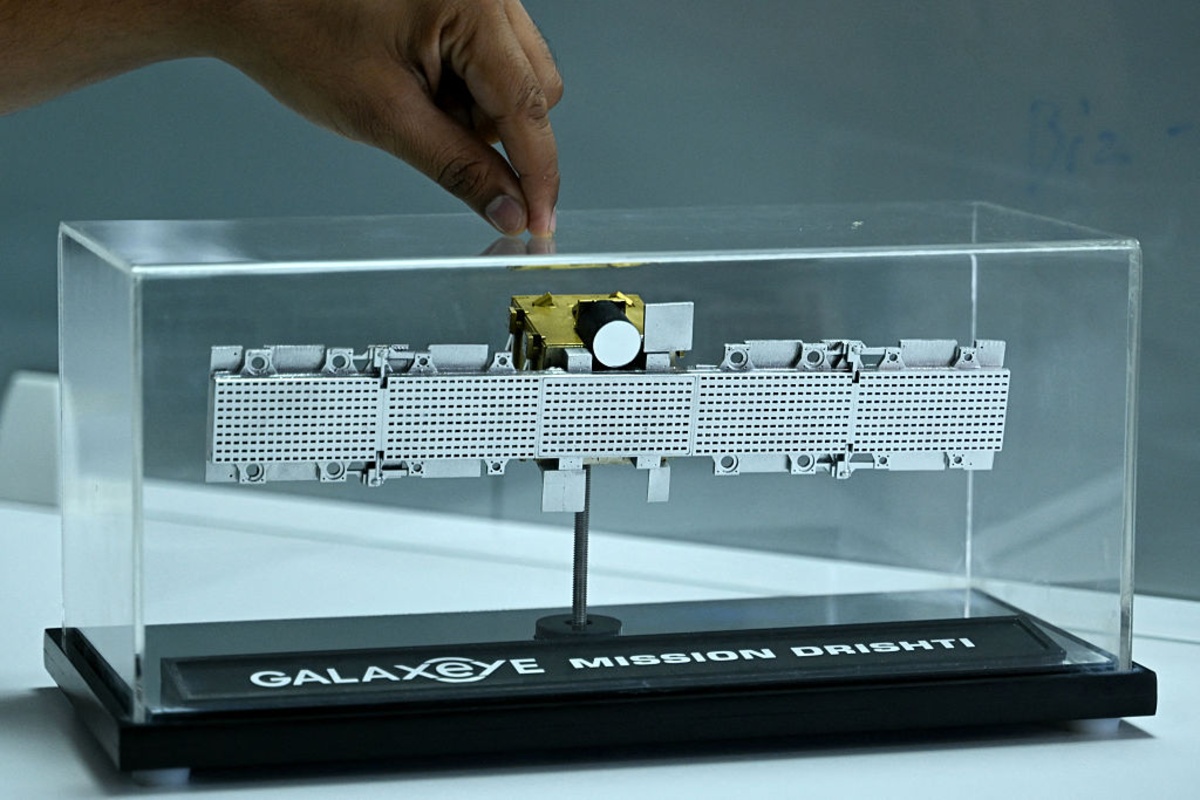
Idrees MOHAMMED/AFP via Getty Images
Pixxel, the Bengaluru-based company that already operates the world's only commercial hyperspectral satellite constellation,
How Pixxel Turns Starlight Into Chemical Fingerprints
Most satellites are essentially cameras with a bias toward the colors humans can see: red, green, and blue. Pixxel's six Firefly satellites, all launched by 2025 aboard SpaceX rideshare missions, do something fundamentally different. Each one carries a push-broom hyperspectral sensor that passes incoming light through a diffraction grating, splitting it into 135 or more narrow, contiguous
The practical applications are significant. Crop disease shows up in infrared reflectance before it is visible to the human eye; methane leaks alter the short-wave infrared signature of an oil field; mineral deposits change the spectral response of rock formations in ways that multispectral satellites — which sample only a handful of spaced wavelengths, not a continuous range — cannot resolve. The Firefly constellation delivers this data at
Customers include the US National Reconnaissance Office (NRO), the Indian Air Force, and NASA under its $476 million
Why Hyperspectral Data Has a Bottleneck — and What Pathfinder Tries to Fix
There is an inconvenient engineering reality that Pixxel's marketing language tends to skip past. A single
In orbit, heat can only be dissipated through radiation — there is no air to carry it away by convection — and downloading raw hyperspectral cubes requires wide-bandwidth ground station infrastructure that costs money and introduces latency. The logical solution is to process the data in orbit, sending only compressed results rather than raw imagery. That is exactly what Pixxel's most ambitious project intends to demonstrate.
In May 2026, Pixxel announced a strategic partnership with Indian AI startup Sarvam to develop and launch Pathfinder, a roughly 200-kilogram satellite the two companies are calling India's first orbital data center. The
The engineering challenge is real. Commercial GPUs were not designed for the radiation environment of low Earth orbit. High-energy cosmic rays cause "bit flips" — random changes in stored data — and gradually degrade semiconductor components, as detailed reporting on
They are not the first to make this bet. In November 2025, a startup called Starcloud launched a satellite carrying an Nvidia H100 GPU into orbit and successfully trained an AI model on it — the first demonstration that data-center-class computing can function in space. The satellite solved the thermal management problem — GPUs generate 700 watts of waste heat that in vacuum can only escape through radiation — using passive radiative cooling panels with no moving parts. Starcloud's second satellite, Starcloud-2, is scheduled to launch in October 2026 carrying Blackwell architecture and AWS server hardware.
The field is crowding fast. At GTC 2026,
What distinguishes Pathfinder from these Western entrants is the sovereignty argument. Sarvam's Indian-language language models and inference stack would run entirely on Indian-operated hardware in Indian-operated orbit, with no data routed through foreign cloud infrastructure. Ahmed has framed this as "sovereign AI in space" — a positioning that resonates specifically with the Indian government contracts Pixxel is building its revenue on.
Aurora: Making the Planet Queryable
Beyond the satellite hardware, Pixxel is investing Series C capital in Aurora, its no-code Earth observation analytics platform. The
The Aurora platform currently offers
India's First Privately-Led National Space Program
In January 2026, Pixxel formalized a landmark partnership with India's national space regulator IN-SPACe to lead a consortium building India's first privately-operated national Earth observation constellation. The
The consortium includes Dhruva Space (handling the overall systems architecture), PierSight (synthetic aperture radar, or SAR, imaging), SatSure Analytics India (multispectral imaging), and Pixxel (hyperspectral and ultra-high-resolution sub-meter imaging). Rather than the Indian government designing, building, and operating satellites through ISRO, private companies will design, finance, and operate a national capability — a model that India's IN-SPACe framework, established in 2020, was designed to enable, as documented in the
Honeybee and Gigapixxel: Next-Generation Hardware
The Series C will also fund Honeybee, Pixxel's next-generation satellite constellation. While Pixxel has not published detailed Honeybee specifications, the company has indicated the satellites will offer significantly higher resolution than Firefly and will add sensor modalities beyond hyperspectral imaging. The first Honeybee launch is expected in 2027.
On the manufacturing side, Pixxel is scaling its Gigapixxel facility in Bengaluru toward a capacity of 100 satellite units, shifting from the artisanal production cadence typical of the space industry toward industrial-scale manufacturing. Gigapixxel is designed to produce not only Pixxel's own satellites but also custom spacecraft for third-party customers — a revenue diversification that reduces the company's dependence on its own imaging constellation.
Who Invested and What the Round Signals
Temasek — Singapore's sovereign wealth fund, which manages assets of more than $300 billion — anchored the round with a $50 million commitment, its first disclosed investment in an Indian hyperspectral imaging company. Seraphim Space Investment Trust, which already held Pixxel in its portfolio from the Series A, invested $25 million (approximately £18.6 million) from its recently raised C-share fund. Seraphim's ordinary shares rallied 7% on the announcement.
New investors 360 ONE Asset — a prominent Indian asset manager — and South Korean private equity firm IMM Investment joined the round, broadening Pixxel's institutional base across Asian capital markets. Returning investors Radical Ventures and growX Ventures also participated.
The round takes Pixxel's total disclosed funding to $195 million and represents the largest single fundraise in India's private space-technology history — more than double the prior record. The
Read more:
Why the Numbers Are Hard to Sustain
Pixxel's growth trajectory impresses on the top line, but the company reported negative EBITDA as recently as 2023, and profitability remains an open question. The company faces established competitors with deeper pockets: Planet Labs in optical imaging, ICEYE and Capella Space in synthetic aperture radar, and Satellogic and Orbital Sidekick in hyperspectral imaging specifically. All four serve some of the same government and enterprise customers Pixxel is pursuing.
Pixxel also depends entirely on third-party launch providers — primarily SpaceX — for getting its satellites into orbit, creating scheduling risk beyond its control. The India-US dual-listed structure (Bengaluru operations, Los Angeles business development) adds regulatory and compliance complexity as the company's defense contracts deepen on both ends.
The orbital computing bet amplifies both the opportunity and the risk. If commercial Blackwell-class GPUs prove durable in the LEO radiation environment, Pathfinder validates an entirely new category of space infrastructure. If they do not, Pixxel will have spent a satellite mission — and some portion of that $100M — finding out.
What Hyperspectral Imaging Still Cannot Do
Hyperspectral data's richness comes with real constraints that the satellite imaging market does not always foreground. The 40-kilometer (24.9-mile) swath width and 24-hour revisit frequency are meaningful for continuous monitoring of large agricultural regions or known pollution sites, but tasking a hyperspectral satellite to cover a specific small area on short notice is harder than with conventional optical satellites, which are more maneuverable and can revisit targeted sites within hours. Hyperspectral sensors are also more sensitive to atmospheric conditions — water vapor and aerosols affect spectral signatures — requiring more intensive atmospheric correction processing than conventional RGB imagery. And the sheer data volume (hundreds of spectral bands per pixel) requires more sophisticated analysis pipelines than most customers currently operate, which is part of the problem Aurora is trying to solve.
The competitive battleground, then, is not purely technical capability. It is whether Pixxel can build a vertically integrated stack — satellites, processing, software, and eventually orbital compute — fast enough to establish lock-in before the field matures and the incumbents respond.
Exchange rate as of September 7, 2026; conversions are approximate.
Frequently Asked Questions
What makes hyperspectral imaging different from standard satellite photography?
Standard satellites and even most commercial imaging constellations capture light in three to ten wavelength bands — roughly corresponding to what a human eye or a conventional camera sees. Hyperspectral imaging captures 135 or more narrow, contiguous bands across a continuous range of the electromagnetic spectrum, extending well beyond visible light into the near-infrared and short-wave infrared. Because every material reflects light differently at each wavelength, this continuous measurement produces a spectral "fingerprint" for every pixel in the image — enabling computers to identify crop diseases, mineral deposits, methane leaks, or water contamination that would be invisible to a conventional satellite sensor.
What exactly is the Pathfinder satellite trying to prove?
Pathfinder, a partnership between Pixxel and Indian AI startup Sarvam, is a 200-kilogram satellite scheduled for launch as early as Q4 2026 that will carry data-center-class GPUs — reportedly Nvidia Blackwell or H200-class chips — rather than the radiation-hardened but far less powerful processors typical of spacecraft. The goal is to demonstrate that commercial-grade AI chips can function reliably in the radiation environment of low Earth orbit, enabling AI training and inference to run entirely in space. If it works, the satellite would compress raw hyperspectral data into actionable intelligence before downlinking the results — eliminating the data-volume bottleneck that currently limits how fast hyperspectral imagery can be delivered and processed. It would also establish that Indian AI workloads can operate in Indian-controlled orbit without routing through foreign cloud infrastructure.
Who are Pixxel's main customers, and does the Indian Air Force's involvement raise concerns about how the data is used?
Pixxel serves a mix of government and commercial customers across agriculture, mining, energy, environmental monitoring, and defense. Disclosed government customers include the US National Reconnaissance Office, the Indian Air Force, and NASA. Commercial clients have included mining companies and agricultural organizations. Hyperspectral imaging is particularly useful for defense because it can detect camouflaged objects — any material has a unique spectral signature across some of the scanned wavelengths, making concealment harder than with conventional cameras. Pixxel discloses its government defense contracts openly, though it has not published the specific terms or use cases of those agreements.
What is the IN-SPACe national constellation, and why does it matter that a private company is leading it?
India's IN-SPACe national Earth observation constellation is a public-private partnership in which Pixxel leads a consortium — including Dhruva Space, PierSight, and SatSure Analytics India — to design, build, own, and operate India's first privately-led national satellite system. The project is valued at ₹1,200+ crore (approximately $126 million USD at current rates) and the first satellites are targeted for launch in early 2027. The significance is structural: rather than ISRO designing and operating government satellites, private companies will finance and operate critical national infrastructure and sell its data commercially. This mirrors models developed by companies like Planet Labs and Maxar in the United States, applied for the first time to India's sovereign space assets.
A note on cookies
Newshunt uses essential cookies to keep you signed in and to remember your language and country, so the site works the way you expect. With your permission, we'd also like to use analytics cookies to understand how people use Newshunt and improve it over time.
Accepting only affects analytics. To learn more, view our Privacy Policy or Terms & Conditions.
(0)Comments