


Battery rickshaws to get QR codes, designated routes: Minister Salahuddin
Category: SciTech
Share
Archive
Like
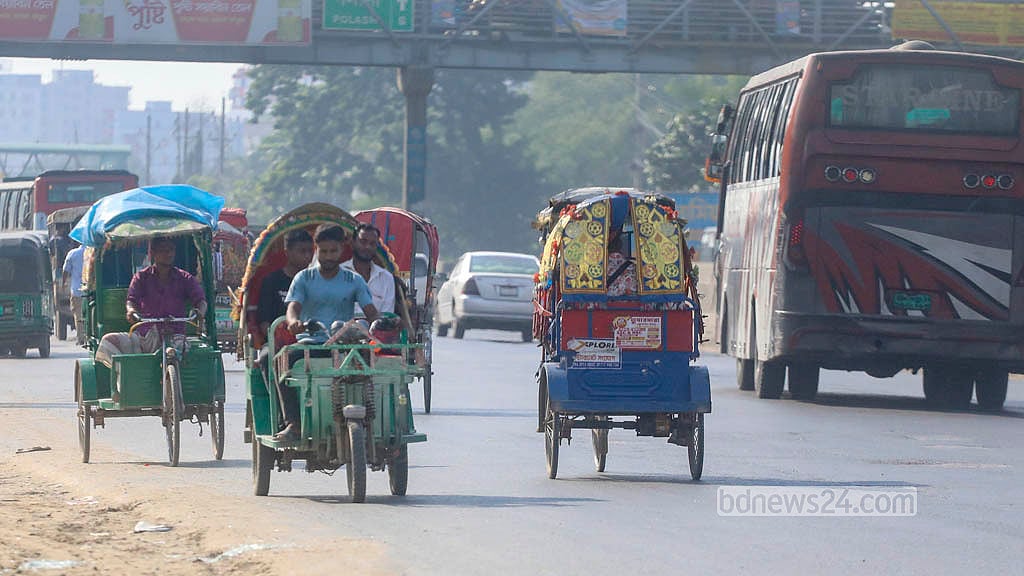
Home Minister Salahuddin Ahmed has said authorised battery-powered autorickshaws will be identified through number plates and QR codes once new regulations governing their operation take effect.
On Monday, he said in parliament the government also plans to register and train drivers before bringing them under a licensing system, while determining which roads the vehicles can use.
The minister spoke in response to a notice from reserved women's seat MP Rehana Akter Ranu.
Ranu drew his attention to the uncontrolled movement of battery-powered autorickshaws in the capital.
She said AI-based traffic cameras installed in different parts of Dhaka had reduced violations such as running red lights, changing lanes and speeding.
However, she said, the lack of number plates on autorickshaws meant they could not be automatically fined even when identified by AI cameras.
She called for number plates, driver training and licences, and a clear regulatory framework.
In a supplementary question, Ranu said: 'I did not say that the operation of uncontrolled battery-powered autorickshaws should be banned. I spoke about regulating their movement.'
In reply, the home minister said battery-powered autorickshaws, easy bikes and similar electric three-wheelers had become an important part of urban and rural transport over the past decade.
Their low fares and convenience for short-distance travel have also created jobs for drivers, owners, garage workers, battery and spare-parts traders, charging-service providers and small entrepreneurs, he said.
But their rapid and largely unregulated expansion has created new challenges for electricity management, road safety, traffic congestion, the environment and public health.
He said unauthorised battery-powered autorickshaws had been banned from major roads in Dhaka, with the DMP traffic division conducting regular drives to enforce the ban.
Vehicles violating the rules are being seized and dumped, with legal action taken.
Joint drives are also being conducted by the DMP, DESCO and DPDC against rickshaw garages using illegal electricity connections, he said.
On registration, Salahuddin said he had spoken to the state minister for local government and learned that regulations and rules had been formulated to control autorickshaws, subject to certain conditions.
Besides keeping them off major roads, designated routes will be set for the vehicles, while ensuring livelihoods are not adversely affected, he said.
He also highlighted environmental pollution caused by uncontrolled recycling of lead-acid batteries. Future rules will require safer, environment-friendly batteries, alongside plans for digital tracking.
A system will also ensure that one registration number cannot be used to operate multiple autorickshaws, he said.
On illegal charging, the minister said some electricity department and city corporation personnel were involved in operating charging stations through illegal connections taken from power poles.
AI Traffic Cameras Set for Major Expansion
Fifty AI-based cameras are now operating at 17 traffic signals in Dhaka to modernise traffic management and vehicle control, Salahuddin said. He claimed they were producing positive results in regulating autorickshaws and other vehicles.
Another 200 AI cameras are being installed under the Ramna and Tejgaon traffic divisions. More will gradually be deployed at other key roads and intersections across Dhaka, he said.
A note on cookies
Newshunt uses essential cookies to keep you signed in and to remember your language and country, so the site works the way you expect. With your permission, we'd also like to use analytics cookies to understand how people use Newshunt and improve it over time.
Accepting only affects analytics. To learn more, view our Privacy Policy or Terms & Conditions.
(0)Comments