


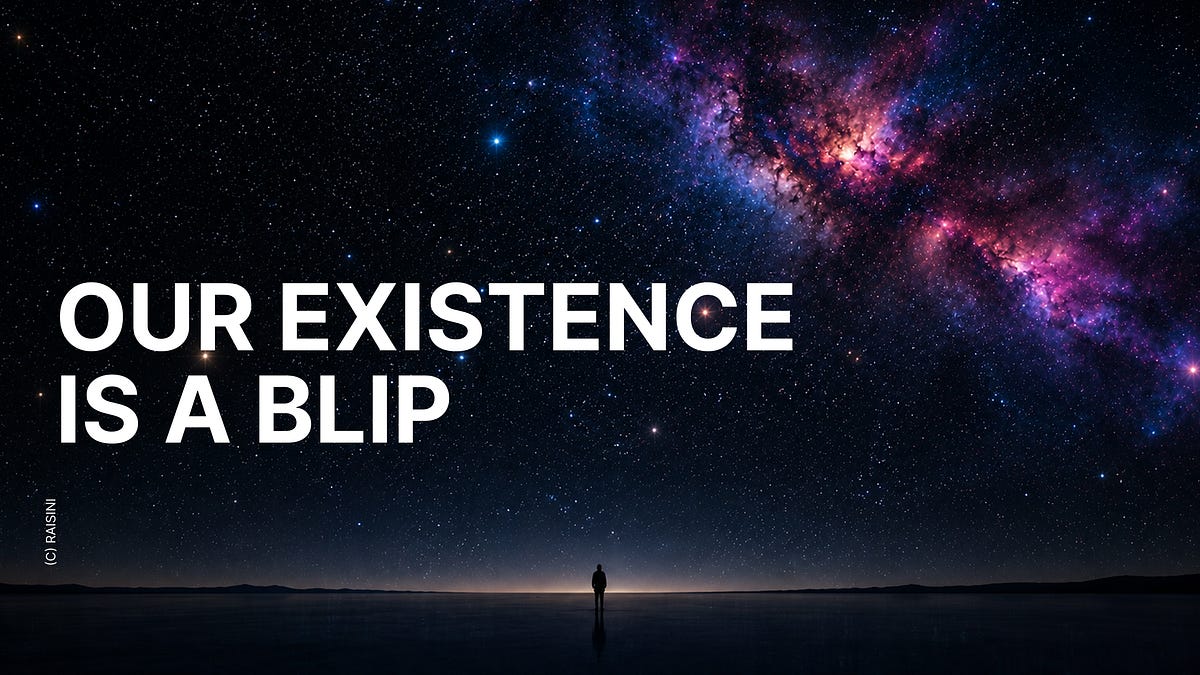
Our Existence Is a Blip
Category: Entertainment
Share
Archive
Like
Subscribe now
Welcome to this week's issue of RAISINI.
Every week, I write about understanding how reality actually works - from human nature and decision-making to power, wealth, entrepreneurship, investing, health, and the invisible systems that shape our lives. This isn't theory. It's what I've lived. Let's keep going.
If you want access to private chats, live events, workshops, and more, consider becoming a paid orfounding member.
Your life is an extraordinarily brief interruption in a timeline that existed long before you and will continue long after you're gone.
When you realize this, you will live your life in a very different way.
I grew up with the same broad understanding of life that most people inherit. You go to school, get an education, find a job, build a career, start a family and eventually retire. That was what adulthood was supposed to look like. It was not presented as one possible arrangement among many. It was simply the arrangement.
I never followed it particularly well. I started solo traveling when I was fourteen, pursued things that interested me, and spent much of my adult life moving towards places and experiences I had not yet had. I did not have a philosophical explanation for it at the time. I simply knew that I did not want to spend my life doing something because everybody else considered it normal.
It took me much longer to understand what that instinct was really about. I had begun to realise that a human life can become almost entirely occupied by the maintenance of a system: earning enough, paying enough, meeting expectations, postponing what matters, and convincing yourself that the things you actually want can wait until some more suitable point in the future.
There is nothing inherently wrong with education, work, family or stability. The problem begins when the sequence becomes automatic, when the life you are building is inherited rather than chosen, and when fear disguises itself as responsibility. You can spend decades doing everything you were told was sensible and still arrive at the end wondering whether you ever actually lived according to your own terms.
A few years ago, as I began to think more seriously about age, time and what remained of my life, that realisation became difficult to ignore. I started looking at my existence differently. Not as an unlimited period in which everything could eventually be done, but as a brief opportunity to find out what I could do with the time I had.
That changed the question. It was no longer simply whether I could afford to take a risk, disappoint someone, leave something unfinished or try something I might fail at. It became whether I could afford to keep postponing the things I genuinely wanted to experience, create and become.
Because the consequences we spend so much of our lives fearing are usually temporary. The time we spend avoiding them is not.
There was no dramatic event attached to it. No diagnosis, no accident, no funeral that forced the thought on me. It happened on an ordinary evening, doing something completely unremarkable, and the thought arrived with no warning at all:if I died tomorrow, everything I had spent decades building simply stops belonging to anyone.Not just my body. The relationships I had shaped, the way people thought of me, the small private world I had spent my whole adult life constructing around myself, all of it would still exist in fragments inside other people's memories for a while, and then it wouldn't. In a hundred years, almost everyone who knows me now will be gone. Whatever remains of me will exist mostly as fragments, records, stories, or something someone happened to preserve.
That's not the same realization as knowing you'll die one day. Everyone knows that, in the distant, abstract way you know most facts you've never actually tested. What hit me that evening was sharper and much more specific. It wasn't about my death. It was about how completely disposable everything I currently treat as permanent actually is. The version of me that worries about what someone thinks, that protects a reputation, that manages how a room perceives me, all of that machinery only runs while I'm the one operating it. The moment I stop, the whole apparatus goes with me, and the world keeps going without needing any of it to have existed at all.
I want to be precise about what that realization did to me, because it would be easy to tell this story wrong. It didn't make life feel meaningless. If anything, it did the opposite. Understanding that nothing about my life was ever going to be permanent, that permanence had simply never been on the table to begin with, made the specific years I actually have feel far more consequential, not less. I hadn't lost something I once had. I had just finally noticed something that had been true the entire time. Our existence is a blip, a brief interruption in a timeline that was running long before any of us arrived and will keep running long after every one of us is gone. That fact used to sound bleak to me in the abstract. Sitting with it directly, for the first time, felt like the opposite of bleak. It felt like being handed the actual terms of existence, finally, after years of unconsciously assuming a different one.
A blip doesn't mean insignificant. A single note in a piece of music is also a blip relative to the whole composition, gone almost as soon as it arrives, and yet the composition doesn't work without it landing exactly when it does. I think most of us live as though we're the whole composition, protecting our note as if it needs to last forever to matter, when the actual arrangement was never built that way to begin with. Once I stopped assuming permanence, I started paying attention to something I had been avoiding for years: how much of my life I had already spent behaving as if I had unlimited time to eventually get around to living it.
What actually struck me wasn't a number. It was the shape of the thing. My life isn't a container the world sits inside. It's the reverse. I'm a short interruption inside a process that was already running for an almost incomprehensible stretch of time before I arrived, and will keep running, completely unbothered, after I'm gone. The exact scale barely matters, whether you measure it in billions of years or hundreds of thousands, once you notice the actual shape of it: everything I call my life is happening inside something vastly larger that never asked my permission to keep going, and never will.
I don't find that thought depressing anymore, though I used to. The Earth existed for billions of years before anyone alive today showed up to notice it, and it's going to keep existing for a very long time after every one of us is gone, indifferent to whether we ever did. Civilizations rose and disappeared before any of our ancestors were born. People loved, built, failed, and died in numbers too large to comprehend, most of them leaving no trace anyone alive today could ever recover, and the world absorbed all of it without missing a beat. That isn't a tragedy specific to any one of us. It's just what time does. It was always going to keep moving regardless of who was standing on it at any given moment.
Here's the part that actually matters, though, and it took me longer to arrive at than the first part. Something being brief doesn't make it worthless. A two-hour concert isn't a failed attempt at something longer. A relationship doesn't become pointless just because one person will eventually watch the other die. A single season doesn't need to last forever to be worth paying attention to while it's happening. If anything, the opposite is closer to true: the fact that something ends is usually exactly what gives it urgency in the first place. Scarcity is one of the things that makes attention urgent. When we believe something will always be available, postponement becomes easy, and easy postponement is exactly how most unlived years actually get spent. Ours does end, on a schedule none of us gets to see in advance, and that single fact is doing more work here than almost anything else.
The universe never owed any of us a single extra day. The fact that we get any at all is the part worth paying attention to, and it raises an obvious question I spent a long time avoiding even after I understood the timeline intellectually: if time is this scarce, why did so much of my own life still get spent as though it wasn't?
Most of us inherit a definition of adulthood before we are old enough to question it. We are told what a successful life looks like, which milestones matter, what responsibilities we should accept and what ambitions are considered sensible. You go to school, get an education, find a job, build a career, start a family, buy a home and eventually retire. The sequence is so familiar that it rarely presents itself as a choice. It simply appears to be what life is.
There is nothing inherently wrong with education, employment, marriage, children or stability. These can all be meaningful parts of a good life. The problem begins when the sequence becomes automatic, when fulfilling expectations takes the place of deciding what you actually want. A person can spend decades doing everything that is considered sensible and still never stop to ask whether the life they are building is the one they would have chosen for themselves.
I began moving differently from that structure quite early. I travelled young, pursued things that interested me and kept looking beyond the immediate surroundings and the familiar sequence of what people were supposed to do. At the time, I did not think of it as a philosophy. I simply found it difficult to accept that the conventional arrangement was the only legitimate way to live. There were too many places I wanted to see, too many things I wanted to understand and too many possibilities that seemed to disappear the moment I accepted that life was supposed to follow one particular order.
It took me much longer to understand what I was really resisting. I was not necessarily resisting work, responsibility or stability. I was resisting the idea that a life could be considered successful simply because it followed the accepted programme. I had begun to realise that there was a difference between choosing a life and becoming occupied with maintaining one that had already been chosen for you.
A system can give you an education, an income, a respectable identity and a series of milestones. It can tell you what to pursue and when you are supposed to pursue it. What it cannot tell you is whether the life you are spending those years building is actually yours. That remains a personal question, and it is one that can be surprisingly easy to avoid when everybody around you appears to be following the same instructions.
The difficulty is that an inherited life does not necessarily feel like a prison. It can feel like security, responsibility or common sense. You may genuinely want a family, but that is different from having one because everybody expects it. You may genuinely want a career, but that is different from remaining in one because leaving would make other people uncomfortable. You may genuinely want a home, but that is different from spending twenty years pursuing one because you have been taught that renting, travelling or changing direction means you have failed to become an adult.
From the outside, these lives may look almost identical. Internally, they can be completely different. One person has made a series of deliberate choices. Another has simply continued doing what comes next.
That is what I think is worth examining. Not whether the conventional life is wrong, but whether we have ever consciously chosen it. Not whether we should reject the system, but whether we have allowed it to become a substitute for thinking. Because the danger is not always that we make one terrible decision. Sometimes it is that we make no meaningful decision at all, and allow the years to organise themselves around expectations we never properly questioned.
Eventually, the life you inherited can become the life you are afraid to question. And by then, the fear may no longer be about what you want. It may be about what you would have to change if you finally admitted that you wanted something else.
Most people do not struggle with the intellectual fact of mortality. Ask any adult whether they know they're going to die, and you'll get an immediate, unbothered yes, the same way they'd confirm any other fact they've simply accepted and stopped thinking about. The problem was never a lack of understanding. The problem is that understanding something and organizing your actual behavior around it are two completely different achievements, and most of us only manage the first one. We know, with total intellectual clarity, that our time is limited, and then we spend that time as though the opposite were true, postponing decisions, protecting comfort, avoiding discomfort we could easily survive, on the unstated assumption that there will always be more runway later to eventually do the thing we actually wanted.
Fear is the mechanism that explains this gap, and it rarely shows up announcing itself honestly. People rarely say, out loud, 'I'm not doing this because I'm afraid.' Instead, fear borrows more respectable language. It becomes patience. It becomes timing. It becomes responsibility, or practicality, or simply not being ready yet. Someone doesn't leave a career they've outgrown because leaving would disappoint the people who expected them to stay in it. Someone doesn't start the business, or write the book, or move to the country they've wanted to live in for a decade, because a parent might not approve, or a friend might quietly think less of them if it doesn't work, or a partner might ask questions they don't yet have good answers for. None of these are irrational fears exactly. Disapproval is uncomfortable. Public failure is embarrassing. Starting over is genuinely hard. But almost every one of these consequences, if you actually sit with them honestly, is temporary. A parent's disapproval softens. A friend's judgment fades once the friend moves on to worrying about their own life again, which happens faster than anyone expects. Even a visible, public failure is survivable in a way that surprises most people the first time they actually go through one; it's uncomfortable for a period of time, and then it becomes a story you tell rather than a wound you're still carrying.
What doesn't soften, what doesn't fade, and what isn't survivable in the same way, is the decade you didn't spend doing the thing you actually wanted to do instead. That decade doesn't come back once the fear that was governing it turns out to have been overblown. This is really the whole argument in a single sentence, and it's worth saying plainly rather than dressing it up: we often sacrifice experiences we could have had to avoid consequences that would barely matter a year later. The trade is almost never a fair one, because the two sides of it aren't operating on the same timescale. The fear is temporary. The forfeited time is not.
'One day' is where this entire mechanism goes to hide, and it might be the single most effective piece of self-deception most people ever construct, precisely because it doesn't feel like avoidance from the inside. It feels like planning. 'One day I'll travel properly.' 'One day I'll actually write the thing.' 'One day, when things settle down, I'll make the change.' One day I'll learn the language." "One day I'll spend more time with my parents." "One day I'll do what I actually want." Each version sounds reasonable enough on its own that nobody, including the person saying it, stops to notice the pattern repeating across every part of their life
The phrase has the shape of a commitment while requiring none of the substance of one. It sets a future date with no actual date attached to it, which means it can never technically be broken, because it was never really a promise to begin with. Years pass this way, comfortably, without any single day ever feeling like the day the decision was made. And then, at some point nobody schedules in advance, you look up and realize that 'one day' has quietly become 'never,' not because you decided against the thing, but because you never decided anything at all.
Time doesn't send a notification when it's about to run out. Nobody receives a message that says:you have ten years remaining, so whatever you were planning to eventually get around to, now would be the time. Waiting for that kind of certainty before acting is waiting for something that was never going to arrive, and treating its absence as permission to keep waiting is exactly how 'one day' quietly finishes becoming 'never.'
None of this means every fear is irrational or that every hesitation deserves to be overridden. Some decisions genuinely warrant caution, and some delays are simply honest preparation rather than disguised avoidance. But it's worth being able to tell the difference, because only one of those two things is actually protecting you from anything. The other is just quietly spending the only resource you can't get back, in exchange for avoiding a cost that, looked at honestly, was never going to be permanent in the first place.
It helps me to think about this the way I'd think about any other trade-off, because that's really all fear is functioning as in most of these situations: a kind of insurance policy, purchased against a specific downside, at a specific price. The question worth asking honestly is what the policy is actually protecting, and what it's actually costing to maintain it. Most of the time, once you name both sides plainly, the trade looks much worse than it felt while you were inside it.
What's usually being protected is something surprisingly modest once you look at it directly: a reputation, a comfortable self-image, someone else's approval, the avoidance of an uncomfortable conversation, the preservation of a plan you'd already told people about and would now have to explain changing. These aren't nothing, and I'm not suggesting they don't matter at all. But measured against what's typically being paid to protect them, years, sometimes an entire decade, of doing something other than what you actually wanted, the exchange rate is almost never in your favor. You're trading something irreversible for something that was mostly going to resolve itself within a year regardless of what you decided.
This isn't an argument for recklessness, and I want to be direct about that distinction because it's the one that actually matters. This isn't 'quit your job tomorrow with no plan' or 'ignore every responsibility you've built because responsibilities are boring.' Some risks genuinely are foolish, and pretending otherwise doesn't make an essay like this one more honest, it makes it less useful. The distinction I actually care about is between eliminating risk and eliminating regret, because those aren't the same project, and chasing the first one often quietly guarantees the second.
The question is not whether life can be made risk-free. It cannot. No decision anyone makes removes risk from their life; it only moves the risk somewhere else, usually somewhere less visible. The real question is why we spend so much of our limited time trying to eliminate risks that are small, temporary, and survivable, while calmly accepting the one risk that's actually irreversible: never finding out what might have happened if we'd tried. That's the trade fear keeps making on our behalf, quietly, without ever presenting it as a trade at all. It just looks, from the inside, like caution. It's only from a distance that it starts to look like the worse deal it actually was.
I don't think fear is the enemy in this story, exactly. It's more like an advisor with a single, narrow mandate: keep you safe from immediate danger, whatever the cost to anything else. Fear still tends to price unfamiliar, survivable risks as though they were immediate threats. It reacts to the possibility of embarrassment, uncertainty, or loss with an intensity that belongs to a different kind of danger, and charges accordingly.
There's a version of this fear I haven't addressed yet, and it's the one that actually sits underneath most of the others, quietly organizing them. It isn't the fear of failing. Most people, if you push them honestly, can imagine surviving failure. What they can't as easily imagine, because it's harder to picture and therefore easier to avoid thinking about at all, is arriving at the actual end of their life and realizing they never tried in the first place.
Those are two completely different outcomes, and it matters that we keep them separate. A failed attempt leaves you with something: information about what didn't work, a story about what you tried, evidence that you were, at least once, willing to find out. A life spent avoiding the attempt leaves that particular question permanently unanswered, a long list of things you meant to get to eventually, unresolved, because the moment where you could have resolved them has already passed and isn't coming back for a second round. Failure hurts, and I don't want to minimize that. But it hurts for a defined, survivable period, and then it becomes something you carry as experience rather than as an open wound. Regret doesn't work the same way. Regret over something you never even tried doesn't resolve on its own timeline, because there's no event marking its end. There's no failure to eventually make peace with. There's only the ongoing, indefinite awareness of a door that used to be open and now isn't, and the quiet suspicion that you're the one who closed it.
I think about this in terms of the specific things people tend to carry, because the abstract version of this argument doesn't land the same way the specific one does. The dream someone had at twenty-five and quietly stopped mentioning by thirty-five, not because it stopped mattering to them, but because it started to feel embarrassing to still want it out loud. The trip that got postponed year after year until the person who would have taken it with you is no longer available to go. The conversation someone meant to have, telling another person plainly what they meant to them, that never happened because there was always going to be another chance to say it, until there wasn't. None of these show up as a single dramatic moment of failure. They show up much quieter than that, as an accumulation of years that simply passed while the decision to act kept getting deferred to a version of the person who felt more ready, more secure, more certain, a version who, it turns out, was never actually going to arrive.
I want to be careful here, because it would be easy to overstate this into something it isn't. Not every dream is achievable, and pretending otherwise does nobody any favors. Some opportunities really do have a window that closes, permanently, regardless of what you eventually decide. Some decisions carry real consequences that don't disappear just because you finally worked up the nerve to make them.
This isn't an argument that everyone can have everything if they just try hard enough. That would be its own kind of dishonesty, dressed up as encouragement.
The actual question isn't whether you can guarantee the outcome. It's whether you gave yourself a real, honest chance to find out what was actually possible, instead of deciding the answer in advance and calling that decision caution. That's the question that eventually reorganized how I thought about my own life, once I let myself actually sit with it instead of moving past it the way I had for years.
I've been traveling very young and adventure has been part of how I move through the world for as long as I can actually remember choosing anything for myself. At that age, none of it came attached to any larger meaning. I wasn't running from anything or chasing some early version of the argument I'm making here. It was simply how I experienced being alive, the same way some people are drawn to music or sport without needing a philosophy attached to the impulse. In my twenties, that same instinct continued, largely unexamined, carried along by an assumption I didn't even realize I was making: that time would simply keep being available, indefinitely, whenever I eventually wanted to draw on it. I didn't consciously believe I was immortal. I just behaved, in every practical sense, as though the supply of years ahead of me was large enough that spending them carelessly, or postponing things I actually wanted, carried no real cost worth calculating.
What changed in my thirties wasn't the instinct itself. It happened, somewhat fittingly, on a long flight home from somewhere I'd waited years to finally see, doing arithmetic on the back of a boarding pass that I probably should have done a decade earlier. The same instinct suddenly came with numbers attached to it, numbers I could no longer avoid.
If I live to eighty, and there's no guarantee of that, I'm sitting almost exactly at the midpoint. If I live to ninety, I've technically still got more years ahead of me than behind, which sounds like good news until you notice how much of what's behind me was spent assuming there was no rush.
The future stopped functioning as an unlimited reserve I could draw against whenever I finally felt ready, and started functioning as a finite account whose balance I could not see, but knew was counting down regardless. That shift didn't turn me into a different person. I didn't wake up one day suddenly brave, or suddenly willing to do things the version of me from ten years earlier wouldn't have done. What actually changed was smaller and, I think, more honest than that: I became less willing to negotiate against my own existence on behalf of fears that, once I looked at them directly, mostly weren't going to matter in a year's time.
This is also where the writing started, and it didn't arrive as a separate decision so much as a natural extension of the same realization. I noticed, somewhere in the middle of all this, that experiences don't just disappear once, when the moment itself ends. They disappear a second time, more completely, when the person who lived through them is gone and there's no longer anyone left carrying the memory of them at all.
A conversation, a place, a specific evening that mattered enormously to me, all of it exists only as long as I exist to hold it, unless I do something deliberate to give it a second, more durable form. Writing became that second form. Not because I believed putting an experience into a book or an essay made it permanent, it doesn't, books disappear too, eventually, in their own slower way. But it does something almost as valuable: it lets an experience survive past the single, fragile vessel it started in. It gives an idea or a moment a chance to reach someone I'll never personally meet, long after the version of me who actually lived it is no longer available to tell the story out loud. That's not immortality. I want to be precise about that, because overstating it would undercut the entire argument I'm making. It's something more modest and, I think, more honest: a way of refusing to let an experience end completely the moment I stop being the one who remembers it.
There's an obvious tension sitting inside everything I've written so far, and it's worth naming directly rather than hoping nobody notices it. I've spent most of this piece arguing that in a hundred years, almost nobody will remember any of this, that permanence was never actually on the table. And yet here I am, writing books, publishing essays, building something specifically because I want part of it to outlast me. Those two positions look, on the surface, like they contradict each other. I don't think they actually do, but the reconciliation requires separating two things that usually get treated as the same thing and really aren't.
This isn't actually a new instinct for me, even though the essay so far might make it sound like something that started with a Substack. I was writing and recording music as far back as 2003, long before I had any language for why, and if I'm honest with myself, some part of that was always about leaving something behind, a way of being remembered that had nothing to do with a job title or a bank balance. Writing essays and books now is really just a different instrument for the same underlying impulse. The medium changed. The reason underneath it didn't.
The first is fame: being remembered by name, specifically, as yourself, by people who know who you were. That kind of legacy is genuinely rare, and even when it happens, it doesn't last nearly as long as people assume. Most names that felt enormously significant a century ago mean almost nothing to anyone alive today, and the same fate is waiting, eventually, for almost every name that currently feels significant now. I'm not writing in pursuit of that, and I think chasing it specifically is usually a losing trade, since it depends entirely on variables nobody actually controls.
The second thing, and the one that actually matters to me, is transmission: not being remembered, but having something you made continue to do work in the world whether or not anyone remembers where it came from. An idea that changes how someone thinks doesn't need your name attached to it to have done its job. A piece of writing that helps someone through a difficult decision works exactly as well if the reader has completely forgotten who wrote it by the time it matters most. A lesson passed from a parent to a child gets carried forward for generations, quietly reshaped along the way, long after the original source has been forgotten entirely, and it still does real work in the lives of people who never knew where it started.
This is the version of legacy I actually care about, and it doesn't require permanence in the way fame does. It only requires that something I created outlives the specific, narrow window during which I was the one experiencing it. Writing, for me, is exactly that kind of vehicle. It takes an experience that would otherwise vanish completely the moment I do, and gives it a chance to keep existing, doing whatever small work it can do, in a form that doesn't need me to still be around to keep functioning. That's not a contradiction of everything I've said about being forgotten. It's actually the same argument, applied one level further out. I was never going to be remembered forever. But something I made might keep moving through the world a little longer than I do, and that's a different, more modest, and more achievable kind of continuing than the one most people are actually chasing when they worry about their legacy.
I want to say the harder version of this plainly, without softening it, because softening it would undercut the point. Probably, eventually, none of it survives. My books likely go out of print. My name, in three generations, most likely means nothing to anyone, including my own descendants if i end up having any, who will know me the way I know a great-great-grandparent I've never seen a photograph of: as a fact, not a person. The essays I've written may or may not still exist in any readable form. This isn't pessimism. It's just an honest extension of the argument this whole piece has been making. Almost nothing survives indefinitely. There's no reason to assume I'm the exception.
Once you sit with that long enough to stop flinching from it, it removes the pressure to perform for history, since history was never going to remember the performance anyway. I find a strange kind of relief in that rather than despair.
There's a test I return to whenever I need to check whether I'm doing something for the right reason. If I knew, with absolute certainty, that nothing I built would be remembered, not the writing, not the travel, not any of it, would I still want to do it anyway? If the honest answer is yes, then I was never actually doing it for legacy in the first place, whatever I might have told myself. I was doing it because I'm here, briefly, and this is what being here, for me, actually looks like.
So here's the corrected version of the thought that started all of this for me. It isn't that there's no downside to living at full intensity, because that isn't true. Reckless decisions have real costs. Ignored responsibilities have real consequences. This wasn't ever an argument for pretending otherwise. The actual claim, the one I actually believe, is smaller and, I think, more defensible: there's no virtue in deliberately making your life smaller than it needs to be.
Nobody hands out a prize for having taken the fewest risks, disappointed the fewest people, and stayed safely within every boundary that was ever placed in front of them. Nobody arrives at the end of a carefully minimized life and receives credit for all the unused potential they managed to preserve. That potential doesn't get banked somewhere for later use. It simply goes unused when the life it belonged to ends. The goal was never to live forever, because that was never actually available to any of us. The goal is to fully inhabit the specific, limited amount of time that is available, rather than spending large parts of it protecting a version of yourself that was never actually at serious risk to begin with.
Every year spent living someone else's version of your life, shaped by a fear that turned out not to matter, is a year you don't get to redo once you notice the mistake. That's the actual stake here, not some grand philosophical wager, just an ordinary, quiet arithmetic that keeps running whether or not anyone is paying attention to it.
I think back often to that ordinary evening, when the thought first arrived without warning that everything I'd built would simply stop belonging to anyone the moment I did. I don't experience that thought as heavy anymore. It's become something closer to quiet company, the kind of fact that sits in the background of most decisions now without needing to announce itself every time.
The Earth was here long before any of us, and it will keep going long after every one of us is gone. That was always true, and it was never actually a tragedy, whatever it might have sounded like the first time I really let myself hear it. It just means none of us were ever promised permanence in the first place, which means nothing was ever taken from us when we didn't get it. What we were given instead is something rarer and, once you actually notice it, far more interesting than permanence would have been: a specific, limited window in which to find out what our particular life could actually be, before the window closes and someone else's begins.
That's really the only shift this whole piece has been trying to describe. Not a plan, not a list of things anyone should go do, since I don't think another person's window looks anything like mine and I'd distrust any essay that told you otherwise. Just a quieter willingness to stop trading real years for the avoidance of costs that were mostly always going to turn out to be temporary. The fear doesn't disappear. It just stops being handed the final vote.
One day, someone who knew me will be asked when I died, and they'll be able to answer. Later, further out, someone will ask the same question and nobody left will know. Eventually, nobody will think to ask at all, because there will be no reason left to. The world will keep moving through all of it exactly the way it moved before I arrived, filling itself with new people who never knew I existed and have no particular reason to wonder about it. I've made my peace with that, more completely than I expected to when I first started sitting with the thought instead of pushing it away.
I was never promised permanence. I was given a brief chance to be here at all, in a world that existed before me and will continue after me, without ever needing to know I was here.
I intend to use it.
—Raisini
If you enjoyed this essay, please show your support by donating and help spread this story with a friend to help them find their purpose.
Share
See you next week,
RAISINI
👉🏻 Connect on LinkedIn -LEONIDAS RAISINI
👉🏻 Listen to my music -RAISINI
👉🏻 Work with me -www.LeonidasRaisini.com
Leonidas Raisini is an entrepreneur, investor, writer and electronic music artist. He is the founder of RAISINI Entertainment (1999), RAISINI Records (2003), RAISINI Music Publishing (2011), RAISINI Investments (2023)
RΛISINI is a reader-supported publication. To receive new posts and support my work, consider becoming a free or paid subscriber.
Founding Member
You can also become a founding member, where you will get a 15 Minutes consultation call with me, have access to super exclusive stories including access to my new Music before others, meet in person (if we are in the same city), invite to our events. All for $150 per year. [This is also a great option if you happen to have, say, an employer-sponsored reading or education budget.]
Copyright RAISINI 2026.Any illegal reproduction of this content will result in immediate legal action.
A note on cookies
Newshunt uses essential cookies to keep you signed in and to remember your language and country, so the site works the way you expect. With your permission, we'd also like to use analytics cookies to understand how people use Newshunt and improve it over time.
Accepting only affects analytics. To learn more, view our Privacy Policy or Terms & Conditions.
(0)Comments