


PP393/PP393: Relampago Blight Disease Caused by the Fungus Parvodontia relampaga
Category: Health
Share
Archive
Like
Skip to main content
Relampago blight is a fungal disease of woody plants that was first documented in Gainesville, Florida, in 2019. It has characteristics of a 'thread blight' disease, in which the fungus grows with bright white, thread-like vegetative structures known as rhizomorphs (Paez et al. 2024). These grow across the outer bark of branches and twigs and cover the lower surfaces of leaves. The zigzagging linear growth pattern of these rhizomorphs led to the common name for this disease, relampago blight, which is derived from the Spanish word for lightning (relámpago). After its initial detection, relampago blight was observed with increasing frequency on a wide variety of host plant species at many sites across northern and central Florida (Figure 1). The fungus grows epiphytically and is primarily found on branches and stems. It causes leaf wilt and dieback of twigs and branches. The fungus sometimes contributes to the death of small understory trees but is generally not associated with the decline and death of healthy, vigorous tree hosts. This publication is intended for Extension agents, homeowners, and other Florida residents to provide guidance on the identification and management of this emerging thread blight disease. Figure 1. Map showing the distribution of P arvodontia relampaga observations in Florida as of December 2025, including approximate locations where the fungus has been detected (red dots), counties where the fungus has been found (red shading), and counties where the fungus has not yet been detected (no shading).
Credit: Alassane Sow, UF/IFAS.
The previously unknown fungus that causes relampago blight was described and named Parvodontia relampaga in 2024 (Paez et al. 2024). The genus Parvodontia is a member of the phylum Basidiomycota, order Agaricales, and family Cystostereaceae. The genus includes four other described species: P. austrosinensis from China, P. gloeocystidia from Italy, and P. albocrustacea and P. luteocystidia from Brazil (Larsson et al. 2025; Li et al. 2022; Baltazar et al. 2016; Hjortstam and Ryvarden 2004). While most species of fungi in the family Cystostereaceae are saprotrophic (decompose dead plant material for energy), the Asian species P. austrosinensis has also been recently identified as a causal agent of thread blight disease and fruit rot on living langsat ( Lansium domesticum ) in Thailand (Pirapak et al. 2025). Among all Parvodontia species, P. relampaga is notable for both its pathogenicity and its wide host range (Paez et al. 2024). The geographic origin of P. relampaga is unknown. Although P. relampaga was not noted to cause disease in Florida prior to 2019, a museum specimen collected in 1972 was examined by Paez et al. (2024) and confirmed as P. relampaga based on molecular data. This indicates that the fungus has been present in Florida since at least the 1970s.
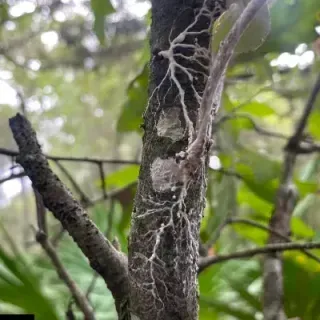
The most common and distinctive sign of P. relampaga infection is the presence of rhizomorphs (Figure 2A–B), which appear as thick, white cords of aggregated mycelium (fungal vegetative tissue) on the outer bark of stems. These rhizomorphs often form a lightning-shaped pattern, giving the disease its name. They commonly grow along the shaded lower surfaces of twigs and branches. Rhizomorphs are often observed spreading to healthy leaves, twigs, and branches through direct contact with infected leaves, twigs, and branches.
When colonizing hosts, the fungus often grows as rhizomorphs along twigs until it reaches the leaves. There, mycelial fans form and coat the underside of the leaf (Figure 2C–E), covering the plant's stomata (breathing pores on the underside of leaves). Mycelium from infected leaves may also spread onward to adjoining leaves or twigs.
Parvodontia relampaga does not form an upright mushroom or conk; its fruiting body (spore-producing structure) is crust-like (sometimes called 'corticioid') and lies flat on the surface of the host tree (Figure 3A). These structures are broadly attached to the substrate, typically on dead twigs and small branches. The fruiting bodies of P. relampaga range in color from pale yellow to yellowish gray to buff (Paez et al. 2024). The surface of the crust structure is often cracked and dry. The fruiting bodies of P. relampaga are typically associated with white rhizomorphs, but they are rarely found and are difficult to distinguish from fruiting bodies of other whitish crust fungi. Many other fungal species can form similar white, flattened fruiting structures, so microscopic examination is needed to tell species apart from one another. Little is currently known about how long it takes for a fruiting body to develop or what role P. relampaga fruiting bodies play in the process of infecting host plants. Figure 2. (A) Lightning-shaped rhizomorphs on a hardwood stem (scale = 1 in). (B) Rhizomorphs causing blight on critically endangered Florida Torreya ( Torreya taxifolia ) (scale = 0.5 in). (C) Twig blight on an oak ( Quercus sp.) host (scale = 2 in). (D) Characteristic mycelial colonization on the undersides of oak ( Quercus sp.) leaves (scale = 2 in). (E) Rhizomorphs and mycelial fans on oak ( Quercus sp.) leaves (scale = 0.5 in).
Credit: Alassane Sow and Matthew E. Smith, UF/IFAS.
Symptoms vary from host to host, but the most common and visible symptom is blighted (dead and brown) leaves, which often appear pale brown due to the white growth of fungus on the undersides. The dead leaves often remain attached to the twig for long periods of time because the growth of fungal tissues prevents leaves from falling off the twigs. Dieback of twigs and small branches is also a common symptom of relampago blight. In seedlings, saplings, and other small plants, this dieback may cause death of the upper crown or even the death of entire small plants. For help with identification, see the YouTube video by K M D (@decay_notes) called 'Identifying Relampago Blight: An Emerging Fungal Disease.'
During typical growth, P. relampaga makes white, aerial hyphae, in which clamp connections can be observed (these are small, swollen protrusions at the septa of the fungal hyphae that are only found in Basidiomycota fungi). The most distinct micromorphological feature is the presence of gloeocystidia (Figure 3B–C), which are small, irregularly swollen cells with thickened walls that grow darker brown as they mature (Figure 3B–C). These gloeocystidia are notable in the microscope because they stand out against the other light-colored hyphae of the fungus. These structures can be observed in mycelium collected in nature or grown in the lab but can also be found in the fruiting bodies (Paez et al. 2024). The basidiospores (sexual spores of the fungus) are difficult to find, even when fruiting bodies can be located. However, when present, they are cylindrical and mostly 4.5–5.5 x 2.5–3.0 μm. Figure 3. (A) Crust-like fruiting body of Parvodontia relampaga on oak ( Quercus sp.) wood (scale = 1 in). (B) Gloeocystidia with protuberances, the type usually found in hyphae outside fruiting bodies (scale = 20 μm). (C) Swollen gloeocystidia without protuberances, the type found more often in fruiting bodies (scale = 20 μm).
Credit: Alassane Sow and Matthew E. Smith, UF/IFAS.
Parvodontia relampaga functions both as a pathogen that causes a thread blight disease in living plants and as a saprotrophic fungus that decomposes dead plant material (Paez et al. 2024). Thread blight diseases are caused by fungi that utilize rhizomorphs to grow across the outer surfaces of hosts as a strategy for seeking out nutrition. When they reach susceptible resource-rich sites, they send out finer structures (hyphae) to penetrate and extract resources from the colonized stem and leaf tissue, resulting in blighted leaves and, in some cases, stem dieback (Amoako-Attah et al. 2020; Hedger 1990).
In natural settings, relampago blight is typically found on seedlings, saplings, and lower branches of trees, shrubs, and vines in the shaded understory of forests. Laboratory observations and greenhouse studies indicate that low light and high moisture conditions encourage its mycelial growth. On infected hosts, the rhizomorphs often form along the lower, more shaded surfaces of branches and twigs and spread across the undersides of leaves. Observations of infection suggest that P. relampaga operates as an opportunistic pathogen, infecting young trees as well as highly stressed or shaded trees.
Parvodontia relampaga has been found on a wide variety of host plants in Florida, including hardwoods, palms, and conifers (Table 1).
Table 1. Currently known host plants of P. r elampaga in Florida.
The disease biology of P. relampaga is currently under investigation. On landscape plants, practice proper pruning techniques to remove dead branches displaying signs of relampago blight and dispose of them in an area away from other plants.
Amoako-Attah, I., A. S. Shahin, M. Catherine Aime, et al. 2020. "Identification and Characterization of Fungi Causing Thread Blight Diseases on Cacao in Ghana." Plant Disease 104 (11): 3033–3042. https://doi.org/10.1094/PDIS-03-20-0565-RE
Baltazar, J. M., R. M. B. Da Silveira, and M. Rajchenberg. 2016. 'Type Studies of J. Rick's Corticioid Homobasidiomycetes (Agaricomycetes, Basidiomycota) Housed in the Herbarium Anchieta (PACA).' Phytotaxa 255 (2): 101–132. https://doi.org/10.11646/phytotaxa.255.2.1.
Hedger, J. 1990. "Fungi in the Tropical Forest Canopy." The Mycologist 4 (4): 200–202. https://doi.org/10.1016/S0269-915X(09)80438-2
Hjortstam, K., and L. Ryvarden. 2004. "Some New Tropical Genera and Species of Corticioid Fungi (Basidiomycotina, Aphyllophorales)." Synopsis Fungorum 18: 20–32.
Larsson, K.-H., V. Spirin, L. Ryvarden, and E. Larsson. 2025. "Reclassification of Eleven Corticioid Basidiomycetes with Nine Typifications." Fungal Systematics and Evolution 16 (1): 1–28. https://doi.org/10.3114/fuse.2025.16.1
Li, Y., K. K. Nakasone, C.-C. Chen, et al. 2022. "Taxonomy and Phylogeny of Cystostereaceae (Agaricales, Basidiomycota): A New Genus, Five New Species, and Three New Combinations." Journal of Fungi 8 (11): 1229. https://doi.org/10.3390/jof8111229
Paez, C. A., J. A. Smith, K. K. Nakasone, et al. 2024. ' Parvodontia relampaga sp. Nov.: A Cystostereaceae Fungal Pathogen That is the Causal Agent of Relampago Blight of Woody Plants in Florida, USA.' Fungal Biology 128 (3): 1758–1770. https://doi.org/10.1016/j.funbio.2024.03.002
Pirapak, W., A. Karunarathna, M. C. Samarakoon, et al. 2025. 'Impact of Parvodontia austrosinensis on Lansium domesticum in Northern Thailand.' New Zealand Journal of Botany 63 (2–3): 428–438. https://doi.org/10.1080/0028825X.2024.2331568
A note on cookies
Newshunt uses essential cookies to keep you signed in and to remember your language and country, so the site works the way you expect. With your permission, we'd also like to use analytics cookies to understand how people use Newshunt and improve it over time.
Accepting only affects analytics. To learn more, view our Privacy Policy or Terms & Conditions.
(0)Comments