


Can dogs sniff cancer? AI joins the hunt in India
Category: Health
Share
Archive
Like
"In an hour, they [dogs] can do thousands of sniffs; each sniff can evaluate a sample," says co-founder Akash Kulgod
When rescue dog Chloe is not tumbling across the grass on a farm outside India's tech capital Bengaluru, she is learning to sniff human breath for cancer with a little help from AI.
Fitted with a 3D-printed helmet and harness packed with sensors, Chloe is part of experimental efforts to use dogs' extraordinary sense of smell to develop a non-invasive test for the disease.
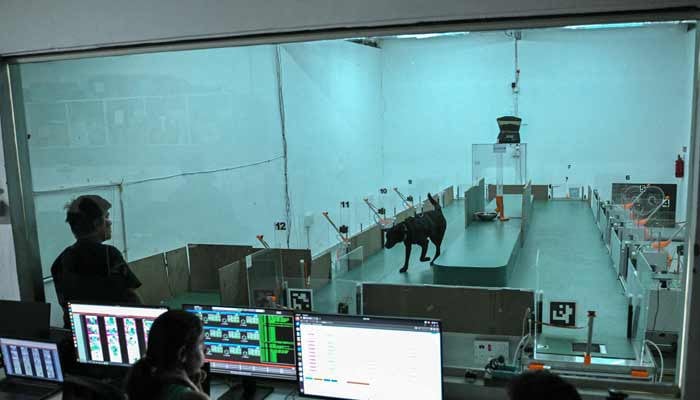
A dog taking part in a cancer detection test inside a laboratory at the Dognosis facility in Kempohalli village on the outskirts of Bengaluru.— AFP
A growing body of global research suggests dogs can be trained to detect cancer and other human illnesses, from Parkinson's to Covid-19.
A dog strolling around while employees working inside the Dognosis R&D facility in Bengaluru.— AFP
The Bengaluru-based startup Dognosis is using AI to analyse dogs' brain activity, respiration and body language — turning their reaction to scent into data.
A dog handler preparing a beagle for a test inside a laboratory at the Dognosis facility in Kempohalli village on the outskirts of Bengaluru. — AFP
"In an hour, they can do thousands of sniffs," co-founder Akash Kulgod, 26, told AFP. "Each sniff can evaluate a sample."
Dognosis hopes to launch commercially next year, which it says would make it the third company of its kind, after firms from Germany and Israel.
co-founder of the Dognosis Itamar Bitan holding a dog inside a kennel at his facility in Kempohalli village on the outskirts of Bengaluru.— AFP
Early detection can make a crucial difference to cancer survival rates, but in India, many patients are diagnosed only after the disease has advanced.
A dog taking part in a cancer detection test inside a laboratory at the Dognosis facility in Kempohalli village on the outskirts of Bengaluru.— AFP
Dog sniffs could provide an easy and affordable first layer of screening to be deployed at scale, finding potential cases for further testing.
A dog sniffing a sample during a cancer detection test inside a laboratory at the Dognosis facility in Kempohalli village on the outskirts of Bengaluru, India.— AFP
As it chases commercial approval, Dognosis — backed by venture-capital firms including Accel India — is collaborating with government medical institutions for its research.
A dog handler playing with beagles inside a kennel at the Dognosis facility in Kempohalli village on the outskirts of Bengaluru. — AFP
Chloe, a Labrador mix, is one of 15 dogs being coached by the startup, clad in customised data-gathering helmets.
"It's like a doggy 'Iron Man' suit," said Kulgod, who comes from a family of doctors and studied cognitive science at the University of California, Berkeley.
'Promising' study
Research suggests diseases can alter the chemicals released by the body, creating distinctive odours.
A dog during a cancer detection test inside a laboratory at the Dognosis facility in Kempohalli village on the outskirts of Bengaluru.— AFP
Dogs have around 300 million scent receptors, compared to about five million in humans.
The testing method is simple: a patient breathes into a cotton mask for about 10 minutes, and the mask is then sealed in a bag and taken to the lab. Patients do not meet the dogs.
The employees are monitoring a cancer detection test inside a laboratory at the Dognosis facility in Kempohalli village on the outskirts of Bengaluru.— AFP
A recent Dognosis study of more than 1,500 participants, involving six hospitals in Karnataka state, was published in the Journal of Clinical Oncology.
The company said it achieved an accuracy rate of more than 90% across seven major types of cancer, and now plans to test in real-world programmes.
A visitor interacting with a beagle inside a kennel at the Dognosis facility in Kempohalli village on the outskirts of Bengaluru.
Cancer specialists in Bengaluru, independent of the project, voiced cautious optimism.
"The study is promising, as an early signal," said Santhosh Kumar Devadas, head of oncology at Ramaiah Memorial Hospital.
Employees preparing for a test inside a laboratory at the Dognosis facility in Kempohalli village on the outskirts of Bengaluru.— AFP
"But they need to do the study with a much larger group before we make any definitive conclusions."
Neelesh Reddy, a senior consultant oncologist at Manipal Hospitals, told AFP that "only time will tell how this technology will be useful to the actual patients".
Dog 'work-life balance'
India has described cancer as a major public health concern, saying one in nine of its 1.4 billion people is likely to develop the disease.
Dognosis says it aims to improve "proactive and preventative medicine" while boosting "human-canine communication".
Most of the dogs are beagles, along with some Malinois and Shepherd mixes, brought on board through adoption or legal breeders.
co-founder of the Dognosis Itamar Bitan (L) and his team member observing a test procedure at their facility in Kempohalli village on the outskirts of Bengaluru. A growing body of global research suggests dogs can be trained to detect cancer and other human illnesses, from Parkinson's to Covid-19.— AFP
But only the best are selected, said Kulgod. The dog team individually lists each animal on the company website as an official "sniffer", alongside their photographs.
All have a great "work-life balance", with work time limited to around 30-45 minutes a day, he added.
Employees monitoring a cancer detection test inside a laboratory at the Dognosis facility in Kempohalli village on the outskirts of Bengaluru.— AFP
At a centre called "Sniffspace", dogs test human samples on platforms equipped with automatic feeders dispensing dog treats.
Kulgod's co-founder Itamar Bitan, 28, who spent four years in an Israeli special-forces canine unit, said the dogs were trained using "positive reinforcement" to detect a "specific funky smell" for a reward.
A growing body of global research suggests dogs can be trained to detect cancer and other human illnesses, from Parkinson's to Covid-19.— AFP
"Some of the dogs run directly to the feeder expecting rewards, some dogs freeze, some dogs will scratch the sample with excitement," Bitan said.
"But, as long as the machine that learns how the dogs react to the sample is very consistent... we don't really mind."
A note on cookies
Newshunt uses essential cookies to keep you signed in and to remember your language and country, so the site works the way you expect. With your permission, we'd also like to use analytics cookies to understand how people use Newshunt and improve it over time.
Accepting only affects analytics. To learn more, view our Privacy Policy or Terms & Conditions.
(0)Comments