


Canada Is Learning the Lesson Russia Forgot
Category: Financial
Share
Archive
Like
Reading time: 9 minutes
By Hans Boserup, Dr.jur. 🇩🇰
Stand for a moment at Churchill, Manitoba, and the idea of great-power politics seems almost absurd.
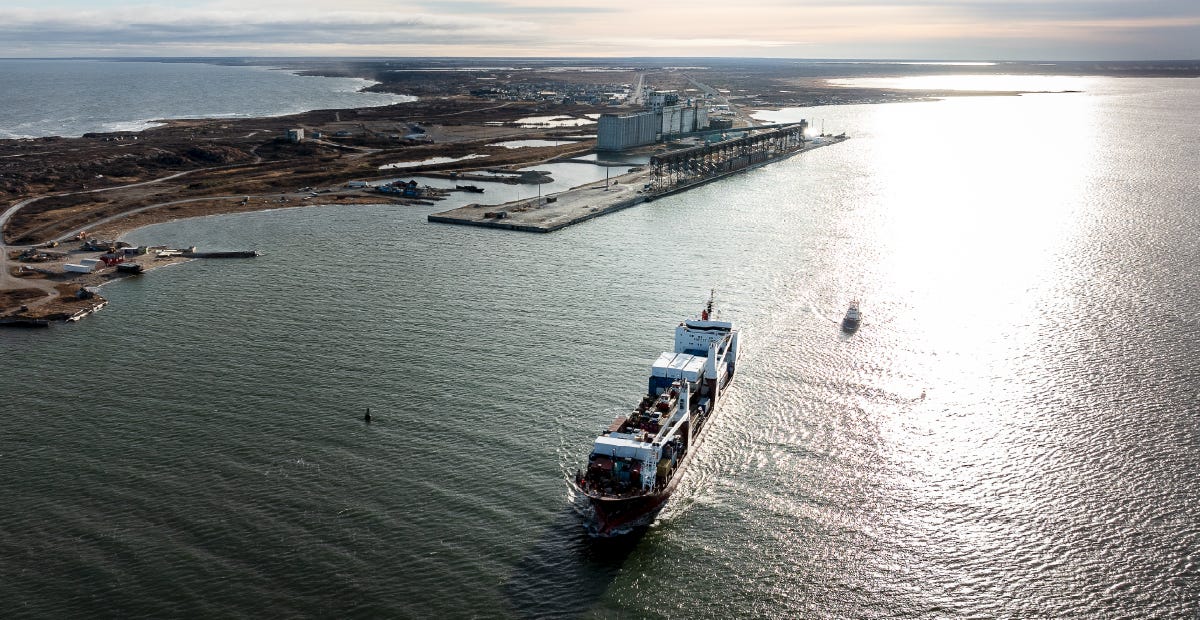
There is Hudson Bay, an enormous grey horizon, a small town, a railway running south through muskeg and permafrost, grain silos beside the water and a port that for long periods seemed to belong more naturally to Canada's past than to its future.
Yet Canada is putting Churchill back on the strategic map.
The port and the Hudson Bay Railway are being modernised. Ottawa has created a C$1 billion Arctic Infrastructure Fund alongside a C$5 billion fund for trade-diversification corridors.
This spring, the federal government also announced more than C$55 million for two northern infrastructure projects intended specifically to help critical minerals reach markets and to make Canadian supply chains more resilient.
The government's economic plans now explicitly aim to double Canadian exports to non-US markets over the coming decade.
Each decision can be explained separately. Canada needs northern infrastructure. It needs roads. It needs ports. It needs markets for minerals. It needs Arctic sovereignty.
But put the decisions beside one another and a different picture begins to appear.
Canada is buying choices.
That may be more important than anything Churchill itself eventually exports.
The Port of Churchill on Hudson Bay looks remote because it is remote. That is precisely what gives it new strategic importance. A functioning northern rail-and-port corridor gives Canadian producers another way of reaching Atlantic and European markets without first moving their goods through the United States. Infrastructure that once appeared marginal can become valuable when the question changes from efficiency to freedom of movement.
For much of the post-Cold War period, Canada's geography seemed almost impossibly fortunate.
It had three oceans, enormous natural resources and, immediately to the south, the world's largest economy, protected by the world's strongest military.
Canadian companies could send goods across the border, Canadian defence could be integrated with American defence, and Canadian prosperity could grow inside a continental economy whose political foundations appeared permanent.
There was nothing irrational about this. Efficiency usually rewards concentration. If the largest, richest and easiest market is next door, why build a more expensive route to somewhere else?
The difficulty only becomes visible when efficiency and resilience cease to mean the same thing.
We encountered this already when we looked at Canada's critical minerals. Canada possesses extraordinary deposits, yet possession of ore does not by itself create strategic power.
Someone must finance the mine, process the material, refine it, transport it, manufacture components from it and provide a market for the finished product.
A country can own the rock beneath its feet while somebody else controls nearly everything that happens after it leaves the ground.
Ottawa increasingly seems to understand that distinction. Canada's updated critical-minerals policy now talks not merely about extraction, but about processing, manufacturing, recycling, stockpiling, infrastructure, financing and partnerships with allies.
This is nation-building, but of a curious modern kind.
The railway matters because there must be another route.
The processing plant matters because there must be another processor.
The European customer matters because there must be another customer.
The domestic data architecture behind an aircraft or weapons platform matters because there must remain some capacity to operate, modify and learn without asking somebody else's permission.
None of those alternatives has to replace the United States. Indeed, attempting to replace Canada's relationship with the United States would make little geographical or economic sense.
The point is precisely the opposite.
An alternative becomes strategically valuable even when you hope never to need it.
This article is free, as promised, and the publication will remain free to read.
If you would like to receive new articles directly in your inbox, you can become a free subscriber. Subscribing costs nothing, helps this publication grow and ensures that you do not miss future analysis.
If you value my work and would also like to support the research and time behind it, you are welcome to upgrade to a paid subscription or make a contribution. Paid support is entirely voluntary; every article remains available whether or not you choose to contribute.
Buy me a coffee
You canlistento all my posts. So, if you are driving or otherwise unable to read, listening is recommended as an alternative to reading. Many readers are happy with that facility.
Now travel east across the Arctic and look at Russia.
Russia entered this war with alternatives that Canada could only envy.
It sold enormous quantities of energy to Europe. It traded with China. Its companies could operate through international financial markets. European technology entered Russian industry. Oil travelled west and east. Gas pipelines led towards some of the richest customers on Earth.
Then Vladimir Putin made a choice that progressively destroyed those options.
Europe did not disappear, but much of Russia's access to Europe did. Western capital, technologies and financial channels became restricted. Moscow redirected trade, oil and political attention eastwards.
China was there.
That fact has often been presented in Moscow as evidence that Western sanctions failed to isolate Russia. In the narrowest sense, that is true. Russia is not isolated from the world, and China has no interest in helping the West create such isolation.
But isolation is not the interesting question.
Dependence is.
Imagine two merchants at a table. One has several customers waiting outside the door. The other urgently needs this particular sale.
They may sign exactly the same contract.
They are not equally powerful.
This is what makes the Russia-China relationship so interesting.
China needs energy. Russia has a great deal of it. China benefits from Russian commodities, geographical proximity and a partner willing to challenge American influence. Moscow and Beijing also share important strategic interests.
There is therefore no reason to pretend that the relationship is imaginary or that China is about to abandon Russia.
The asymmetry lies somewhere else.
China can shop.
Russia increasingly needs to sell.
The distinction becomes beautifully visible in oil markets. This year, when disruptions in the Middle East reduced supplies, China's Sinopec increased purchases of Russian crude.
Russian ESPO oil was useful partly because it was cheaper than competing barrels from Brazil, West Africa and elsewhere. When circumstances changed, Chinese refiners could compare suppliers and alter their purchases.
That is what an option looks like.
China can buy Russian oil and still seek Brazilian oil. It can import from Russia while maintaining relations with Gulf producers. When Middle Eastern supply was disrupted in 2026, Beijing shifted sourcing towards Russia and South America rather than becoming dependent upon a single replacement.
Russia cannot perform the equivalent manoeuvre nearly as easily with its customers.
The imbalance has become sufficiently visible that Igor Sechin, the powerful head of Rosneft and one of Putin's closest associates, said only days ago that China, rather than OPEC, had become the actor calling the shots in world energy markets. Whatever one thinks of Sechin's broader argument, the remark is striking coming from Moscow.
Russia has not become a Chinese colony. Beijing does not have to annex Siberia, occupy Vladivostok or dictate instructions to the Kremlin for an asymmetry to exist.
It merely needs to retain more alternatives.
Freight crossing the Russia–China frontier is normally presented as evidence of the growing partnership between Moscow and Beijing. It is also evidence of something subtler. Railways create connections, but connections do not tell us which participant needs the connection more. Russia's eastward turn has increased commerce with China while simultaneously reducing many of the alternatives Moscow once possessed.
This brings us back to Canada.
Our earlier critical-minerals article began with a deceptively simple problem. Canada had treated its mineral wealth as though geology itself conferred power.
It does not.
A nickel deposit that cannot reach a processing plant is geology.
A processing plant without customers is industry waiting for a market.
A port without a railway is concrete beside water.
A fighter aircraft whose software, mission data and upgrades are permanently controlled elsewhere may provide formidable military capability while still creating a particular kind of dependency.
None of these observations means that foreign partnerships are undesirable. Modern economies cannot become self-sufficient without becoming poorer, weaker and technologically backward.
The interesting question is therefore not whether a country depends upon others.
Every serious country does.
The interesting question is whether dependency contains an exit.
That changes the meaning of Churchill. It also changes how we should think about Canadian LNG terminals, critical-mineral processing, European defence partnerships, Arctic infrastructure and new markets across the Atlantic and Pacific.
Viewedindividually, these projects are economic policies.
Viewedtogether, they are an attempt to increase Canada's room to manoeuvre.
There is a temptation in Western discussion of China to look for a master plan behind everything Beijing does.
Reality is less tidy. China makes mistakes. It creates dependencies of its own. Its huge industrial economy relies heavily on imported commodities and on foreign customers. Today's extraordinary Chinese export machine is itself evidence of how much Beijing needs access to markets abroad. Chinese exports surged again in August, particularly in high-technology goods, while weak domestic demand continued to make foreign demand important to economic growth.
Yet China has spent decades doing something that deserves more attention.
It has tried to create alternatives.
Alternative suppliers.
Alternative markets.
Alternative payment arrangements.
Alternative transport corridors.
Domestic alternatives to foreign technologies.
Stockpiles where immediate alternatives cannot be created.
Influence over processing where possession of the raw material alone would not suffice.
Not all of these policies succeed. Some are enormously expensive. Some provoke precisely the foreign resistance Beijing hoped to avoid.
But the instinct behind them is intelligible.
Never allow one door to become the only door.
That is also why critical minerals matter so much. China's leverage in rare earths does not principally come from the fact that unusual elements happen to exist beneath Chinese soil. It comes from decades spent building processing and manufacturing capacity around them. Europe is now discovering how difficult and expensive it is to construct alternatives quickly; even projects specifically selected to reduce European dependence on China are struggling to obtain financing.
The power was never merely in the mine.
It was in what happened after the mine.
Here, perhaps, lies Putin's deeper mistake.
The invasion of Ukraine was built upon an extraordinarily old conception of power.
Land mattered. Borders mattered. Territory could be seized. Cities could be occupied. A neighbouring country could supposedly be forced back into a Russian sphere of influence.
Ukraine has paid an appalling price for resisting that conception.
But while Russia fought to enlarge the territory under its control, it simultaneously reduced the number of choices available to the Russian state.
It gained occupied land and lost markets.
It seized Ukrainian factories and lost access to technologies.
It proclaimed sovereignty while increasing dependence upon Chinese trade and finance.
It tried to prevent Ukraine from choosing Europe and thereby made Russia less able to choose among Europe and Asia.
There is an irony here that deserves to be allowed to sit quietly.
Putin went to war because he believed great powers possess spheres of influence.
His war may have pushed Russia deeper into somebody else's.
It would be much too easy to end the comparison there.
Canada has not solved its dependence problem. Announcing a corridor does not build one. A mineral strategy does not produce a refinery. A railway in northern Manitoba cannot suddenly redirect hundreds of billions of dollars in continental trade.
Nor should Canada interpret diversification as a search for independence from everyone.
That would simply replace one misunderstanding with another.
Canada's prosperity will remain profoundly connected to the United States. Its defence will remain linked to NORAD and NATO. Its industries will depend upon foreign technologies, capital and customers. Geography cannot be diversified away.
But geography need not become destiny.
If Churchill works, Canada has another route.
If Canadian minerals are processed domestically or through several allied supply chains, Canada has another buyer and somebody else has another supplier.
If Canadian defence industries can work with several European and North American partners, Ottawa gains another choice.
If Atlantic and Pacific markets grow, a disagreement at one border becomes less capable of determining the country's economic future.
The objective is not autonomy in the literal sense.
It is room.
We are accustomed to recognising power when it becomes visible.
A carrier group moves towards a coastline, a missile is launched, troops cross a border, or one government publicly threatens another. These are the moments that make headlines because power appears to be doing something in front of us.
Yet some of the most consequential forms of power work in almost the opposite way.
They become visible through the decisions a country is able to avoid.
A government can resist pressure because another supplier is available. A company can survive a trade dispute because it has customers elsewhere. A state can reject an unfavourable technological dependency because it still possesses the knowledge, infrastructure and partnerships needed to choose differently.
Seen from that perspective, a railway is more than a railway.
It can give exporters access to another coast. A pipeline can connect a producer to another market. A stockpile can give a government time to wait rather than accept the first terms offered. A domestic processing plant can make the difference between owning a resource and actually being able to use it strategically.
None of these things looks dramatic when it works. There may be no confrontation, no public refusal and no photograph of a victorious moment, because the alternative existed before the crisis arrived. The possession of that alternative quietly changes the balance of the conversation.
This may be why we so often underestimate this kind of power. We notice coercion because it produces an event, while resilience often prevents one.
Churchill gives us a rare physical image of something that is otherwise difficult to see. At the end of a railway beside Hudson Bay, Canada is not simply building infrastructure. It is creating another possibility.
For a country that spent decades in an unusually comfortable strategic environment, that may amount to relearning an older truth. Sovereignty is not only the ability to say no when pressure comes. It is the ability to know that, after saying no, there is still another road, another customer, another partner or another port available.
If this way of looking at power is useful, share the article with someone who still thinks sovereignty begins and ends with borders. Everything here is public, and the conversation in the comments is part of the work.
Myarchiveis organised into clickable topic sections. Each section is intended as a reading path rather than a simple collection of posts.
This article belongs particularly with:
Power Without War
Canada, Arctic and Atlantic Security
In the table of contents in myarchive, you can find other—systematised by topic or category—sections with previous articles.
Russia Discovers That China Does Not Need Russia
Government of Canada — Canada's Critical Minerals StrategyRead the strategy
Government of Canada — Arctic infrastructure and critical minerals, 20 May 2026Read the announcement
Government of Canada — Trade Diversification Corridors Fund and Arctic Infrastructure FundRead the announcement
Arctic Gateway Group — Port of Churchill and Hudson Bay RailwayVisit Arctic Gateway Group
There is a danger in turning every commercial relationship into a story about vulnerability.
Trade creates dependence precisely because it also creates value, and countries that try to eliminate dependence altogether usually discover that autarky is another form of weakness.
The distinction that matters may therefore be betweendependence and dependence without alternatives.
That is why Canada and Russia belong in the same article even though almost everything else about their situations differs.
Canada is not trying to escape its neighbours or alliances. It is beginning to ask how many choices should remain available if circumstances change.
Russia once possessed far more choices than it does today.
China, meanwhile, has become powerful partly because it rarely stops looking for another one.
Perhaps we have been using the wrong mental picture of power.
We imagine a fist.
Perhaps we should imagine a hand holding several keys.
The strongest country is not necessarily the one that can force every door open.
It may be the one that never allows itself to be left with only one door.
Leave a comment
Stay with the conversation
This publication is, and will remain, free to read.
If you find these articles helpful, I invite you to become afree subscriber. New articles will then arrive directly in your inbox, and you will never miss an analysis.
If you would like to support my research, I would be grateful for a contribution of$5–8, or any amount you choose. Every contribution helps me continue writing and keeping the publication free for everyone.
You can also support this publication by:
Restacking or sharing an article you found valuable.
Leaving a comment. Your questions and observations often inspire future articles and help shape future analysis.
There are no paywalls and no exclusive content. My aim has always been to make careful, evidence-based analysis available to anyone with an interest in Ukraine, Russia and European security.
Thank you for reading, for sharing, and for being part of this growing community.
Share
Buy me a coffee
Upgrade to paid
A note on cookies
Newshunt uses essential cookies to keep you signed in and to remember your language and country, so the site works the way you expect. With your permission, we'd also like to use analytics cookies to understand how people use Newshunt and improve it over time.
Accepting only affects analytics. To learn more, view our Privacy Policy or Terms & Conditions.
(0)Comments