


Japan is overrun with tourists, but this city wants more visitors
Category: Tourism
Share
Archive
Like
Advertisement
InspirationJapan Japan is overrun with tourists, but this city wants more visitors Ben Groundwater
September 8, 2026 — 3:00am
Save
You have reached your maximum number of saved items.
Remove items from your saved list to add more.
Share
A A A
It's ironic, that for hundreds of years the only place you would find a foreigner in all of Japan was Nagasaki.
This city was once the gateway to the outside world, the lifeline, the only port where non-Japanese ships were allowed to make contact and trade with locals.
During the isolationist Edo era, from 1600 to 1868, Japan's independence was fiercely guarded, and Dejima, an island connected by footbridge to the Nagasaki mainland, was the only spot Portuguese and then Dutch traders were permitted to land.
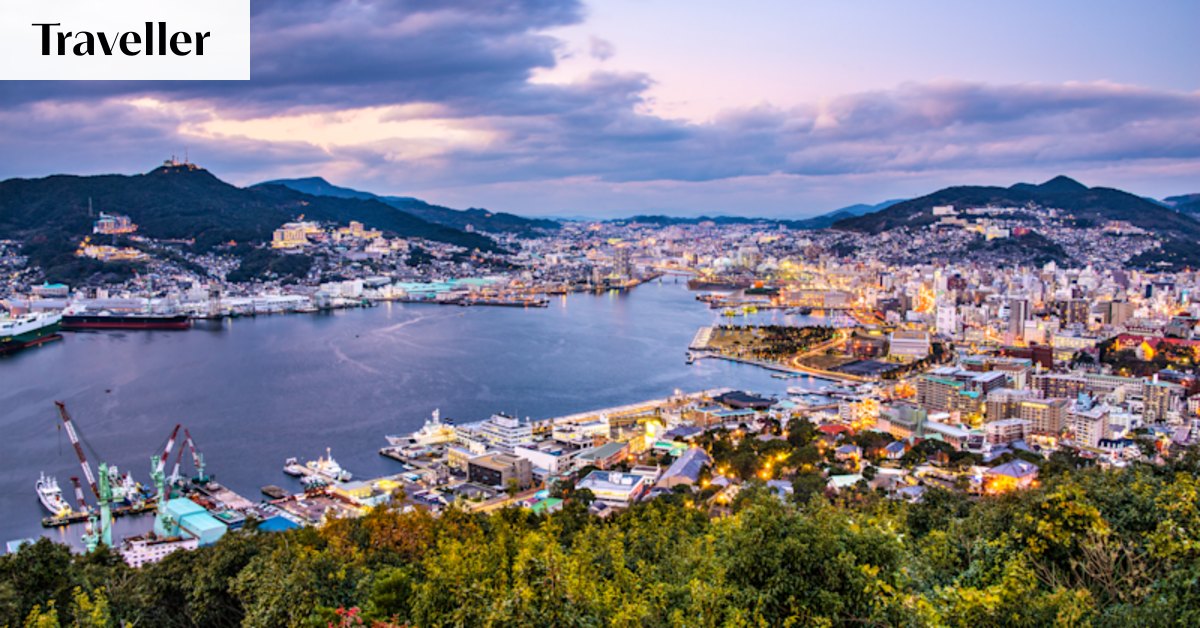
The port city of Nagasaki.
iStock
Step across the bridge, and you would be captured and executed. Stay on the island, however, and you could meet with Japanese officials and trade goods.
Advertisement
But modern-day Nagasaki is no longer Japan's only contact point with the outside world – the city now has among the fewest foreign visitors of any Japanese hub. Just 1 per cent of the annual 42 million tourists who visit Japan make their way to this southern prefecture; by comparison, almost 50 per cent of Japan's tourists visit Tokyo, 43 per cent visit Osaka, and 32 per cent go to Kyoto.
Sign up for the Traveller Deals newsletter
Get exclusive travel deals delivered straight to your inbox. Sign up now.
Nagasaki, the city that was once the only lifeline between Japan and the world, now probably feels a little isolated itself.
Megane Bridge, also known as Spectacles Bridge, in Nagasaki.
iStock
Though maybe that will soon change. The reason I'm in this laid-back port city is because it wants more visitors. Unlike some of its famously over-touristed brethren, Nagasaki is keen for an increase in tourists, and Australia-based company InsideJapan has heeded the call, creating itineraries in five Japanese prefectures, including Nagasaki, that could use a little more love.
The idea is to spread the load, to take the pressure off Kyoto, Tokyo and Osaka and show international visitors what the rest of Japan has to offer.
Advertisement
Nagasaki is in Kyushu, the island at the south of Japan. Cruise ships call in here occasionally, pouring forth a stream of tourists who whip through the key attractions, but for the most part this is a city that feels like the old Japan, the Japan of 20 years ago, when there were few foreign visitors and little dedicated infrastructure to cater for them.
If Nagasaki is known for anything on the world stage these days, it is probably the events of August 9, 1945, when US forces dropped a nuclear bomb on the city, killing 35,000 people, making it one of only two cities in the world to suffer such a horrific fate.
The Nagasaki Atomic Bomb Museum is therefore the first port of call for many visitors, a moving and often disturbing demonstration of the day and the fallout that the city's residents will never forget. Read the stories, look at the twisted shards of metal that were once factories and bridges, and marvel at the idea that Nagasaki can even still exist.
flowers divide the staircases of the Nagasaki Peace Park.
iStock
Not all the history here, however, is so confronting. Walk the quiet, tidy streets of Nagasaki and you notice temples and cafes, gardens and shopping malls, a harmonious blend of cultures known locally as 'wakaran', 'wa' meaning Japan, 'ka', meaning China, and 'ran' referring to the Netherlands. This place has long welcomed visitors, has taken influence from them and moulded them into its own identity.
Advertisement
Consider the local cuisine. This city was the birthplace of yoshoku cuisine, or Western food made in Japanese style, and perhaps the signature dish in Nagasaki is toruko rice, a frankly bonkers plate of food that translates to 'Turkey rice', Turkey being the country that's half in Asia and half in Europe, as this dish is.
Toruko rice has a rice pilaf on the bottom of the plate, topped with a pork katsu, which itself is topped with a mild curry sauce, and then on the side there's a giant pile of spaghetti with a Neapolitan sauce that's made up in large part of tomato ketchup.
The Peace Statue, Nagasaki.
iStock
I meet an Italian tourist, Giovanni, while I'm at a bar in Nagasaki, and he offers this opinion on the pasta: 'You know, it's not as bad as I thought.' High praise.
Nagasaki is also the home of champon, a vegetable-heavy noodle soup that has been heavily influenced by Chinese cuisine. I sample it at Kanro, a no-frills diner on a quiet backstreet, and enjoy the absolute charm of a true throwback, with its high-backed wooden chairs, its doily-style tablecloths and the TV softly playing Japanese soap operas in the corner.
Advertisement
Tokyo has many things, but it doesn't have Kanro.
That famous island in Nagasaki, Dejima, the lifeline to the world, still exists, though it has since been surrounded by reclaimed land. The site has been preserved in its historic state, a collection of small warehouses and living quarters that once served as the claustrophobic home for the few Portuguese and Dutch traders who were allowed to live there.
Unlike those traders, I'm not staying. Instead, I'm heading north to another Kyushu prefecture that remains underappreciated by the tourist masses: Fukuoka, another port city with a long history of welcoming visitors.
Fukuoka's famous dish of tonkotsu ramen.
iStock
This is an area known for its relaxed, friendly style, a city with plenty going for it, even if the bulk of visitors to Japan still haven't wised up to it. Again, here it feels different to the 'golden triangle' cities, with fewer signs in English, fewer foreign faces in the crowds.
Advertisement
They like their food big and bold in Fukuoka with a preference for punchy flavours and unusual ingredients. I realise this on my first night, as a local guide takes me to a few izakaya, or sake bars, and orders the local specialties.
We start with gomasaba, a dish of raw mackerel fillets that are slathered with a thick, soy-and-sesame sauce. We move on to motsunabe, a hotpot with beef intestines. My guide decides against yobuko ikizukuri, a famous local dish of raw squid served so fresh it should still be twitching.
Fukuoka's other famous dish, and the one that it's well worth travelling here just to experience, is tonkotsu ramen. This is probably the best known, globally, of all Japan's ramen styles, with a rich, emulsified broth made with pork bones, mixed with thin noodles and draped with slices of pork chashu.
Street side eateries are packed in Fukuoka.
iStock
My idea is to visit the most famous shop in Fukuoka, Hakata Issou, but I find a queue there that must be at least 50 metres long, stretching two city blocks, so I detour to the main train station, which has a huge ramen alley that includes the city's second-most famous shop, Shin Shin.
Advertisement
The line here is only about 30 metres long. Score. Related Article Japan The delightful region of Japan tourists haven't discovered yet
There's a good reason, however, that all these people are lining up for so long: the ramen is incredibly tasty, hearty and filling and packed with umami goodness, and it costs the equivalent of about $11.
From there, Fukuoka is a place to stroll, to enjoy quiet streets and shop unhassled by the hordes. Here you can pick up a few local delicacies and plan your next Japanese adventure, somewhere that's not already popular. Five more underappreciated prefectures
Advertisement
Ehime
On the western end of the island of Shikoku, Ehime is a quiet, historic prefecture with plenty to offer. Matsuyama, the capital, has a 17th-century hilltop castle, as well as one of Japan's most famous hot springs, Dogo Onsen. It's also known for its cycling routes.
Niigata
Want to go skiing, but without Australians? Niigata is your prefecture, with plenty of mountains, lightning-fast shinkansen access from Tokyo, and yet barely any foreigners. This prefecture is also known for the quality of its sake, and the eponymous capital is a buzzing city with an excellent dining scene.
Aomori
There's a vast swathe of land to the north of Tokyo, known as the Tohoku region, that goes largely untouched by foreign tourists. One of the most interesting prefectures is Aomori, where you will find Hirosaki, with a samurai-era castle popular during cherry blossom season, while Aomori city is known for its huge annual festival.
Wakayama
Given the quality of its experiences, it's a wonder Wakayama prefecture, near Nara and Kyoto, isn't more popular. This is where you will find the Kumano Kodo, a series of pilgrimage trails through old-growth forest. There's also Koyasan, a mountaintop village known for being the centre of Shingon Buddhism, and Nachi Falls, Japan's highest waterfall.
Toyama
You get the best of both worlds in Toyama: soaring mountains – a section of the Japanese alps with undulating scenery ripe for exploration – and coastline, which means excellent seafood, and yet more chance for active adventure. Toyama city has parks, markets and a well-known glass art museum.
Advertisement
THE DETAILS Related Article Asia Once a rival to Tokyo and Kyoto, this extraordinary city is exquisite
TOUR
InsideJapan has a 13-night Kyushu Adventure package that includes time in both Nagasaki and Fukuoka, from $4580 a person. The company can also organise bespoke, single-day 'insider' experiences in either city. See insidejapantours.com/au
FLY
ANA has flights from Sydney and Melbourne to Fukuoka and Nagasaki, via Tokyo. See ana.co.jp
STAY
In Nagasaki, the Hotel Indigo is a new, modern facility with excellent views of the city. Rooms from $333. In Fukuoka, The Gate Hotel is central, smart and comfortable. Rooms from $411. See ihg.com; gate-hotel.jp
The writer travelled as a guest of InsideJapan
Save
You have reached your maximum number of saved items.
Remove items from your saved list to add more.
Share License this article
More: Japan
Foodie travel
Asia
North-East Asia Ben Groundwater is a Sydney-based travel writer, columnist, broadcaster, author and occasional tour guide with more than 25 years' experience in media, and a lifetime of experience traversing the globe. He specialises in food and wine – writing about it, as well as consuming it – and at any given moment in time Ben is probably thinking about either ramen in Tokyo, pintxos in San Sebastian, or carbonara in Rome. Follow him on Instagram @bengroundwater Connect via email
From our partners
A note on cookies
Newshunt uses essential cookies to keep you signed in and to remember your language and country, so the site works the way you expect. With your permission, we'd also like to use analytics cookies to understand how people use Newshunt and improve it over time.
Accepting only affects analytics. To learn more, view our Privacy Policy or Terms & Conditions.
(0)Comments