


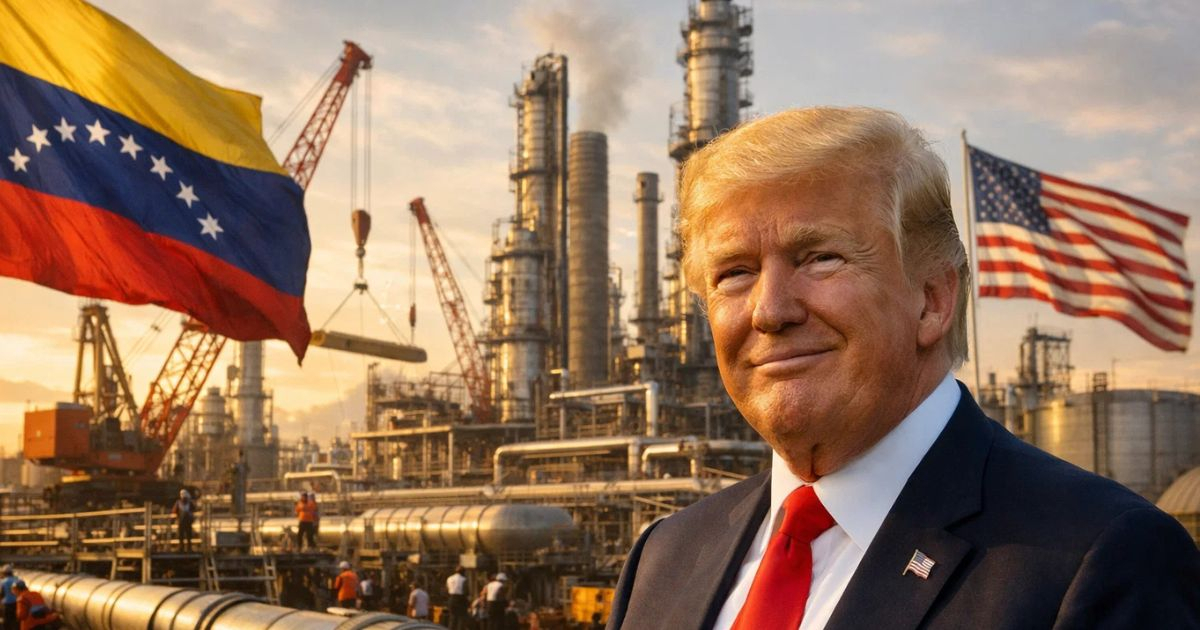
The Economist criticizes Trump's oil deal with the Venezuelan regime: "It blocks the transition to democracy."
Category: Politics
Share
Archive
Like
The magazine The Economist published a harsh editorial describing the oil deal between Donald Trump and the Venezuelan government led by Delcy Rodríguez as "bold but shady" and warns that it creates perverse incentives to hinder any democratic transition in Venezuela.
The pact, announced by Trump at the end of August and described by him as "the largest oil deal in world history," grants the private company North American Blue Energy Partners (NABEP) concessions over 17 Venezuelan oil fields with proven reserves of approximately 65 billion barrels.
In exchange for Washington's support, the Pentagon receives a 35% stake in NABEP and rights over its production, which guarantees the United States the right of first refusal on fields that represent one-fifth of Venezuela's reserves over the next hundred years, with some acquisitions at a discounted price.
The Economist identifies three warning signs that it believes make the agreement "regrettable".
The first: «was negotiated with an illegitimate regime that stole the last elections».
The second: the private partner chosen by Trump, Alejandro Betancourt, head of NABEP, is a deeply controversial figure in Venezuela due to his business dealings with chavismo and for having been investigated—though never formally charged—by authorities in the United States and Europe.
The third warning sign points directly at Trump: the day after the announcement of the agreement, the president declared that he would take «all» of Venezuela's oil, words that the magazine describes as «imperialist bragging» capable of igniting the resentment of Venezuelans.
The editorial emphasizes that any democratically elected Venezuelan government could challenge a pact that grants such control to Washington over the country's resources, which in turn discourages major investors.
The major international oil companies remain cautious, although Chevron separately announced a $7 billion investment in its existing operations in Venezuela.
The most serious argument of the publication points to the political heart of the agreement: the flow of money and the tax revenue it will generate create incentives for powerful actors to obstruct the democratic transition.
Betancourt, "well-connected both in Caracas and Mar-a-Lago, has every reason to whisper to Trump that rushing into free elections could ruin his oil boon," the magazine notes. Rodríguez, it adds, will not hesitate to reinforce that message.
Delcy Rodríguez, for her part, stated that the project could eventually produce more than 1.5 million barrels per day, which would raise Venezuela's total production to 2.5 million, equivalent to three-quarters of the levels before Hugo Chávez. However, she did not provide a clear timeline or specify where the more than 100 billion dollars needed for such an expansion would come from.
The Economist recognizes that some officials in the Trump administration, particularly Secretary of State Marco Rubio, 'clearly understand that a democratic Venezuela is desirable and is in the interest of the United States.'
In theory, Washington could use its power over NABEP to demand transparent competition in the Venezuelan oil industry and create space for the opposition.
For her part, the opposition leader María Corina Machado had already warned that an agreement of that magnitude can only be signed by a democratically elected government, with legitimacy, the rule of law, and transparency—conditions that Rodríguez's regime does not meet.
A note on cookies
Newshunt uses essential cookies to keep you signed in and to remember your language and country, so the site works the way you expect. With your permission, we'd also like to use analytics cookies to understand how people use Newshunt and improve it over time.
Accepting only affects analytics. To learn more, view our Privacy Policy or Terms & Conditions.
(0)Comments