


Freedom Has Prisoners
Category: Politics
Share
Archive
Like
In the fall of 2020, I was sitting in the holding cell of the county jail, my mind in wonder at how it was possible to tour that same facility that morning with the executive director, discussing programs and ways to help victims of incarceration being released, opportunities and actual plans of action, only to have the city police issue a warrant for me that would lead me to seeing the same elder Black lady guard twice in one day. Once as an invited guest, second as an inmate.
My charges consisted of nothing violent, a biased argument over whether I had actually broken any laws. But it was the same act that had always gotten me in trouble since I talked too much in grade school. My words.
Thanks for reading The Bloodline's Substack! Subscribe for free to receive new posts and support my work.
It was at that moment that I learned freedom of speech isn't free. The constitutional right was as conditional as the Constitution itself, and the consequences still came because the system of control doesn't need you guilty, it just needs you to stop talking. I resonate today with why our elders chose free Black Press, inking those press rooms from start to finish.
Thanking the ancestors, after years of battle, the charges that brought that traumatic experience were dropped. But even that one night, less than 24 hours, I closed my eyes and listened to the beat of those whose lives were subjugated to prison walls for their liberation work, for their stances, and those who are still there now.
And in those conditions, the voices of Kulanshi ancestors and our elders still echo in encased rooms. George Jackson and Mumia Abu-Jamal worked tirelessly despite conditions built to break them and never let their voices dwindle. Today, Mumia Abu-Jamal continues to preserve Black Press and educate himself despite losing his eyesight, with inadequate medical care despite national advocacy. Stories and work that will never be witnessed but still expand to the masses.
George Jackson and Mumia Abu-Jamal did some of the most disciplined work of Black liberation from inside a cell, while most of us walk around free and do nothing with it. That is the inversion sitting at the center of this piece, and it should trouble every one of us who has never had to earn what freedom actually costs. No one will ever know the cost or relate to the price, while most of us walk around free and do little with it. The privilege to walk to the fridge, modern tools that place pen and paper in the Stone Age, and yet that is all we will ever need.
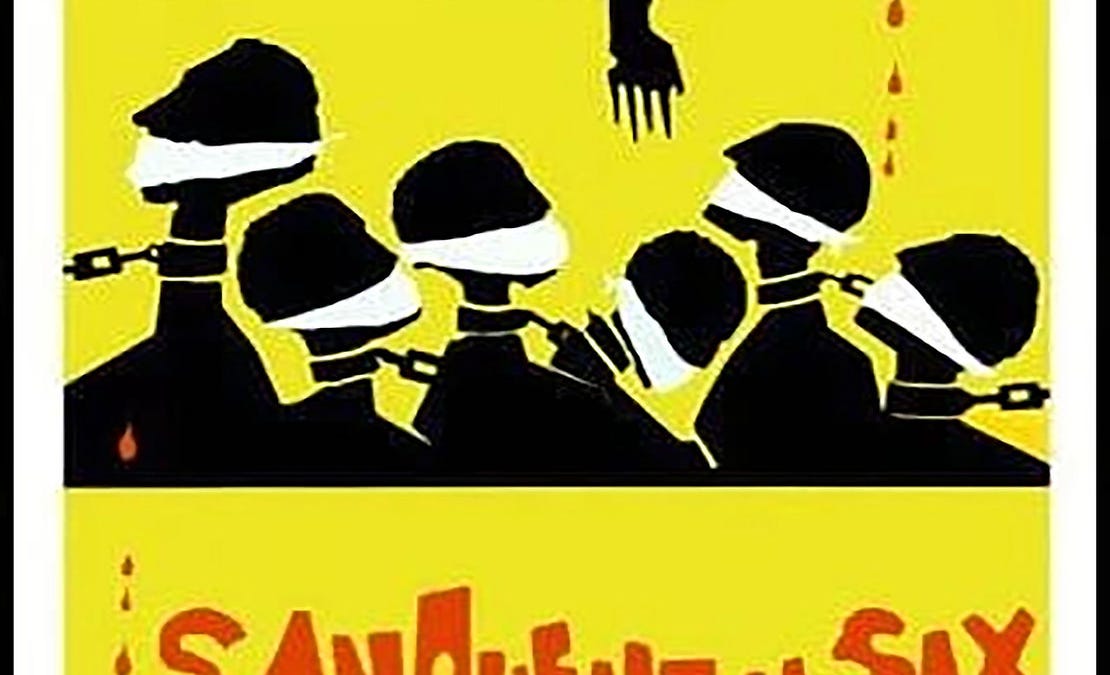
This Black August, we honor them and the other Black political prisoners amongst the diaspora, with reflective accountability on where we are in the fight for Black liberation today. Is it intentional, or has social presence become the priority? Can likes and views be documented as components of actual change? Most importantly, how and what are we teaching and leaving our youth? Because if the ones who gave the most to our liberation gave it selflessly while incarcerated, then political education cannot be optional for the rest of us out here free.
In the essence of our youth, we look for mentors and guidance from the start, whether that be positive or what some may see as negative. And with the lack of structure, village, and Black infrastructure available, trust goes to the 'system,' the operative norm by default.
Mentorship itself has been saturated by Western, non-melanated standards. During my experience fighting for justice, I often found myself the outlier when it came to the elders' 'demands' or their way of handling issues that needed to be addressed. When I examined the reasoning behind it, it became clear that the priority was often whether those who do not look like us would be uncomfortable, rather than the discomfort of our own people. This way of mentoring was nothing more than teaching us how to camouflage ourselves in controlled rooms.
As an example and a victim myself, I can see why George Jackson dedicated his life to exposing this. At only 18, he was arrested and accused of a gas station robbery that netted $71. Though there was evidence of his innocence, it was his own lawyer who suggested that, with two previous petty crimes on his record, it would be best that he plead guilty. How many other Black men with frivolous legal representation never received proper advocacy, but were served like lambs to a slaughter instead? That is George getting time for trusting the very system assigned to protect him and not having a village around him to know better. That trust cost him an indeterminate sentence, one year to life. A sentence like that today would be considered inhuman. It was inhuman then. So George had to stand as a living testimony of what that costs.
What stood in a space of shackles and chains was an army of liberated minds, not taught through lessons and guides, but forced by their conditions to understand the structure itself. Less than a month after arriving at Soledad, George Jackson came across elders in the form of mentors, such as W. L. Nolen. Together, they started a Black Family study group, creating a form of mentorship that did not exist only on the reactionary side, but intentionally instilled political education into the understanding of structures, systems, and the social sciences themselves.
When time is stripped away, when luxuries are lost, whether voluntarily or involuntarily, life slows down and focus centers. Reading socially conscious material and educating himself in a way no wall could restrict, he found a voice that still resonates, encourages, and teaches revolutionaries today. And the truth you find is that no matter how fast time goes, or how fast society progresses, the same oppressive situations don't just exist, they still control the Black collective.
That corresponds to our youth today because these teachings, this access, this priority, are not shared with them until they're already in a position where choices are minimal. A young brother the same age George was can make one impulsive decision to harm another, whether for personal gain or the delusion of gang and drill violence as a form of equity. Consequently, his life is taken by the system and given numbers before he can ever see the long picture. The consequences, if caught, get manufactured into sweat equity. Then, and only then, under Black unity systems inside those walls, do they have no choice but to follow principles they were never taught before, principles that should have reached them long before the cell did. That is not an accident. This is by design.
They learn that the person who resembles them, whom they saw as an enemy, is under the same conditions as they are. And if the hatred and narrative weren't pointed inward, they would be comrades, which by blood they already are.
Political education almost never happens in Black environments. Before you argue, I am not talking about fish fries and Democratic rallies, marches to the polls, or even panel discussions where the narrative is still controlled by outside, non-melanated voices. These are performative. It's performance alone to think that anyone but we ourselves wants real solutions for the conditions of our people collectively, the absurdism that anyone else places, or is even willing to place, this at the highest priority we so desperately need today.
The education our ancestors left us in the form of some of the greatest Black writers in history did not focus on telling us what to think, but rather how to think. This is a strong difference in a society where narratives become the reliance of truth. Thus, to keep the truth, you must keep a narrative. And this is why we can't find, or have to dig for, Black books.
A young person by default will learn of Dr. Martin Luther King Jr., in whichever twisted agenda they may choose to teach. But almost never, and certainly not in public schools, will Marcus Garvey, George Jackson, Frantz Fanon, or others be shared. Yet these are the core context of education within the Black man, Black woman, Black child, and the Black family as a whole.
We have to take accountability that we simply send our children off to school to learn what is taught only, never challenging, never clarifying, or telling another point of view. One of the negatives of segregation is that it released the duty of educating from relying solely on us and planted systems that would make our history waterlogged. Eventually, our culture dissolved into what we call Black History today. As we watch heroes fade to memories, events turn to myths, and truths, well, lies.
So where do they find this material? Where is the initiative to open access points that become portals of self-acknowledgment? I myself did not find many of these scholars' names, let alone their testimony, until age 30. Maybe that's the cause for my sense of urgency.
Some brothers make it their life commitment. Minister Paul Scott, a resourceful agent of Black literacy, would walk throughout the streets of Durham, NC, passing out Black books to youth. But there are no TV series for this, no holidays but the one we choose to selflessly honor here, to carry the name of our own lineage.
Where do they find this knowledge? Prison. That's where. In a chamber of brothers providing sweat equity, united not only by melanin but forced into action, realizing we all have, in so many ways, one common cause.
If we take nothing else into action, we must dissect this roadmap, laying the instructions at the starting point instead of making waste of learning experiences generation after generation, to intentionally set our own protected paths to make things better and ensure ourselves actual solutions rather than a vote or a political promise.
I believe this is why the ones who could not leave the rooms prepared everything for the ones who were already out, planting seeds that require watering, nourishment for the youth garden. George Jackson never had the luxury of choosing when to start that work. He built it anyway, in a cell, with nothing but time that wasn't even his. So the least the rest of us owe him, and every brother still finding this same discipline only once he's already lost his freedom, is to stop treating political education like it's optional for those of us still standing in the sun. That gap is on us, not the walls. Freedom has prisoners too, and until we close it ourselves, our people will keep paying with their freedom for an education we owe them for free.
May the ancestors guide and protect you always.
Thanks for reading The Bloodline's Substack! Subscribe for free to receive new posts and support my work.
A note on cookies
Newshunt uses essential cookies to keep you signed in and to remember your language and country, so the site works the way you expect. With your permission, we'd also like to use analytics cookies to understand how people use Newshunt and improve it over time.
Accepting only affects analytics. To learn more, view our Privacy Policy or Terms & Conditions.
(0)Comments