


When Britain forgot its coastal people
Category: Blend
Share
Archive
Like
Welcome to your first Best of Bylines of the week, bringing you a standout article from one of our10 UK national and regional publications. This time it's the turn ofSussex BylinesjournalistOdi Okaka Oquosa, who brings an insightful historical perspective that feels remarkably timely.
After a weekend in which Britain's southern coast witnessed worrying actions by masked anti-immigration protestors, Odi's article considers Britain's history as a maritime nation shaped by the sea.
Fishing communities fed towns and cities, developed extraordinary maritime knowledge, built local economies and connected Britain to the wider world long before the Industrial Revolution or the British Empire reached their height. Yet, as Odi points out, there is a paradox at the heart of Britain's national story; we celebrate our coastline but, too often, we forget the people who built it.
That paradox first became clear to me during my doctoral research at the University of Sussex, where I explored how public symbols, monuments, architecture and civic institutions shape historical consciousness and belonging in Brighton.
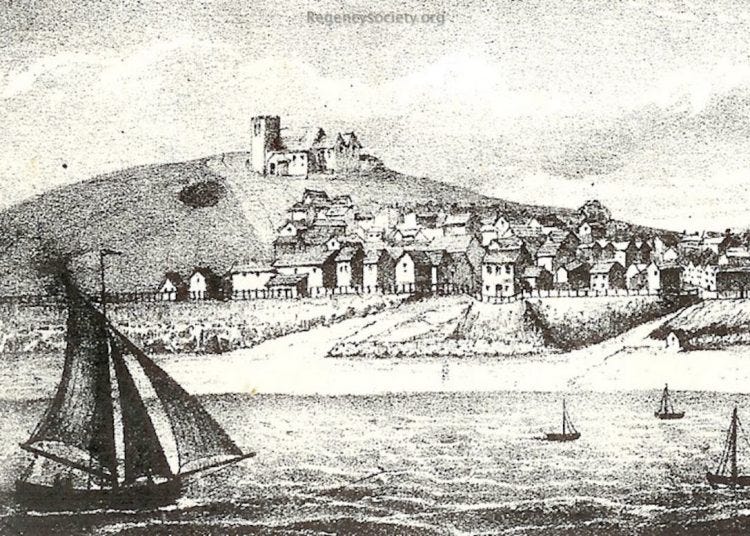
Most people know Brighton. Far fewer knowBrighthelmstone.
Before it became one of Britain's best-known seaside destinations, Brighthelmstone was a small fishing settlement whose existence depended upon generations of fishing families who lived and worked along the Sussex coast. Their labour sustained the community for centuries. Their knowledge of the sea shaped local life. Their resilience made later prosperity possible.
Yet as Brighton reinvented itself during the eighteenth and nineteenth centuries through royal patronage, fashionable tourism and imperial prosperity, another transformation quietly took place. The fishing community gradually disappeared from the city's dominant public story.
The Royal Pavilion became famous, visits from the Royal Family became celebrated, elegant architecture became protected, and imperial achievements became commemorated. Yet commemoration of the people whose labour laid the foundations of the town became increasingly difficult to find within Brighton's symbolic landscape.
It reflects a wider process that can be described through the concept of Symbolic Environments: the interconnected landscapes of monuments, buildings, institutions, street names, education and public narratives that quietly teach societies what deserves remembering and what can be forgotten.
These environments do more than preserve history. They shape identity. They influence belonging. They determine whose achievements become visible and whose contributions fade into silence.
This matters because public memory is never neutral. Every city and town makes choices about what to honour and commemorate. Every monument represents one story among many, every museum display highlights certain lives while leaving others in the background. Over generations, these choices become normal. They shape how citizens understand their country and their place within it.
For many years, Britain's national memory has rightly celebrated explorers, monarchs, military victories, scientific innovation and industrial achievement. But what happens when ordinary working people become almost invisible within that story?
This question extends well beyond Brighton.
Today, many of Britain's coastal towns facepersistent social and economic challenges. Clacton-on-Sea has become one of the most recognisable examples of this wider reality. Nearby Jaywick has repeatedly ranked among the most deprived neighbourhoods in England. Many coastal communities experience lower wages, unreliable seasonal employment, poorer transport links, declining high streets and fewer opportunities for young people than many inland areas.
These challenges are real and their causes are complex. Globalisation, deindustrialisation, changes in fishing, housing policy, education, investment and political decisions have all contributed. When it comes to a solution, communities need more than economic investment.
They also need recognition.
When the histories of ordinary working people gradually disappear from public consciousness, communities may begin to feel that they have disappeared from the nation's imagination as well. Recognition is not merely symbolic.
It shapes dignity. It shapes identity. It shapes whether people believe their lives matter within the national story.
Throughout Britain, fishing families, dock workers, market traders, shipbuilders, coastal labourers and small business owners helped create the prosperity from which later generations benefited. Yet their histories are overshadowed by grander narratives of empire, royalty, commerce and tourism.
The result is not simply historical imbalance, it creates what might be called an inequality of recognition. Some communities repeatedly see themselves reflected in public space. Others might never do.
My doctoral research suggests that this imbalance has profound consequences for belonging. When people cannot recognise themselves within the places they inhabit, feelings of exclusion may deepen even where physical regeneration takes place. New buildings alone cannot restore belonging. Economic investment alone cannot repair historical invisibility. Communities flourish when people believe that their work, their ancestors and their histories have contributed to something larger than themselves.
This insight lies at the heart of another concept developed through my research: the EtuPath Six Sense Continuum of Collective Self (ESSCCS).
This proposes that people encounter the world not only through what they physically observe, but also through inherited memory, emotion, culture, relationships and symbolic meaning.
Public environments continually influence these processes, shaping how individuals understand themselves, others and the societies they inhabit. Seen in this way, Britain's coastal challenges are not only economic, they are also cultural, historic, and symbolic.
The question is no longer simply how we regenerate coastal towns, it is also how we regenerate public memory.
Brighthelmstone offers an important lesson. Remembering its fishing community does not diminish Brighton's remarkable history. It enriches it. It reminds us that every successful city rests upon generations of ordinary people whose names rarely appear on monuments, but whose labour made everything else possible.
The same principle applies across Britain.
From Clacton-on-Sea to Grimsby, Hastings to Fleetwood, Hull to North Shields, Britain's coastal communities deserve more than occasional political attention during election campaigns or moments of economic crisis.
They deserve recognition as makers of Britain, as contributors to Britain's democratic, cultural and economic life. As communities whose histories matter just as much as the stories already carved into statues, museums and civic buildings.
Perhaps Britain's greatest challenge is not simply rebuilding its coastal economy, perhaps it is rebuilding the relationship between memory and belonging. When nations forget the people who built them, they risk weakening the very foundations upon which social trust depends.
But when forgotten histories are brought back into public consciousness, something remarkable becomes possible. Communities begin to see themselves again. Belonging becomes stronger. History becomes more honest, and the future becomes something that everyone can recognise as their own.
Britain's coastline has always connected us to the world.
Perhaps now it can reconnect us to one another.
Every month, we release a newBylines Network Gazette- to get your's sign up asFriend of Bylines Networknow. Each tackles an important issue like poverty, climate change, education, media power…the list goes on. They are packed with articles by citizens from across the UK and interviews with leading figures including George Monbiot, Sangita Myska, Michael Rosen, Gina Miller, Gavin Esler, and many more.
Now, with your help, one our Gazettes could influence those in power to make real change.
One more day of silence is one too many, is a special Gazette featuring articles from survivors of trafficking and abuse at the hands of Mohamed Al Fayed. Alongside former chief prosecutors, investigative journalists and anti-slavery networks they call for a public inquiry into the failings that have left them without justice for decades. Working with the survivor groupNo One Abovewe plan to print a copy of the July Gazette for every MP, and to help surivors finally put their case to Downing Street.
We don't normally print Gazettes, or organise trips to Westminster, and we need to raise some extra funds to do it properly. If everyone reading this newsletter donated just £5 to support this effort, we would smash the target instantly. You can help here:
Where Is Justice
Telling others is also really helpful – click this preview of our co-founder's post on Bluesky and reshare it so others can learn about what we're doing and why:
To receive new posts and support Bylines Network's powerful citizen journalism, consider becoming a free or paid subscriber.
A note on cookies
Newshunt uses essential cookies to keep you signed in and to remember your language and country, so the site works the way you expect. With your permission, we'd also like to use analytics cookies to understand how people use Newshunt and improve it over time.
Accepting only affects analytics. To learn more, view our Privacy Policy or Terms & Conditions.
(0)Comments