


Nationwide probe targeting over 36K foreigner linked firms with land and a further 7k which own condos
Category: Financial
Share
Archive
Like
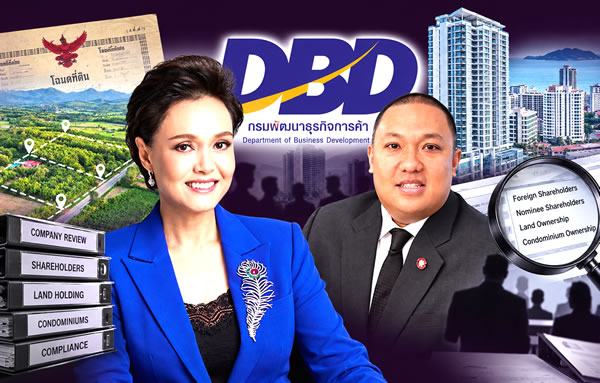
Thailand launches a vast property crackdown, screening 36,277 foreign-linked firms holding 305,838 plots and over one million rai. Condo ownership is now in the crosshairs as investigators trace shareholders, directors, capital and company histories.
Thailand has launched a nationwide drive into foreign-linked property ownership, putting 36,277 companies holding 305,838 land plots under scrutiny. Together, they control more than 1.064 million rai, while 7,082 foreign-linked companies own another 76,840 condominium units. The crackdown intensified after a September 4 meeting between Commerce Minister Suphajee Suthumpun and Deputy Interior Minister Polpeera Suwannachawi. Investigators are now digging beyond current shareholder lists into past owners, directors, financial statements, capital sources and property purchases. Corporate, personal and land databases are being linked nationwide, while police, the DSI and anti-money laundering officials can pursue deeper cases. The target is nominee structures used to circumvent foreign ownership restrictions. Where violations are proven, offenders face prison, heavy fines and forced disposal of unlawfully held land.
Thailand has widened a nationwide investigation into foreign-linked companies holding land and condominiums across the kingdom. The Department of Business Development is examining 36,277 landholding entities with foreign participation. Together, those companies hold 305,838 plots covering 1,064,265.38 rai. Crucially, investigators are now tracing ownership history, directors, financial statements and investment capital. Condominium ownership has also moved firmly into the investigation.
The Commerce Ministry disclosed the expanded figures on Monday, September 7. The update followed a high-level meeting three days earlier. On September 4, Commerce Minister Suphajee Suthumpun met Deputy Interior Minister Polpeera Suwannachawi. Senior officials from both ministries also attended. Notably, the meeting brought together agencies controlling corporate registration, population records and property ownership.
At the centre is the Department of Business Development, or DBD. It is working with the Department of Lands and the Department of Provincial Administration. As part of this, the three departments agreed to exchange and continually update information. Investigators can now connect companies with shareholders, directors, individuals and property records. They can also move backwards through earlier company structures.
DBD traces past shareholders, directors and capital as 36,277 foreign-linked landholders face checks
That historical element marks an important expansion. Investigators are no longer confined to the ownership structure currently registered with the DBD. Instead, they can trace former shareholders and past directors. Financial statements can then be checked against those changes. Likewise, investigators can examine who supplied investment capital at different stages.
The inquiry targets nominee arrangements used to bypass restrictions on foreign ownership. However, the 36,277 companies have not all been accused of breaking the law. They form the entire foreign-linked landholding group identified for examination. Some are genuine Thai-foreign joint ventures. Others have statutory rights allowing foreign-controlled companies to hold land.
Still, the DBD is examining the ownership structure behind each category. Investigators can determine whether Thai shareholders supplied their own investment capital. They can also establish whether those shareholders controlled their shares independently. In contrast, nominee arrangements involve Thais holding shares for foreigners. That distinction sits at the heart of the investigation.
Under Thai law, foreigners generally face strict limits on direct land ownership. Thai companies can hold land when they satisfy applicable legal requirements. Yet registered ownership percentages do not resolve whether a structure is genuine. For that reason, officials are examining the money behind corporate shareholdings. They are also reviewing when ownership changes occurred.
September 4 meeting links corporate and property records as officials widen historical nominee checks
The September 4 meeting gave this approach greater reach. Commerce and Interior Ministry officials agreed to link information used in nominee investigations. In practical terms, corporate records can now be matched against property holdings. Personal records can also be connected with registered shareholders. Meanwhile, financial statements provide another layer for examining capital.
Earlier, DBD checks focused heavily on company formation. That approach was widened from August 1. Since then, later changes involving shareholders and directors can also face scrutiny. In response, investigators can identify companies which changed structures after initial registration. The September initiative goes further by examining those changes historically.
A company may have begun with one shareholder structure. Later, Thai shareholders may have entered or departed. Directors may also have changed. Separately, investment capital may have increased as property was acquired. Investigators can now compare those events on the same timeline.
The Department of Lands supplied the property records behind the latest operation. Those records covered 144,706 legal entities holding land or condominium property. Of those, 125,622 fall under DBD supervision. Within that group, 123,542 legal entities hold land title deeds. Collectively, they control 1,269,326 plots.
Foreign-linked companies hold more than one million rai as DBD screening expands across Thailand
Their combined land area reaches 4,504,926.88 rai. Most landholding entities in the database are wholly Thai-owned. Specifically, 87,265 entities are recorded as having 100% Thai ownership. Those companies hold 963,488 plots covering 3,440,661.50 rai. By comparison, 36,277 landholding entities have some foreign investment.
Those 36,277 companies represent 29.36% of landholding entities in the database. They own 305,838 plots, representing 24.10% of recorded plots. Their land covers 1,064,265.38 rai. Accordingly, foreign-linked companies account for 23.62% of the land area examined. That entire foreign-linked group is now within the DBD screening exercise.
The largest category contains companies with foreign shareholdings between 0.01% and 49%. There are 31,516 such companies. They represent 86.88% of all foreign-linked landholding entities under examination. Together, they own 287,176 plots. Those holdings cover 901,596.92 rai.
This category has particular importance for nominee checks. On paper, a company can remain majority Thai-owned while foreigners hold up to 49%. Yet investigators can look beyond that registered percentage. They can examine who provided the capital. They can also test whether Thai shareholders have an independent economic interest.
For example, genuine Thai-foreign joint investment remains lawful. Foreign participation alone does not establish a nominee offence. On the other hand, Thai shareholders cannot lawfully act merely for foreign beneficiaries. The DBD therefore has to establish the substance behind individual structures. Financial and historical records now form part of that process.
Foreign-linked property holdings concentrate heavily in Bangkok, Chon Buri and major tourism provinces
Geographically, the foreign-linked holdings are heavily concentrated. Earlier DBD figures placed 35,154 of the 36,277 companies within only 16 provinces. Just 1,123 were spread across the remaining provinces. The main group includes Bangkok and five surrounding provinces. It also covers major tourism and industrial centres.
Bangkok is joined by Nonthaburi, Samut Prakan and Pathum Thani. Samut Sakhon and Nakhon Pathom are also included. On another front, Chon Buri, Surat Thani, Phuket and Rayong appear prominently. Chiang Mai and Chiang Rai are included as well. Prachuap Khiri Khan, Krabi, Phang Nga and Mae Hong Son complete the list.
The September figures provide a sharper provincial breakdown. Among companies with foreign ownership below 49.01%, Bangkok leads by plot numbers. Those companies hold 36,047 plots covering 29,518.43 rai. Chon Buri follows with 29,214 plots covering 95,846.83 rai. Samut Prakan has 25,029 plots covering 35,649.62 rai.
Pathum Thani accounts for another 24,876 plots covering 24,441.04 rai. Nonthaburi has 19,874 plots covering 12,563.45 rai. Taken together, those five provinces contain 135,040 plots. That equals 47.02% of plots held by this foreign-shareholding category. Almost half are therefore concentrated in five provinces.
Chon Buri and Rayong lead higher foreign-owned land groups while legal investment rights remain central
A second category contains 1,311 companies with foreign ownership between 49.01% and 99.99%. These companies hold 8,633 plots covering 59,077.06 rai. Chon Buri has the largest concentration. Rayong is also prominent. In addition, Bangkok, Samut Prakan and Chachoengsao rank among the leading provinces.
Those five provinces account for 4,395 plots in this ownership category. Their combined area reaches 34,928.30 rai. Even so, high foreign ownership does not by itself indicate unlawful landholding. Certain companies have legal rights granted through specific investment regimes. That distinction remains essential when officials assess individual cases.
A third group contains 3,450 entities recorded as 100% foreign-owned. Together, they hold 10,029 plots covering 103,591.40 rai. Once again, Chon Buri has the largest concentration. Rayong and Samut Prakan also feature strongly. Phra Nakhon Si Ayutthaya and Prachin Buri complete the leading five provinces.
Those five provinces account for 6,463 plots. Their combined land area reaches 79,125.54 rai. Importantly, some foreign-controlled companies can lawfully own land through Board of Investment privileges. Others have rights under industrial estate legislation. Chon Buri and Rayong contain significant concentrations of such industrial investment.
Police, DSI and anti-money laundering officials join scrutiny of companies, shareholders and advisers
The investigation therefore cannot rely on foreign ownership percentages alone. Each company's legal basis for holding land must also be established. Where investment privileges exist, officials can confirm them with relevant agencies. Where they do not, the ownership and capital structure can face deeper scrutiny. This is where cross-agency records become critical.
The Board of Investment is among the agencies able to provide information. The Industrial Estate Authority of Thailand can also confirm statutory landholding rights. In parallel, the Royal Thai Police and Department of Special Investigation can become involved. The Anti-Money Laundering Office can provide financial investigation support. Provincial governors can also participate where required.
The operation can therefore expand well beyond a single registered company. Investigators can follow connected businesses and individual shareholders. They can also examine those involved in company formation or later restructuring. Where evidence warrants it, professional intermediaries can enter the inquiry. Accounting firms and law firms are among those potentially examined.
Government officials can also be investigated where evidence indicates involvement in unlawful transactions. This means the inquiry can follow a corporate arrangement through several layers. First comes the company holding the property. Next come shareholders, directors and capital providers. From there, investigators can examine related companies and intermediaries.
Agencies combine corporate, personal and property records to trace nominee structures through time
The September 4 agreement is designed to make those connections easier. The DBD controls company registrations and corporate financial statements. It also maintains shareholder information. The Department of Lands controls records for land and condominium ownership. Meanwhile, the Department of Provincial Administration holds information concerning individuals.
Previously, those datasets sat within separate agencies. Now, officials have agreed to cross-check and update them systematically. Consequently, investigators can compare shareholder identities with personal records. They can also match those identities against land and condominium holdings. Corporate changes can then be placed within a property acquisition timeline.
This matters because nominee structures can change over time. A company might alter shareholders after purchasing property. Alternatively, shareholders can change before a significant land acquisition. Directors may also be replaced while ownership remains outwardly unchanged. Historical records allow investigators to identify those sequences.
Capital is another major focus. A Thai shareholder listed on company records may hold a substantial percentage. However, investigators can examine whether that person actually supplied investment funds. Corporate financial statements provide one source of information. Other financial evidence can be considered where an investigation expands.
Condominium scrutiny now widens as 7,082 foreign-linked companies hold 76,840 units across Thailand
The government's scrutiny now also reaches condominiums on a substantial scale. The latest database contains 14,878 legal entities owning condominium units. Together, they hold 244,115 units. Their combined floor space reaches 13,153,690.14 square metres. Nearly half of those corporate owners have some foreign investment.
Specifically, 7,796 corporate condominium owners are wholly Thai-owned. Another 7,082 entities have foreign participation. Those foreign-linked companies own 76,840 units. Their combined floor area totals 4,103,114.88 square metres. Thus, foreign-linked entities represent 47.6% of corporate condominium owners examined.
They also control 31.48% of condominium units in the corporate ownership database. Again, those figures do not prove wrongdoing. Foreigners can legally own condominium units within statutory foreign ownership limits. Nevertheless, corporate ownership raises separate questions once those limits are reached. The DBD is now examining that issue directly.
The concern centres on company structures used to acquire units beyond foreign ownership quotas. A foreign buyer can legally purchase while quota space remains available. Once that quota is exhausted, additional foreign ownership faces restrictions. At that stage, a Thai company could potentially be used. Investigators must then determine whether its Thai ownership is genuine.
Land and condominium probes now track shareholders, capital and corporate histories across both sectors
The test again turns on shareholders and capital. A company may show majority Thai ownership on paper. Yet officials can examine whether the Thai shareholders invested independently. They can also trace who financed the company's purchases. In this way, the condominium review mirrors the land investigation.
The latest operation therefore has two major property fronts. One covers 36,277 foreign-linked entities holding land. The other covers 7,082 foreign-linked entities holding condominium units. Both can be examined using current and historical corporate information. Both can also be checked against sources of capital.
At the same time, Thailand's broader corporate universe is much larger. More than one million active legal entities were recorded when tighter DBD screening began. Of those, 119,116 had foreign shareholders holding no more than 49.99%. That figure does not mean those companies are suspected nominees. Rather, it shows the scale of Thai-foreign corporate participation.
The property review is narrower and more targeted. It starts with companies appearing in Department of Lands ownership records. From there, the DBD separates wholly Thai-owned entities from those with foreign participation. The foreign-linked group then becomes subject to structural examination. Legal investment privileges must also be checked.
Nominee violations carry prison terms, heavy fines and possible forced disposal of unlawfully held land
Where a company has legitimate rights, the inquiry can establish that position. Where questions remain, officials can examine shareholders, directors and capital. They can also review earlier ownership structures. Property acquisitions can then be compared with those changes. The result is a much broader corporate history.
Penalties become significant when nominee violations are actually established. Sections 36 and 37 of the Foreign Business Act provide criminal sanctions. Offenders can face imprisonment for up to three years. Fines range between ฿100,000 and ฿1 million. Courts can impose both imprisonment and fines.
Unlawfully acquired land can also trigger separate action. Under the Land Code, the Department of Lands can require property disposal. The period can range from 180 days to one year. Thus, an established nominee arrangement can create both criminal and property consequences. These measures apply only after violations are established.
Monday's Commerce Ministry update put the national scale into clear numbers. The DBD supervises 125,622 property-owning legal entities in the supplied records. Of those, 123,542 hold land title deeds. Within that landholding group, 36,277 have foreign investment. Together, they control more than one million rai.
September 4 framework links historic company changes with property purchases and investment capital
The condominium figures add another substantial layer. Foreign-linked companies hold 76,840 units across the country. Their combined space exceeds 4.1 million square metres. Meanwhile, the broader corporate condominium database contains 244,115 units. The DBD is now using those records within the expanded nominee screening process.
More significantly, the September 4 meeting established how the investigation will operate. Commerce and Interior Ministry agencies will exchange company, individual and property information. Historical shareholder data will form part of that examination. Financial statements and capital will also be followed. Current registration records are no longer the sole reference point.
The operation can therefore trace a company from registration through later restructuring. For instance, it can compare those changes with land or condominium acquisitions. It can identify when shareholders entered and left. It can also determine when directors changed. In turn, financial records can be matched against those events.
For the 31,516 companies with foreign ownership below 49.01%, that scrutiny is particularly relevant. They represent the overwhelming majority of foreign-linked landholders. Together, they control 287,176 plots covering more than 901,000 rai. Their Thai-majority structures place the shareholder relationship directly under examination.
Nationwide screening separates lawful foreign investment from nominee ownership of land and condos
Yet the government's own figures require careful distinction. Foreign participation does not establish nominee ownership. Nor does 100% foreign ownership automatically mean unlawful landholding. Statutory privileges can permit foreign-controlled companies to own land. Each company must therefore be tested against its legal basis and actual ownership structure.
Even so, the scale of the screening exercise is now nationwide. The investigation covers corporate histories rather than only current records. It reaches land and condominium holdings. This rigorous probe examines shareholders, directors and investment capital. It also allows officials to follow connected companies and individuals.
Monday's update showed the numbers behind that system. The September 4 meeting supplied the cross-agency framework. Together, they place 36,277 foreign-linked landholding entities under systematic review. Another 7,082 foreign-linked corporate condominium owners are also being examined. The focus now extends from registered ownership to the money and history behind it.
Further reading:
Frenchman's Koh Samui business empire enmeshed in knotty police probe of nominee firms and pot farm
Drive against foreign owned property and business on Koh Samui and Koh Phangan now targets leases
International reservations system used by hotels targeted in latest Koh Phangan swoop by ministers
Anutin visits Koh Phangan as nominee crackdown shows 68% of firms with foreign ownership links
Blitzkrieg on foreign firms and enterprises on Koh Phangan continues with French owned resort busted
35-year-old Frenchman arrested on Koh Phangan on Sunday for rape as island-wide swoop nets 6 suspects
Ten foreign Poker players arrested in a police swoop on a rented house in Koh Phangan on Tuesday night
Russian-Chinese Koh Phangan alliance to sell drugs to foreigners. Accused entered Thailand illegally
Sex, drugs, business and work abuses linked to expats targeted this week by police raids on Koh Phangan
Ten arrested and two illegal hostels shuttered on Koh Phangan as fierce crackdown continues on the island
Crackdown aimed at upending foreign business trade moves from Koh Phangan to Phuket. Four arrested
Crackdown to wipe out foreign business abuses and ownership on Koh Phangan & Koh Samui intensifies
A note on cookies
Newshunt uses essential cookies to keep you signed in and to remember your language and country, so the site works the way you expect. With your permission, we'd also like to use analytics cookies to understand how people use Newshunt and improve it over time.
Accepting only affects analytics. To learn more, view our Privacy Policy or Terms & Conditions.
(0)Comments