


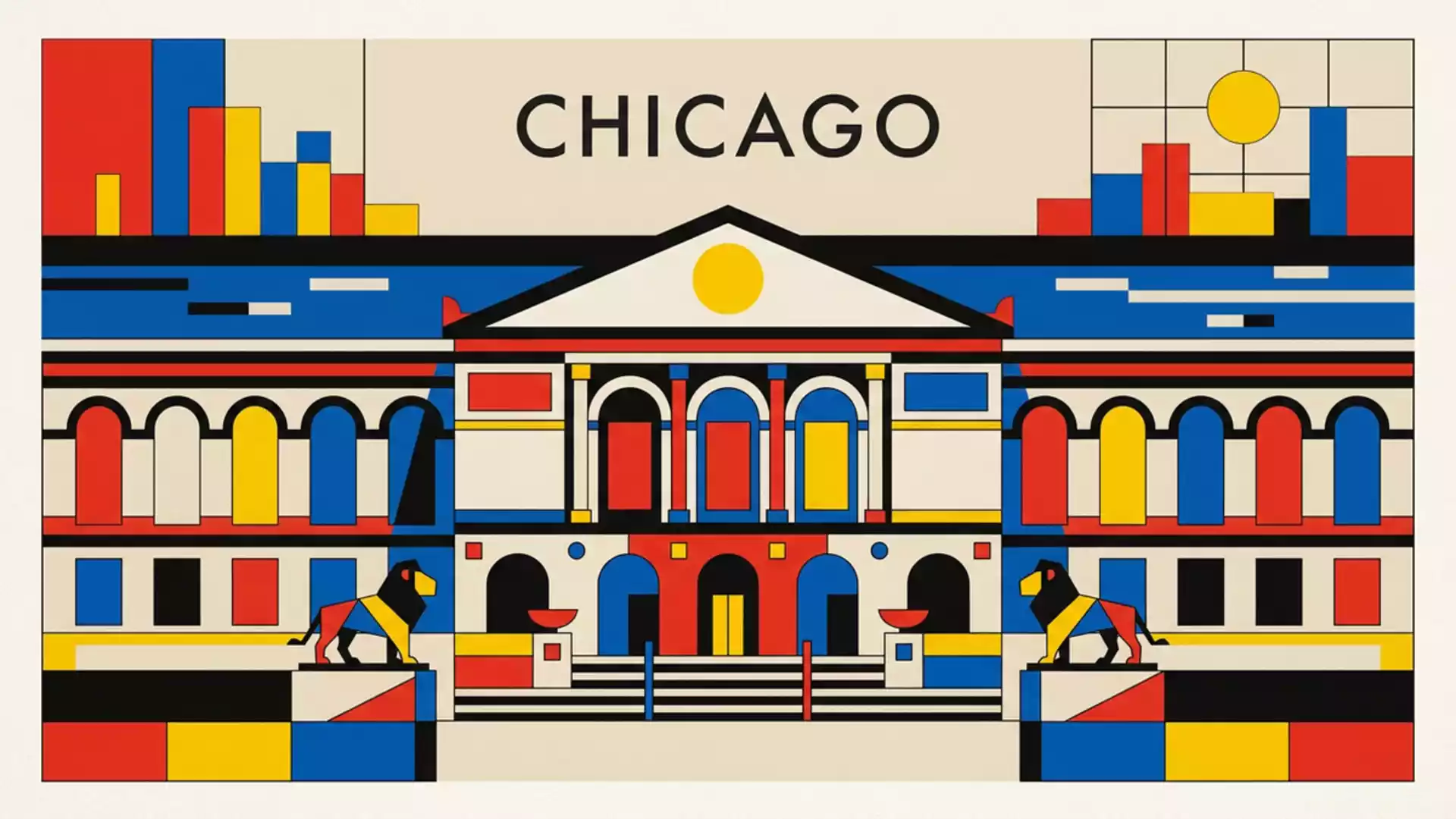
Art Institute of Chicago and its Beaux-Arts presence in Grant Park
Category: Entertainment
Share
Archive
Like
Art Institute of Chicago is one of the major art museums in the United States, set on the edge of Chicago's Grant Park with a classical Beaux-Arts building completed for the World's Columbian Exposition of 1893.World's Columbian Exposition The museum combines galleries, a school of art and extensive research libraries in a single complex that occupies a full city block along South Michigan Avenue.
A Beaux-Arts facade facing Grant Park
The main Art Institute of Chicago building stands between Jackson and Monroe streets, facing Grant Park on one side and South Michigan Avenue on the other.bounded by Columbus Drive and Michigan Avenue It was designed in the Beaux-Arts style by the Boston architectural firm Shepley, Rutan and Coolidge, which also worked on other prominent Chicago civic buildings.Shepley, Rutan and Coolidge The symmetrical stone facade, broad stairs and classical ornament give the museum the character of a formal civic monument.
The building that visitors enter dates from the late nineteenth century, although the institution itself traces its roots to the Chicago Academy of Design founded in 1866 and later the Chicago Academy of Fine Arts established in 1879.established in 1866 In 1893 the museum moved into the present Beaux-Arts structure, which originally served as the World's Congress Auxiliary Building during the World's Columbian Exposition before being adapted for permanent gallery use.World's Congress Auxiliary Building
Growing museum, expanding footprint
Art Institute of Chicago has expanded repeatedly beyond its original nineteenth-century structure to house an ever-growing collection of art. The first major extension over the Illinois Central Railroad tracks was completed in 1916, linking the historic building to new gallery space constructed above the lines.completion date 1893–1916 Further additions followed to the north and south, including the B.F. Ferguson Memorial Building and the Morton Wing built in the mid-twentieth century to extend the museum along Michigan Avenue and towards Grant Park.B.F. Ferguson Memorial Building and Morton Wing
The most striking contemporary addition is the Modern Wing, a large extension on the north side of the complex designed by Italian architect Renzo Piano and opened in 2009.Modern Wing 264,000-square-foot addition This light-filled wing increased the museum's footprint to nearly one million square feet and significantly expanded the galleries devoted to twentieth- and twenty-first-century art, as well as the Ryan Education Center and an outdoor terrace with a physical connection towards Millennium Park.footprint nearly one million square feet
Collections, libraries and departments
Art Institute of Chicago holds a permanent collection that covers more than 5,000 years of human creativity, with works from cultures across the world and more than 300,000 individual objects organised into curatorial departments.more than 300,000 works of art The museum is especially noted for extensive holdings of nineteenth-century French painting, particularly Impressionist and Post-Impressionist works, alongside major twentieth-century painting and sculpture.extensive collections of French painting
The institution also maintains substantial research resources. The Ryerson and Burnham Libraries form the art and architecture research collection, with strengths in eighteenth-, nineteenth- and twentieth-century architecture and nineteenth-century painting, prints, drawings and decorative arts.Ryerson and Burnham Libraries Archival collections preserve institutional records and artists' and architects' papers, while the Department of Architecture and Design alone comprises tens of thousands of objects, from models and drawings to industrial design pieces reflecting the development of design from the 1870s onwards.Department of Architecture and Design
Visiting Art Institute of Chicago: what travellers from Western Europe should know
Art Institute of Chicago stands on South Michigan Avenue at the edge of Grant Park in central Chicago, with entrances from Michigan Avenue and from the park side.
The museum complex occupies a full city block and includes multiple levels of galleries connected by stairs and internal routes, so moving through the building involves regular walking on hard floors.
Lake Michigan lies a short walk east of the museum across Grant Park, and Millennium Park with its contemporary landscape and public art sits immediately to the north of the main building.
The official language is English and the currency is the United States dollar.
Searching for Art Institute of Chicago on social platforms
Frequently asked questions about Art Institute of Chicago
Where is Art Institute of Chicago located in Chicago?
These links open searches for Art Institute of Chicago on each platform.
Art Institute of Chicago stands on South Michigan Avenue beside Grant Park, occupying a city block between Jackson and Monroe streets in central Chicago.
What should visitors expect on a visit to Art Institute of Chicago?
Visitors encounter a large museum complex with historic Beaux-Arts architecture and extensive galleries displaying art from many periods, cultures and media across several levels.
What makes Art Institute of Chicago distinctive among art museums?
Art Institute of Chicago combines a major Impressionist and modern art collection with a landmark Beaux-Arts building, significant architectural archives and contemporary extensions such as the Modern Wing.
A note on cookies
Newshunt uses essential cookies to keep you signed in and to remember your language and country, so the site works the way you expect. With your permission, we'd also like to use analytics cookies to understand how people use Newshunt and improve it over time.
Accepting only affects analytics. To learn more, view our Privacy Policy or Terms & Conditions.
(0)Comments